

64
2.5 Conclusions
Based on direct evidence of fossil pathogenic viruses, bacteria and protozoa in hosts
and arthropod vectors embedded in amber, it is obvious that these agents have been
present since at least the mid-Cretaceous. The majority of the findings reported here
are due to the preservative qualities of amber (De Baets et al. 2021; Poinar and
Hess 1985).
Determining that the viruses, bacteria and protozoa reported here involved
pathogenic and not other symbiotic associations was based on their comparisons
with present day pathogens and the law of behavior fixity. The latter states that the
behavior of fossil organisms will be similar to that of their present day descendants
at the generic level (Boucot 1990; Boucot and Poinar 2010; Poinar and Poinar 1999).
The association between organisms are typically expressed with the following
terms: Inquilinism, where neither organism suffers or benefits from the relationship;
commensalism, where one organism benefits while the other organism is not
harmed; mutualism, where both organisms benefit and neither is harmed and; parasitism, where one organism benefits by taking nourishment from the other organism
(now a host) that is harmed (Poinar 1983). These basic definitions are very simplified since associations between two organisms are often much more intricate and
complicated.
In regards to polydnaviruses in parasitic wasps, it is generally agreed that since
the viral genome is incorporated into that of the wasp, there is no detriment to the
wasp (Hess et al. 1980). However, this scenario changes dramatically after the wasp
introduces the virus into an insect host. Not only does the virus enter many of the
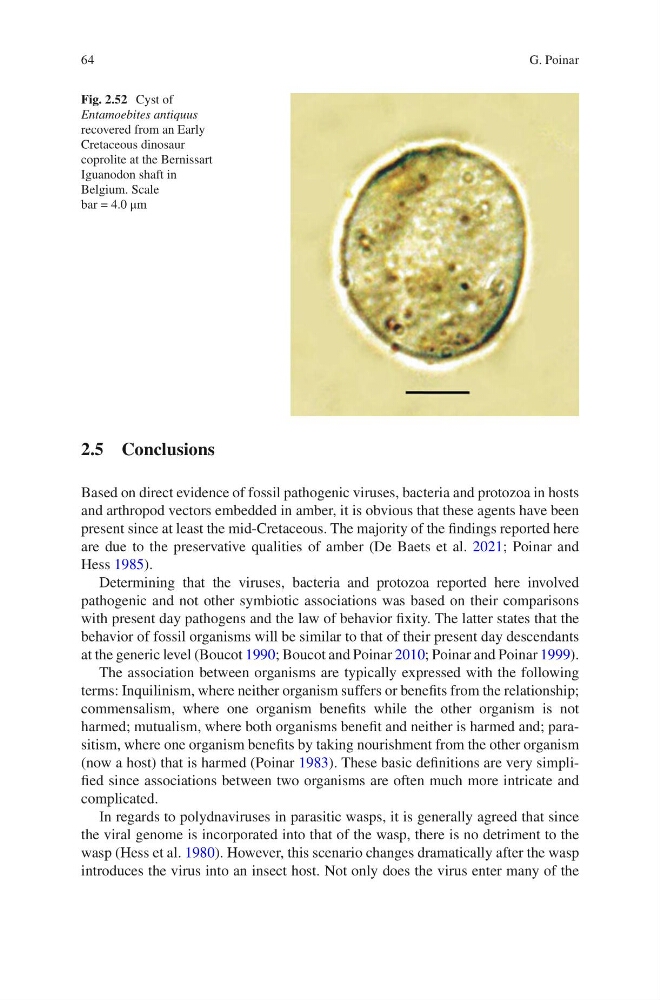
Fig. 2.52 Cyst of
Entamoebites antiquus
recovered from an Early
Cretaceous dinosaur
coprolite at the Bernissart
Iguanodon shaft in
Belgium. Scale
bar = 4.0 μm
G. Poinar
2.5 Conclusions
Based on direct evidence of fossil pathogenic viruses, bacteria and protozoa in hosts
and arthropod vectors embedded in amber, it is obvious that these agents have been
present since at least the mid-Cretaceous. The majority of the findings reported here
are due to the preservative qualities of amber (De Baets et al. 2021; Poinar and
Hess 1985).
Determining that the viruses, bacteria and protozoa reported here involved
pathogenic and not other symbiotic associations was based on their comparisons
with present day pathogens and the law of behavior fixity. The latter states that the
behavior of fossil organisms will be similar to that of their present day descendants
at the generic level (Boucot 1990; Boucot and Poinar 2010; Poinar and Poinar 1999).
The association between organisms are typically expressed with the following
terms: Inquilinism, where neither organism suffers or benefits from the relationship;
commensalism, where one organism benefits while the other organism is not
harmed; mutualism, where both organisms benefit and neither is harmed and; parasitism, where one organism benefits by taking nourishment from the other organism
(now a host) that is harmed (Poinar 1983). These basic definitions are very simplified since associations between two organisms are often much more intricate and
complicated.
In regards to polydnaviruses in parasitic wasps, it is generally agreed that since
the viral genome is incorporated into that of the wasp, there is no detriment to the
wasp (Hess et al. 1980). However, this scenario changes dramatically after the wasp
introduces the virus into an insect host. Not only does the virus enter many of the
Fig. 2.52 Cyst of
Entamoebites antiquus
recovered from an Early
Cretaceous dinosaur
coprolite at the Bernissart
Iguanodon shaft in
Belgium. Scale
bar = 4.0 μm
G. Poinar