

63
Fossil Gregarine Parasites
Gregarines are a very complex group of protozoans that evolved as monoxenous
parasites of a wide variety of marine and terrestrial invertebrates (Desportes and
Schrevel 2013). Among the insects that are parasitized are cockroaches, which
may have been one of the original host groups. Discovering trophozoites and
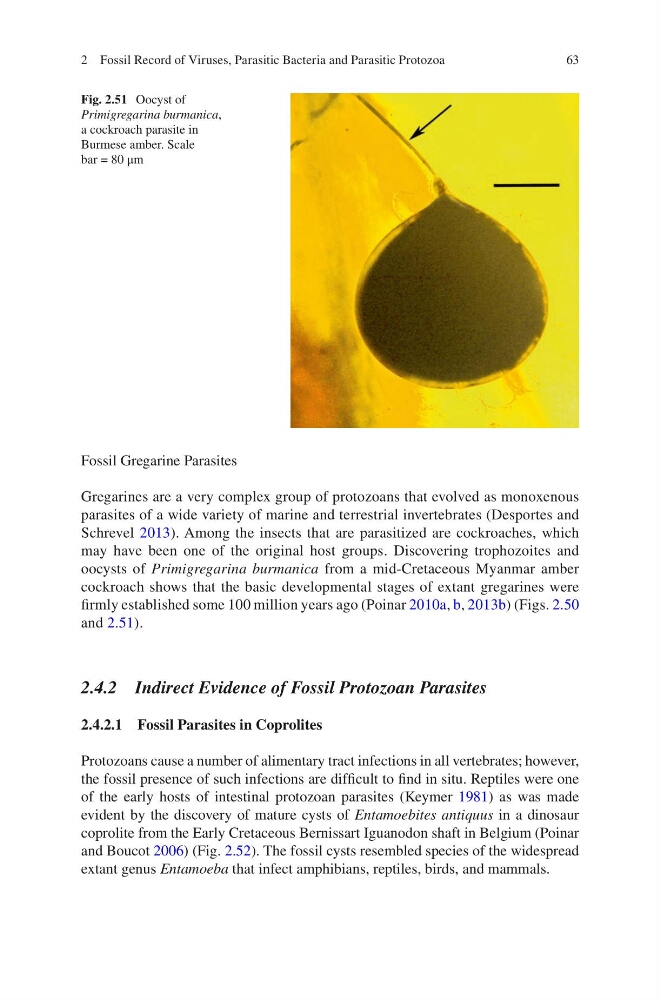
oocysts of Primigregarina burmanica from a mid-Cretaceous Myanmar amber
cockroach shows that the basic developmental stages of extant gregarines were
firmly established some 100 million years ago (Poinar 2010a, b, 2013b) (Figs. 2.50
and 2.51).
2.4.2 Indirect Evidence of Fossil Protozoan Parasites
2.4.2.1 Fossil Parasites in Coprolites
Protozoans cause a number of alimentary tract infections in all vertebrates; however,
the fossil presence of such infections are difficult to find in situ. Reptiles were one
of the early hosts of intestinal protozoan parasites (Keymer 1981) as was made
evident by the discovery of mature cysts of Entamoebites antiquus in a dinosaur
coprolite from the Early Cretaceous Bernissart Iguanodon shaft in Belgium (Poinar
and Boucot 2006) (Fig. 2.52). The fossil cysts resembled species of the widespread
extant genus Entamoeba that infect amphibians, reptiles, birds, and mammals.
Fig. 2.51 Oocyst of
Primigregarina burmanica,
a cockroach parasite in
Burmese amber. Scale
bar = 80 μm
2 Fossil Record of Viruses, Parasitic Bacteria and Parasitic Protozoa
Fossil Gregarine Parasites
Gregarines are a very complex group of protozoans that evolved as monoxenous
parasites of a wide variety of marine and terrestrial invertebrates (Desportes and
Schrevel 2013). Among the insects that are parasitized are cockroaches, which
may have been one of the original host groups. Discovering trophozoites and
oocysts of Primigregarina burmanica from a mid-Cretaceous Myanmar amber
cockroach shows that the basic developmental stages of extant gregarines were
firmly established some 100 million years ago (Poinar 2010a, b, 2013b) (Figs. 2.50
and 2.51).
2.4.2 Indirect Evidence of Fossil Protozoan Parasites
2.4.2.1 Fossil Parasites in Coprolites
Protozoans cause a number of alimentary tract infections in all vertebrates; however,
the fossil presence of such infections are difficult to find in situ. Reptiles were one
of the early hosts of intestinal protozoan parasites (Keymer 1981) as was made
evident by the discovery of mature cysts of Entamoebites antiquus in a dinosaur
coprolite from the Early Cretaceous Bernissart Iguanodon shaft in Belgium (Poinar
and Boucot 2006) (Fig. 2.52). The fossil cysts resembled species of the widespread
extant genus Entamoeba that infect amphibians, reptiles, birds, and mammals.
Fig. 2.51 Oocyst of
Primigregarina burmanica,
a cockroach parasite in
Burmese amber. Scale
bar = 80 μm
2 Fossil Record of Viruses, Parasitic Bacteria and Parasitic Protozoa