

476
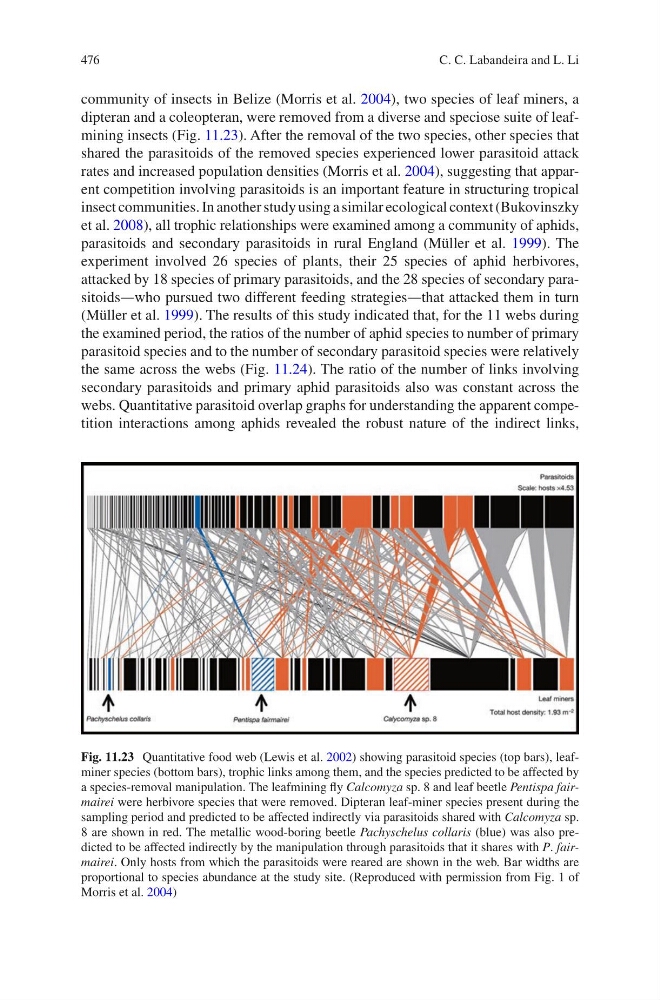
community of insects in Belize (Morris et al. 2004), two species of leaf miners, a
dipteran and a coleopteran, were removed from a diverse and speciose suite of leafmining insects (Fig. 11.23). After the removal of the two species, other species that
shared the parasitoids of the removed species experienced lower parasitoid attack
rates and increased population densities (Morris et al. 2004), suggesting that apparent competition involving parasitoids is an important feature in structuring tropical
insect communities. In another study using a similar ecological context (Bukovinszky
et al. 2008), all trophic relationships were examined among a community of aphids,
parasitoids and secondary parasitoids in rural England (Müller et al. 1999). The
experiment involved 26 species of plants, their 25 species of aphid herbivores,
attacked by 18 species of primary parasitoids, and the 28 species of secondary parasitoids―who pursued two different feeding strategies―that attacked them in turn
(Müller et al. 1999). The results of this study indicated that, for the 11 webs during
the examined period, the ratios of the number of aphid species to number of primary
parasitoid species and to the number of secondary parasitoid species were relatively
the same across the webs (Fig. 11.24). The ratio of the number of links involving
secondary parasitoids and primary aphid parasitoids also was constant across the
webs. Quantitative parasitoid overlap graphs for understanding the apparent competition interactions among aphids revealed the robust nature of the indirect links,
Fig. 11.23 Quantitative food web (Lewis et al. 2002) showing parasitoid species (top bars), leafminer species (bottom bars), trophic links among them, and the species predicted to be affected by
a species-removal manipulation. The leafmining fly Calcomyza sp. 8 and leaf beetle Pentispa fairmairei were herbivore species that were removed. Dipteran leaf-miner species present during the
sampling period and predicted to be affected indirectly via parasitoids shared with Calcomyza sp.
8 are shown in red. The metallic wood-boring beetle Pachyschelus collaris (blue) was also predicted to be affected indirectly by the manipulation through parasitoids that it shares with P. fairmairei. Only hosts from which the parasitoids were reared are shown in the web. Bar widths are
proportional to species abundance at the study site. (Reproduced with permission from Fig. 1 of
Morris et al. 2004)
C. C. Labandeira and L. Li
community of insects in Belize (Morris et al. 2004), two species of leaf miners, a
dipteran and a coleopteran, were removed from a diverse and speciose suite of leafmining insects (Fig. 11.23). After the removal of the two species, other species that
shared the parasitoids of the removed species experienced lower parasitoid attack
rates and increased population densities (Morris et al. 2004), suggesting that apparent competition involving parasitoids is an important feature in structuring tropical
insect communities. In another study using a similar ecological context (Bukovinszky
et al. 2008), all trophic relationships were examined among a community of aphids,
parasitoids and secondary parasitoids in rural England (Müller et al. 1999). The
experiment involved 26 species of plants, their 25 species of aphid herbivores,
attacked by 18 species of primary parasitoids, and the 28 species of secondary parasitoids―who pursued two different feeding strategies―that attacked them in turn
(Müller et al. 1999). The results of this study indicated that, for the 11 webs during
the examined period, the ratios of the number of aphid species to number of primary
parasitoid species and to the number of secondary parasitoid species were relatively
the same across the webs (Fig. 11.24). The ratio of the number of links involving
secondary parasitoids and primary aphid parasitoids also was constant across the
webs. Quantitative parasitoid overlap graphs for understanding the apparent competition interactions among aphids revealed the robust nature of the indirect links,
Fig. 11.23 Quantitative food web (Lewis et al. 2002) showing parasitoid species (top bars), leafminer species (bottom bars), trophic links among them, and the species predicted to be affected by
a species-removal manipulation. The leafmining fly Calcomyza sp. 8 and leaf beetle Pentispa fairmairei were herbivore species that were removed. Dipteran leaf-miner species present during the
sampling period and predicted to be affected indirectly via parasitoids shared with Calcomyza sp.
8 are shown in red. The metallic wood-boring beetle Pachyschelus collaris (blue) was also predicted to be affected indirectly by the manipulation through parasitoids that it shares with P. fairmairei. Only hosts from which the parasitoids were reared are shown in the web. Bar widths are
proportional to species abundance at the study site. (Reproduced with permission from Fig. 1 of
Morris et al. 2004)
C. C. Labandeira and L. Li