

477
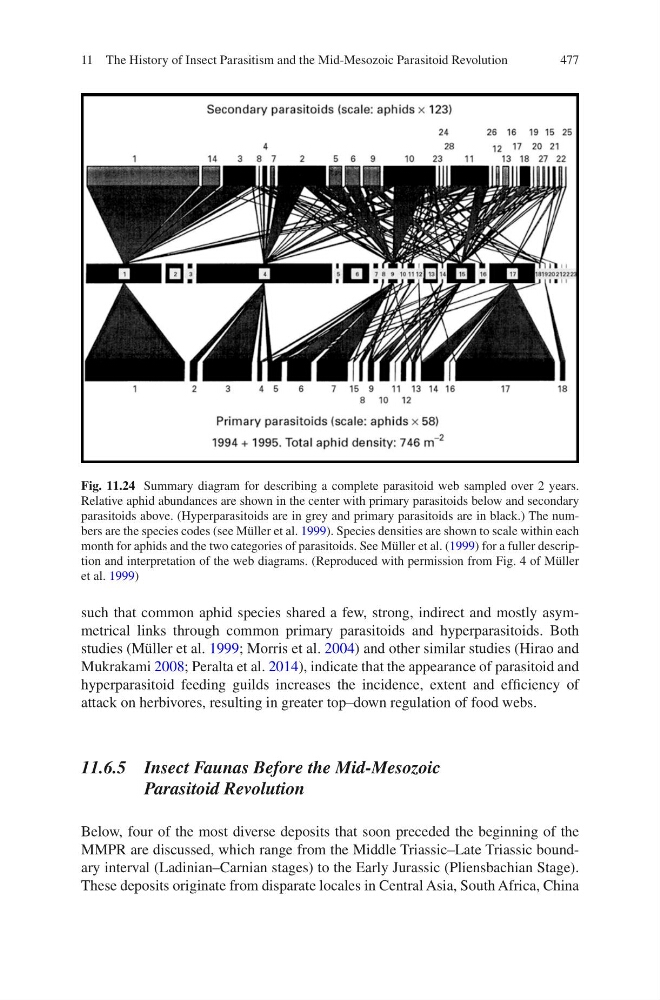
such that common aphid species shared a few, strong, indirect and mostly asymmetrical links through common primary parasitoids and hyperparasitoids. Both
studies (Müller et al. 1999; Morris et al. 2004) and other similar studies (Hirao and
Mukrakami 2008; Peralta et al. 2014), indicate that the appearance of parasitoid and
hyperparasitoid feeding guilds increases the incidence, extent and efficiency of
attack on herbivores, resulting in greater top–down regulation of food webs.
11.6.5 Insect Faunas Before the Mid-Mesozoic
Parasitoid Revolution
Below, four of the most diverse deposits that soon preceded the beginning of the
MMPR are discussed, which range from the Middle Triassic–Late Triassic boundary interval (Ladinian–Carnian stages) to the Early Jurassic (Pliensbachian Stage).
These deposits originate from disparate locales in Central Asia, South Africa, China
Fig. 11.24 Summary diagram for describing a complete parasitoid web sampled over 2 years.
Relative aphid abundances are shown in the center with primary parasitoids below and secondary
parasitoids above. (Hyperparasitoids are in grey and primary parasitoids are in black.) The numbers are the species codes (see Müller et al. 1999). Species densities are shown to scale within each
month for aphids and the two categories of parasitoids. See Müller et al. (1999) for a fuller description and interpretation of the web diagrams. (Reproduced with permission from Fig. 4 of Müller
et al. 1999)
11 The History of Insect Parasitism and the Mid-Mesozoic Parasitoid Revolution
such that common aphid species shared a few, strong, indirect and mostly asymmetrical links through common primary parasitoids and hyperparasitoids. Both
studies (Müller et al. 1999; Morris et al. 2004) and other similar studies (Hirao and
Mukrakami 2008; Peralta et al. 2014), indicate that the appearance of parasitoid and
hyperparasitoid feeding guilds increases the incidence, extent and efficiency of
attack on herbivores, resulting in greater top–down regulation of food webs.
11.6.5 Insect Faunas Before the Mid-Mesozoic
Parasitoid Revolution
Below, four of the most diverse deposits that soon preceded the beginning of the
MMPR are discussed, which range from the Middle Triassic–Late Triassic boundary interval (Ladinian–Carnian stages) to the Early Jurassic (Pliensbachian Stage).
These deposits originate from disparate locales in Central Asia, South Africa, China
Fig. 11.24 Summary diagram for describing a complete parasitoid web sampled over 2 years.
Relative aphid abundances are shown in the center with primary parasitoids below and secondary
parasitoids above. (Hyperparasitoids are in grey and primary parasitoids are in black.) The numbers are the species codes (see Müller et al. 1999). Species densities are shown to scale within each
month for aphids and the two categories of parasitoids. See Müller et al. (1999) for a fuller description and interpretation of the web diagrams. (Reproduced with permission from Fig. 4 of Müller
et al. 1999)
11 The History of Insect Parasitism and the Mid-Mesozoic Parasitoid Revolution