

475
scoparius, at a single site in Berkshire, England (Memmott et al. 2000). This study
showed that predators consumed a median of two host species, whereas the median
for parasitoids was one host species, indicating greater host specificity for the parasitoids (Memmott et al. 2000). External foliage feeders were more vulnerable than
concealed feeders such as leaf miners. The parasitoid sub-webs had considerably
lower connectance (higher host specificity) than the predator sub-webs, a feature
seen in other studies when parasitoid sub-webs were compared to predator webs
(Van Veen et al. 2008). Another measure of parasitoid efficiency concerned a study
of a host–parasitoid community in Guanacaste, Costa Rica. In this study (Memmott
et al. 1994), leaf-miner host mortality due to parasitoidism varied greatly, but
resulted in an overall value of 32.1% of leaf miners succumbing to parasitoids
(Memmott et al. 1994).
One important avenue of research has been documenting apparent competition,
in which species can interact, or compete, through shared natural enemies such as
parasitoids (Holt 1977; Rott and Godfray 2000). In one study of a hyperdiverse
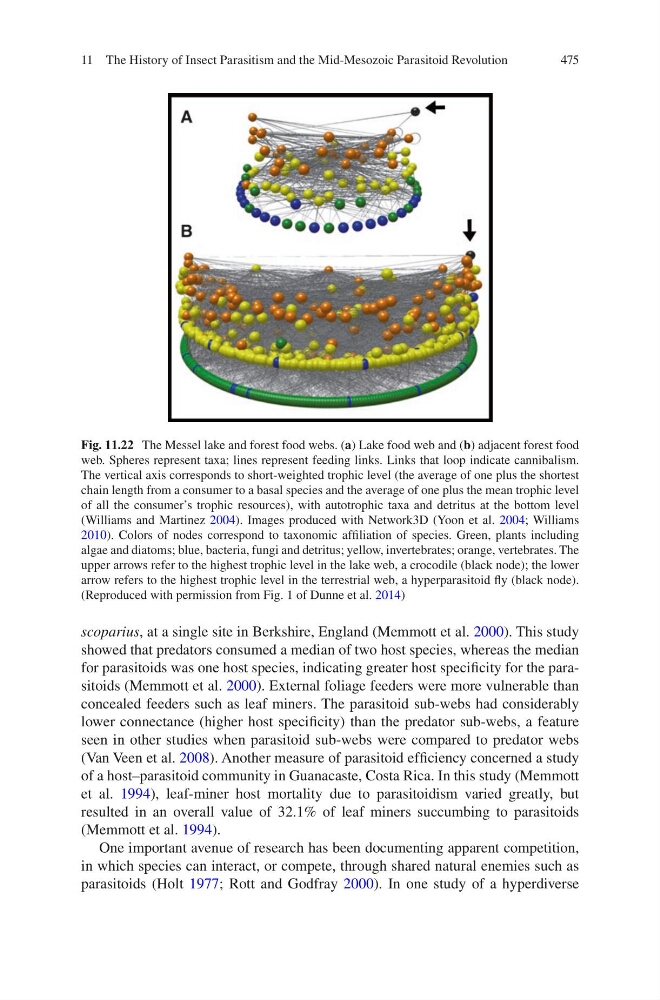
Fig. 11.22 The Messel lake and forest food webs. (a) Lake food web and (b) adjacent forest food
web. Spheres represent taxa; lines represent feeding links. Links that loop indicate cannibalism.
The vertical axis corresponds to short-weighted trophic level (the average of one plus the shortest
chain length from a consumer to a basal species and the average of one plus the mean trophic level
of all the consumer’s trophic resources), with autotrophic taxa and detritus at the bottom level
(Williams and Martinez 2004). Images produced with Network3D (Yoon et al. 2004; Williams
2010). Colors of nodes correspond to taxonomic affiliation of species. Green, plants including
algae and diatoms; blue, bacteria, fungi and detritus; yellow, invertebrates; orange, vertebrates. The
upper arrows refer to the highest trophic level in the lake web, a crocodile (black node); the lower
arrow refers to the highest trophic level in the terrestrial web, a hyperparasitoid fly (black node).
(Reproduced with permission from Fig. 1 of Dunne et al. 2014)
11 The History of Insect Parasitism and the Mid-Mesozoic Parasitoid Revolution
scoparius, at a single site in Berkshire, England (Memmott et al. 2000). This study
showed that predators consumed a median of two host species, whereas the median
for parasitoids was one host species, indicating greater host specificity for the parasitoids (Memmott et al. 2000). External foliage feeders were more vulnerable than
concealed feeders such as leaf miners. The parasitoid sub-webs had considerably
lower connectance (higher host specificity) than the predator sub-webs, a feature
seen in other studies when parasitoid sub-webs were compared to predator webs
(Van Veen et al. 2008). Another measure of parasitoid efficiency concerned a study
of a host–parasitoid community in Guanacaste, Costa Rica. In this study (Memmott
et al. 1994), leaf-miner host mortality due to parasitoidism varied greatly, but
resulted in an overall value of 32.1% of leaf miners succumbing to parasitoids
(Memmott et al. 1994).
One important avenue of research has been documenting apparent competition,
in which species can interact, or compete, through shared natural enemies such as
parasitoids (Holt 1977; Rott and Godfray 2000). In one study of a hyperdiverse
Fig. 11.22 The Messel lake and forest food webs. (a) Lake food web and (b) adjacent forest food
web. Spheres represent taxa; lines represent feeding links. Links that loop indicate cannibalism.
The vertical axis corresponds to short-weighted trophic level (the average of one plus the shortest
chain length from a consumer to a basal species and the average of one plus the mean trophic level
of all the consumer’s trophic resources), with autotrophic taxa and detritus at the bottom level
(Williams and Martinez 2004). Images produced with Network3D (Yoon et al. 2004; Williams
2010). Colors of nodes correspond to taxonomic affiliation of species. Green, plants including
algae and diatoms; blue, bacteria, fungi and detritus; yellow, invertebrates; orange, vertebrates. The
upper arrows refer to the highest trophic level in the lake web, a crocodile (black node); the lower
arrow refers to the highest trophic level in the terrestrial web, a hyperparasitoid fly (black node).
(Reproduced with permission from Fig. 1 of Dunne et al. 2014)
11 The History of Insect Parasitism and the Mid-Mesozoic Parasitoid Revolution