

466
more recent geochronologic range, from Cenomanian to the present, mostly represented by Cenozoic first occurrences. One interesting clade, Eucharitidae (eucharitid wasps), are the only insect family to exclusively parasitoidize ants (Lachaud
and Pérez-Lachaud 2009), a relationship that represents a conserved association
extending to the early Paleogene based on a patterns of ancient colonization of
novel hosts and later host tracking (Murray et al. 2013). Ichneumonoidea consist of
two families that attack eggs, larvae, pupae and adults of wood borers, but occasionally aphid nymphs and ants; their range is Early Cretaceous to Recent (Poinar Jr
1987). A mid-Mesozoic to Recent member of one of these families, Braconidae, is
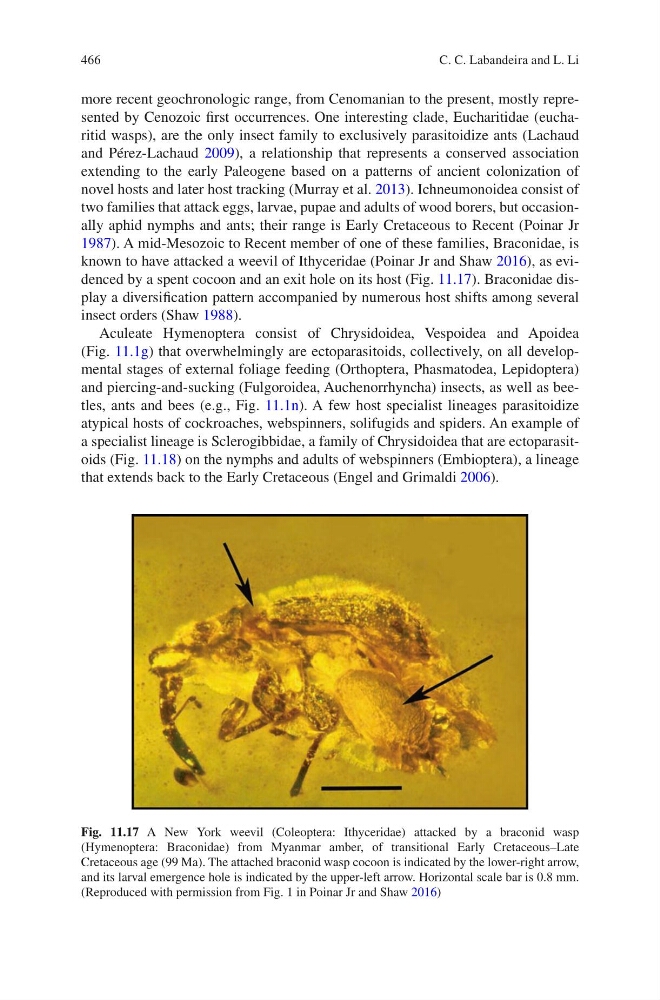
known to have attacked a weevil of Ithyceridae (Poinar Jr and Shaw 2016), as evidenced by a spent cocoon and an exit hole on its host (Fig. 11.17). Braconidae display a diversification pattern accompanied by numerous host shifts among several
insect orders (Shaw 1988).
Aculeate Hymenoptera consist of Chrysidoidea, Vespoidea and Apoidea
(Fig. 11.1g) that overwhelmingly are ectoparasitoids, collectively, on all developmental stages of external foliage feeding (Orthoptera, Phasmatodea, Lepidoptera)
and piercing-and-sucking (Fulgoroidea, Auchenorrhyncha) insects, as well as beetles, ants and bees (e.g., Fig. 11.1n). A few host specialist lineages parasitoidize
atypical hosts of cockroaches, webspinners, solifugids and spiders. An example of
a specialist lineage is Sclerogibbidae, a family of Chrysidoidea that are ectoparasitoids (Fig. 11.18) on the nymphs and adults of webspinners (Embioptera), a lineage
that extends back to the Early Cretaceous (Engel and Grimaldi 2006).
Fig. 11.17 A New York weevil (Coleoptera: Ithyceridae) attacked by a braconid wasp
(Hymenoptera: Braconidae) from Myanmar amber, of transitional Early Cretaceous–Late
Cretaceous age (99 Ma). The attached braconid wasp cocoon is indicated by the lower-right arrow,
and its larval emergence hole is indicated by the upper-left arrow. Horizontal scale bar is 0.8 mm.
(Reproduced with permission from Fig. 1 in Poinar Jr and Shaw 2016)
C. C. Labandeira and L. Li
more recent geochronologic range, from Cenomanian to the present, mostly represented by Cenozoic first occurrences. One interesting clade, Eucharitidae (eucharitid wasps), are the only insect family to exclusively parasitoidize ants (Lachaud
and Pérez-Lachaud 2009), a relationship that represents a conserved association
extending to the early Paleogene based on a patterns of ancient colonization of
novel hosts and later host tracking (Murray et al. 2013). Ichneumonoidea consist of
two families that attack eggs, larvae, pupae and adults of wood borers, but occasionally aphid nymphs and ants; their range is Early Cretaceous to Recent (Poinar Jr
1987). A mid-Mesozoic to Recent member of one of these families, Braconidae, is
known to have attacked a weevil of Ithyceridae (Poinar Jr and Shaw 2016), as evidenced by a spent cocoon and an exit hole on its host (Fig. 11.17). Braconidae display a diversification pattern accompanied by numerous host shifts among several
insect orders (Shaw 1988).
Aculeate Hymenoptera consist of Chrysidoidea, Vespoidea and Apoidea
(Fig. 11.1g) that overwhelmingly are ectoparasitoids, collectively, on all developmental stages of external foliage feeding (Orthoptera, Phasmatodea, Lepidoptera)
and piercing-and-sucking (Fulgoroidea, Auchenorrhyncha) insects, as well as beetles, ants and bees (e.g., Fig. 11.1n). A few host specialist lineages parasitoidize
atypical hosts of cockroaches, webspinners, solifugids and spiders. An example of
a specialist lineage is Sclerogibbidae, a family of Chrysidoidea that are ectoparasitoids (Fig. 11.18) on the nymphs and adults of webspinners (Embioptera), a lineage
that extends back to the Early Cretaceous (Engel and Grimaldi 2006).
Fig. 11.17 A New York weevil (Coleoptera: Ithyceridae) attacked by a braconid wasp
(Hymenoptera: Braconidae) from Myanmar amber, of transitional Early Cretaceous–Late
Cretaceous age (99 Ma). The attached braconid wasp cocoon is indicated by the lower-right arrow,
and its larval emergence hole is indicated by the upper-left arrow. Horizontal scale bar is 0.8 mm.
(Reproduced with permission from Fig. 1 in Poinar Jr and Shaw 2016)
C. C. Labandeira and L. Li