

467
The emergence of parasitoidism in aculeates began during the Late Jurassic to
Early Cretaceous boundary interval and continued into the Cenozoic. Evolutionary
shifts to the parasitoid life habit in Hymenoptera have involved transitions overwhelmingly from mycophagy and to a lesser extent, phytophagy (Fig. 11.4c)
(Dowton and Austin 1995a). The origin of parasitoidism from mycophagy involved
Orussidae and most Apocrita lineages whereas the shifts from phytophagy or seed
predation (Fig. 11.1m) involved principally the chalcidoids Agaonidae, Eulophidae,
Pteromalidae, Tanaostigmatidae and Torymidae, in addition to the nutritionally
diverse Cynipidae and Apidae (Eggleton and Belshaw 1992). One significant difference between Hymenoptera and Diptera parasitoids involve searching behavior for
the target host (Morris 1998). In Hymenoptera, searching behavior is incumbent on
the adult wasp, which places its eggs accurately and directly on the host, resulting
in minimal movement of the newly hatched larva as it becomes embedded in the
host (Askew 1971). A much different mechanism of host searching is found in
Strepsiptera and Coleoptera with a host-seeking, active triungulin larva
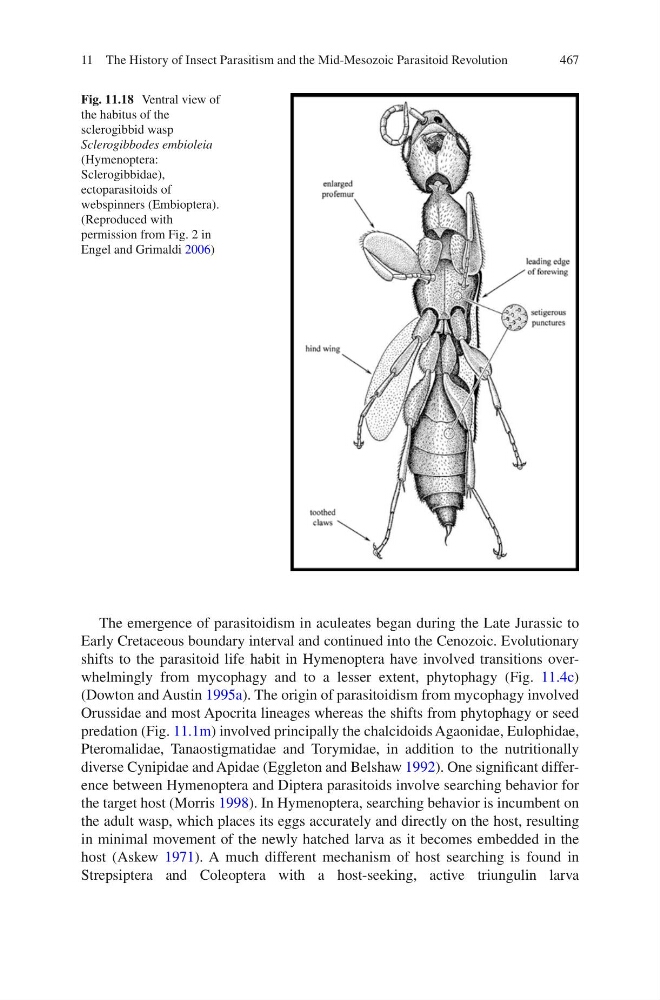
Fig. 11.18 Ventral view of
the habitus of the
sclerogibbid wasp
Sclerogibbodes embioleia
(Hymenoptera:
Sclerogibbidae),
ectoparasitoids of
webspinners (Embioptera).
(Reproduced with
permission from Fig. 2 in
Engel and Grimaldi 2006)
11 The History of Insect Parasitism and the Mid-Mesozoic Parasitoid Revolution
The emergence of parasitoidism in aculeates began during the Late Jurassic to
Early Cretaceous boundary interval and continued into the Cenozoic. Evolutionary
shifts to the parasitoid life habit in Hymenoptera have involved transitions overwhelmingly from mycophagy and to a lesser extent, phytophagy (Fig. 11.4c)
(Dowton and Austin 1995a). The origin of parasitoidism from mycophagy involved
Orussidae and most Apocrita lineages whereas the shifts from phytophagy or seed
predation (Fig. 11.1m) involved principally the chalcidoids Agaonidae, Eulophidae,
Pteromalidae, Tanaostigmatidae and Torymidae, in addition to the nutritionally
diverse Cynipidae and Apidae (Eggleton and Belshaw 1992). One significant difference between Hymenoptera and Diptera parasitoids involve searching behavior for
the target host (Morris 1998). In Hymenoptera, searching behavior is incumbent on
the adult wasp, which places its eggs accurately and directly on the host, resulting
in minimal movement of the newly hatched larva as it becomes embedded in the
host (Askew 1971). A much different mechanism of host searching is found in
Strepsiptera and Coleoptera with a host-seeking, active triungulin larva
Fig. 11.18 Ventral view of
the habitus of the
sclerogibbid wasp
Sclerogibbodes embioleia
(Hymenoptera:
Sclerogibbidae),
ectoparasitoids of
webspinners (Embioptera).
(Reproduced with
permission from Fig. 2 in
Engel and Grimaldi 2006)
11 The History of Insect Parasitism and the Mid-Mesozoic Parasitoid Revolution