

465
attack a variety of larvae occupying principally soil or wood microhabitats, although
some families occasionally occur on rotting meat or attack leaf mining larvae
(Askew 1971). The third superfamily, Platygastroidea, attack insect eggs, inhabitants of plant galls and scale insects (Whitfield 2003). The next series of superfamilies—Ceraphronoidea, Mymarommatoidea and Serphitoidea—are ectoparasitoids
and endoparasitoids on insect eggs, nymphs, larvae, pupae and puparia of hemimetabolous and holometabolous insects (Clausen 1940; Askew 1971). The
Ceraphronoidea and Mymarommatoidea have an Early Cretaceous–Holocene fossil
record whereas the extinct Serphitoidea, the only extinct superfamily of
hymenopteran parasitoids, ranges from Early Cretaceous to mid Cretaceous. The
Ceraphronoidea consists of five families, one of which is the Cretaceous
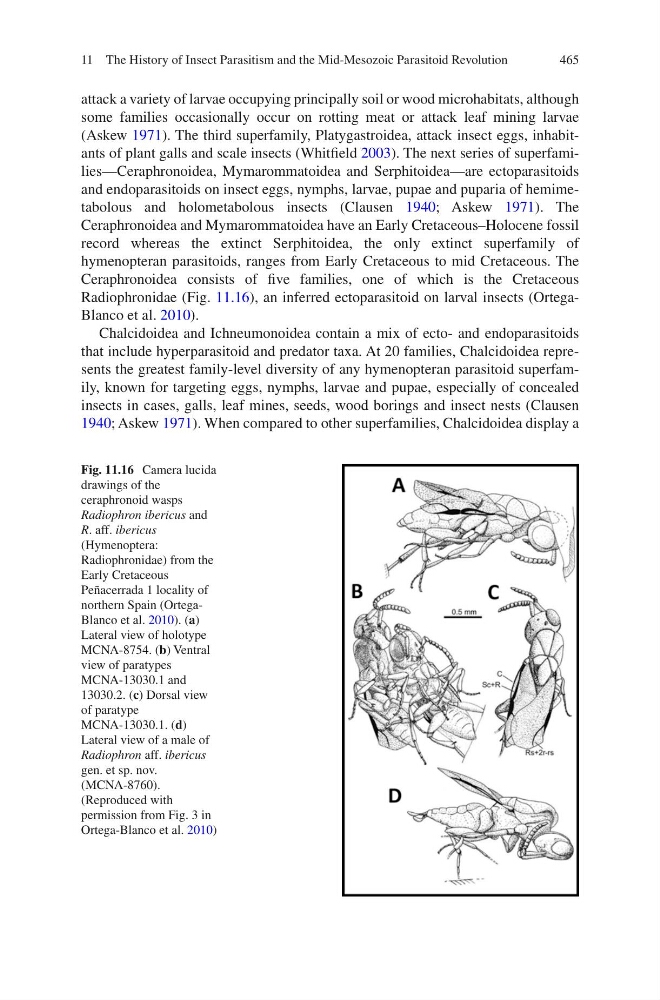
Radiophronidae (Fig. 11.16), an inferred ectoparasitoid on larval insects (OrtegaBlanco et al. 2010).
Chalcidoidea and Ichneumonoidea contain a mix of ecto- and endoparasitoids
that include hyperparasitoid and predator taxa. At 20 families, Chalcidoidea represents the greatest family-level diversity of any hymenopteran parasitoid superfamily, known for targeting eggs, nymphs, larvae and pupae, especially of concealed
insects in cases, galls, leaf mines, seeds, wood borings and insect nests (Clausen
1940; Askew 1971). When compared to other superfamilies, Chalcidoidea display a
Fig. 11.16 Camera lucida
drawings of the
ceraphronoid wasps
Radiophron ibericus and
R. aff. ibericus
(Hymenoptera:
Radiophronidae) from the
Early Cretaceous
Peñacerrada 1 locality of
northern Spain (OrtegaBlanco et al. 2010). (a)
Lateral view of holotype
MCNA-8754. (b) Ventral
view of paratypes
MCNA-13030.1 and
13030.2. (c) Dorsal view
of paratype
MCNA-13030.1. (d)
Lateral view of a male of
Radiophron aff. ibericus
gen. et sp. nov.
(MCNA-8760).
(Reproduced with
permission from Fig. 3 in
Ortega-Blanco et al. 2010)
11 The History of Insect Parasitism and the Mid-Mesozoic Parasitoid Revolution
attack a variety of larvae occupying principally soil or wood microhabitats, although
some families occasionally occur on rotting meat or attack leaf mining larvae
(Askew 1971). The third superfamily, Platygastroidea, attack insect eggs, inhabitants of plant galls and scale insects (Whitfield 2003). The next series of superfamilies—Ceraphronoidea, Mymarommatoidea and Serphitoidea—are ectoparasitoids
and endoparasitoids on insect eggs, nymphs, larvae, pupae and puparia of hemimetabolous and holometabolous insects (Clausen 1940; Askew 1971). The
Ceraphronoidea and Mymarommatoidea have an Early Cretaceous–Holocene fossil
record whereas the extinct Serphitoidea, the only extinct superfamily of
hymenopteran parasitoids, ranges from Early Cretaceous to mid Cretaceous. The
Ceraphronoidea consists of five families, one of which is the Cretaceous
Radiophronidae (Fig. 11.16), an inferred ectoparasitoid on larval insects (OrtegaBlanco et al. 2010).
Chalcidoidea and Ichneumonoidea contain a mix of ecto- and endoparasitoids
that include hyperparasitoid and predator taxa. At 20 families, Chalcidoidea represents the greatest family-level diversity of any hymenopteran parasitoid superfamily, known for targeting eggs, nymphs, larvae and pupae, especially of concealed
insects in cases, galls, leaf mines, seeds, wood borings and insect nests (Clausen
1940; Askew 1971). When compared to other superfamilies, Chalcidoidea display a
Fig. 11.16 Camera lucida
drawings of the
ceraphronoid wasps
Radiophron ibericus and
R. aff. ibericus
(Hymenoptera:
Radiophronidae) from the
Early Cretaceous
Peñacerrada 1 locality of
northern Spain (OrtegaBlanco et al. 2010). (a)
Lateral view of holotype
MCNA-8754. (b) Ventral
view of paratypes
MCNA-13030.1 and
13030.2. (c) Dorsal view
of paratype
MCNA-13030.1. (d)
Lateral view of a male of
Radiophron aff. ibericus
gen. et sp. nov.
(MCNA-8760).
(Reproduced with
permission from Fig. 3 in
Ortega-Blanco et al. 2010)
11 The History of Insect Parasitism and the Mid-Mesozoic Parasitoid Revolution