

36
is introduced and replicates in cells of the potential host, thus preventing the host
immune system from encapsulating the wasp eggs or developing larvae.
Polydnaviruses in braconid wasps (Hymenoptera: Braconidae) are placed in the
genus Bracovirus and polydnaviruses in ichneumonid wasps (Hymenoptera:
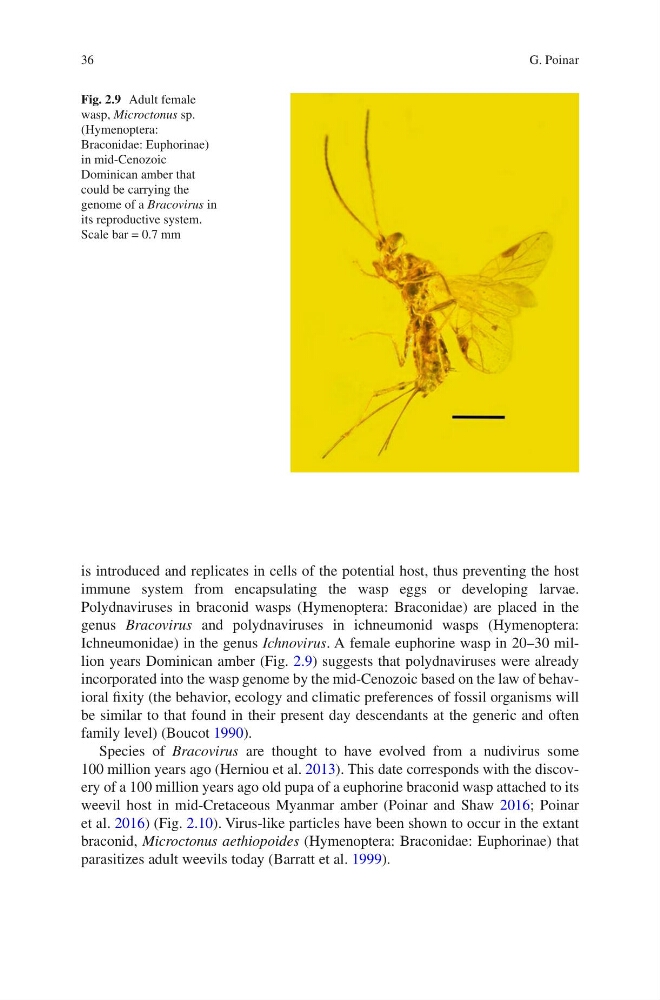
Ichneumonidae) in the genus Ichnovirus. A female euphorine wasp in 20–30 million years Dominican amber (Fig. 2.9) suggests that polydnaviruses were already
incorporated into the wasp genome by the mid-Cenozoic based on the law of behavioral fixity (the behavior, ecology and climatic preferences of fossil organisms will
be similar to that found in their present day descendants at the generic and often
family level) (Boucot 1990).
Species of Bracovirus are thought to have evolved from a nudivirus some
100 million years ago (Herniou et al. 2013). This date corresponds with the discovery of a 100 million years ago old pupa of a euphorine braconid wasp attached to its
weevil host in mid-Cretaceous Myanmar amber (Poinar and Shaw 2016; Poinar
et al. 2016) (Fig. 2.10). Virus-like particles have been shown to occur in the extant
braconid, Microctonus aethiopoides (Hymenoptera: Braconidae: Euphorinae) that
parasitizes adult weevils today (Barratt et al. 1999).
Fig. 2.9 Adult female
wasp, Microctonus sp.
(Hymenoptera:
Braconidae: Euphorinae)
in mid-Cenozoic
Dominican amber that
could be carrying the
genome of a Bracovirus in
its reproductive system.
Scale bar = 0.7 mm
G. Poinar
is introduced and replicates in cells of the potential host, thus preventing the host
immune system from encapsulating the wasp eggs or developing larvae.
Polydnaviruses in braconid wasps (Hymenoptera: Braconidae) are placed in the
genus Bracovirus and polydnaviruses in ichneumonid wasps (Hymenoptera:
Ichneumonidae) in the genus Ichnovirus. A female euphorine wasp in 20–30 million years Dominican amber (Fig. 2.9) suggests that polydnaviruses were already
incorporated into the wasp genome by the mid-Cenozoic based on the law of behavioral fixity (the behavior, ecology and climatic preferences of fossil organisms will
be similar to that found in their present day descendants at the generic and often
family level) (Boucot 1990).
Species of Bracovirus are thought to have evolved from a nudivirus some
100 million years ago (Herniou et al. 2013). This date corresponds with the discovery of a 100 million years ago old pupa of a euphorine braconid wasp attached to its
weevil host in mid-Cretaceous Myanmar amber (Poinar and Shaw 2016; Poinar
et al. 2016) (Fig. 2.10). Virus-like particles have been shown to occur in the extant
braconid, Microctonus aethiopoides (Hymenoptera: Braconidae: Euphorinae) that
parasitizes adult weevils today (Barratt et al. 1999).
Fig. 2.9 Adult female
wasp, Microctonus sp.
(Hymenoptera:
Braconidae: Euphorinae)
in mid-Cenozoic
Dominican amber that
could be carrying the
genome of a Bracovirus in
its reproductive system.
Scale bar = 0.7 mm
G. Poinar