

35
polyhedrosis viruses have been reported from extant lower Diptera (Nematocera)
(Poinar and Poinar 2005). These two cases show that cypoviruses and NPV viruses
were infecting lower Diptera by the mid-Cretaceous.
2.2.2 Indirect Evidence of Virus Infections
2.2.2.1 Parasitic Wasps with Polydnaviruses
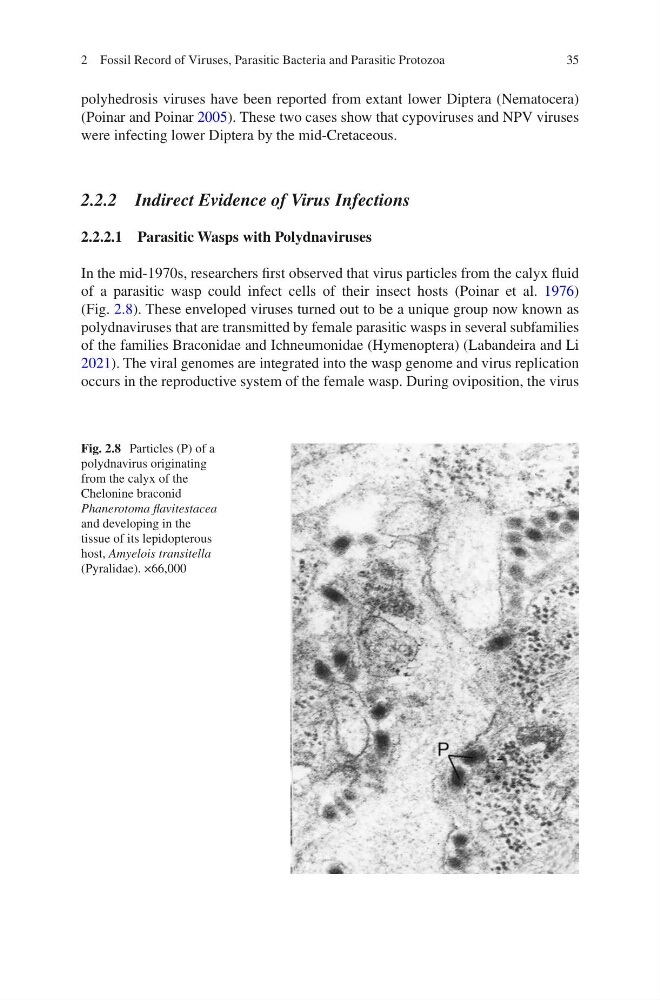
In the mid-1970s, researchers first observed that virus particles from the calyx fluid
of a parasitic wasp could infect cells of their insect hosts (Poinar et al. 1976)
(Fig. 2.8). These enveloped viruses turned out to be a unique group now known as
polydnaviruses that are transmitted by female parasitic wasps in several subfamilies
of the families Braconidae and Ichneumonidae (Hymenoptera) (Labandeira and Li
2021). The viral genomes are integrated into the wasp genome and virus replication
occurs in the reproductive system of the female wasp. During oviposition, the virus
Fig. 2.8 Particles (P) of a
polydnavirus originating
from the calyx of the
Chelonine braconid
Phanerotoma flavitestacea
and developing in the
tissue of its lepidopterous
host, Amyelois transitella
(Pyralidae). ×66,000
2 Fossil Record of Viruses, Parasitic Bacteria and Parasitic Protozoa
polyhedrosis viruses have been reported from extant lower Diptera (Nematocera)
(Poinar and Poinar 2005). These two cases show that cypoviruses and NPV viruses
were infecting lower Diptera by the mid-Cretaceous.
2.2.2 Indirect Evidence of Virus Infections
2.2.2.1 Parasitic Wasps with Polydnaviruses
In the mid-1970s, researchers first observed that virus particles from the calyx fluid
of a parasitic wasp could infect cells of their insect hosts (Poinar et al. 1976)
(Fig. 2.8). These enveloped viruses turned out to be a unique group now known as
polydnaviruses that are transmitted by female parasitic wasps in several subfamilies
of the families Braconidae and Ichneumonidae (Hymenoptera) (Labandeira and Li
2021). The viral genomes are integrated into the wasp genome and virus replication
occurs in the reproductive system of the female wasp. During oviposition, the virus
Fig. 2.8 Particles (P) of a
polydnavirus originating
from the calyx of the
Chelonine braconid
Phanerotoma flavitestacea
and developing in the
tissue of its lepidopterous
host, Amyelois transitella
(Pyralidae). ×66,000
2 Fossil Record of Viruses, Parasitic Bacteria and Parasitic Protozoa