

66
B. S. Mukesh et al.
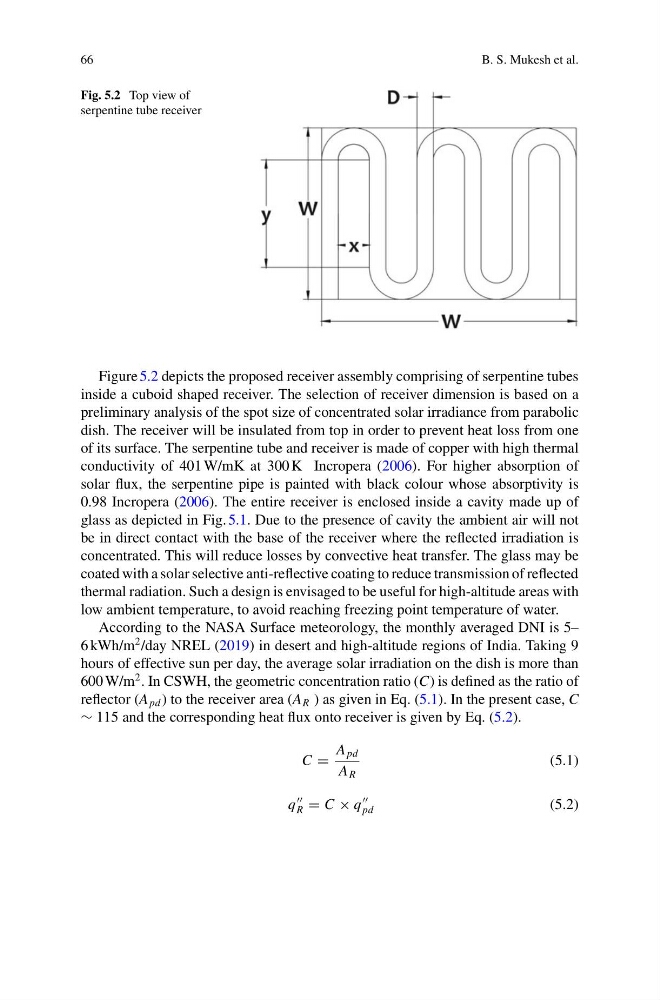
Fig. 5.2 Top view of
serpentine tube receiver
Figure 5.2 depicts the proposed receiver assembly comprising of serpentine tubes
inside a cuboid shaped receiver. The selection of receiver dimension is based on a
preliminary analysis of the spot size of concentrated solar irradiance from parabolic
dish. The receiver will be insulated from top in order to prevent heat loss from one
of its surface. The serpentine tube and receiver is made of copper with high thermal
conductivity of 401 W/mK at 300 K Incropera (2006). For higher absorption of
solar flux, the serpentine pipe is painted with black colour whose absorptivity is
0.98 Incropera (2006). The entire receiver is enclosed inside a cavity made up of
glass as depicted in Fig. 5.1. Due to the presence of cavity the ambient air will not
be in direct contact with the base of the receiver where the reflected irradiation is
concentrated. This will reduce losses by convective heat transfer. The glass may be
coated with a solar selective anti-reflective coating to reduce transmission of reflected
thermal radiation. Such a design is envisaged to be useful for high-altitude areas with
low ambient temperature, to avoid reaching freezing point temperature of water.
According to the NASA Surface meteorology, the monthly averaged DNI is 5–
6 kWh/m
2 /day NREL (2019) in desert and high-altitude regions of India. Taking 9
hours of effective sun per day, the average solar irradiation on the dish is more than
600 W/m
2 . In CSWH, the geometric concentration ratio (C) is defined as the ratio of
reflector (A pd ) to the receiver area (A R ) as given in Eq. (5.1). In the present case, C
∼ 115 and the corresponding heat flux onto receiver is given by Eq. (5.2).
C =
A pd
A R
(5.1)
q
R = C × q
pd
(5.2)
B. S. Mukesh et al.
Fig. 5.2 Top view of
serpentine tube receiver
Figure 5.2 depicts the proposed receiver assembly comprising of serpentine tubes
inside a cuboid shaped receiver. The selection of receiver dimension is based on a
preliminary analysis of the spot size of concentrated solar irradiance from parabolic
dish. The receiver will be insulated from top in order to prevent heat loss from one
of its surface. The serpentine tube and receiver is made of copper with high thermal
conductivity of 401 W/mK at 300 K Incropera (2006). For higher absorption of
solar flux, the serpentine pipe is painted with black colour whose absorptivity is
0.98 Incropera (2006). The entire receiver is enclosed inside a cavity made up of
glass as depicted in Fig. 5.1. Due to the presence of cavity the ambient air will not
be in direct contact with the base of the receiver where the reflected irradiation is
concentrated. This will reduce losses by convective heat transfer. The glass may be
coated with a solar selective anti-reflective coating to reduce transmission of reflected
thermal radiation. Such a design is envisaged to be useful for high-altitude areas with
low ambient temperature, to avoid reaching freezing point temperature of water.
According to the NASA Surface meteorology, the monthly averaged DNI is 5–
6 kWh/m
2 /day NREL (2019) in desert and high-altitude regions of India. Taking 9
hours of effective sun per day, the average solar irradiation on the dish is more than
600 W/m
2 . In CSWH, the geometric concentration ratio (C) is defined as the ratio of
reflector (A pd ) to the receiver area (A R ) as given in Eq. (5.1). In the present case, C
∼ 115 and the corresponding heat flux onto receiver is given by Eq. (5.2).
C =
A pd
A R
(5.1)
q
R = C × q
pd
(5.2)