

5 Design and Development of a Concentrated Solar …
67
5.2.1 Parabolic Dish Design
The parabolic dish reflector is designed for an input power of 2 kW thermal power
i.e. the reflector area collects 2 kJ/s from DNI. Aluminum foil used as the reflector
material on the dish has a reflectivity 0.85. For an average DNI 641.1 W/m
2 , the
required minimum area of reflector is 4.3 m
2 . For a parabolic dish with aperture of
W = 2.4 m and focal length f = 1.5 m where long focal length is chosen such that
the shadow effects are minimized, the depth of the parabolic dish Z R is calculated
as 0.24 m using Eq. (5.3).
f =
W
2
16Z R
(5.3)
The central role of the parabolic dish in solar concentrator systems is its ability to
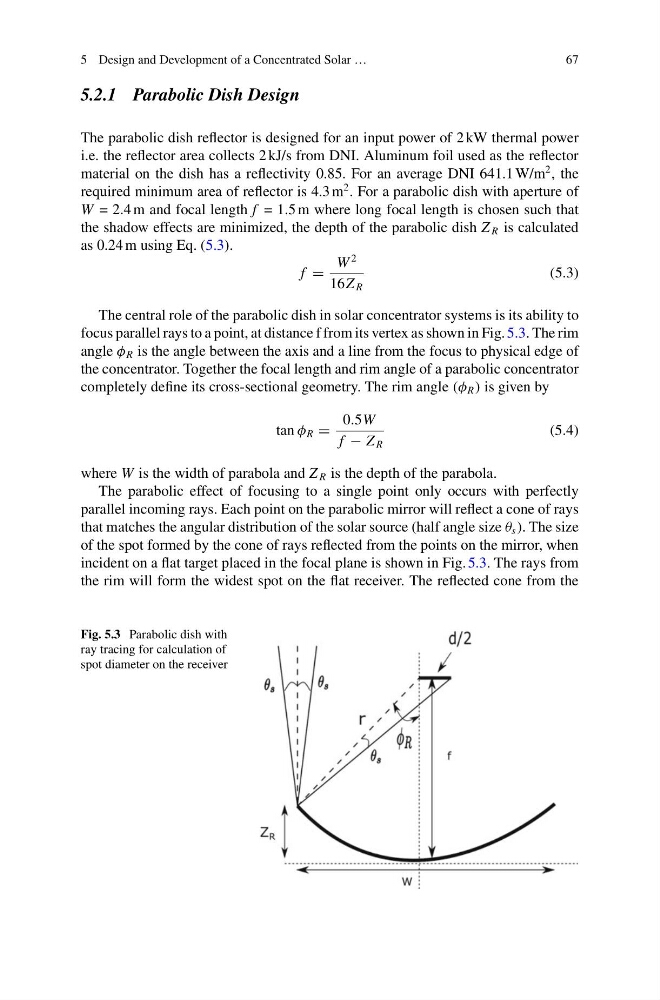
focus parallel rays to a point, at distance f from its vertex as shown in Fig. 5.3. The rim
angle φ R is the angle between the axis and a line from the focus to physical edge of
the concentrator. Together the focal length and rim angle of a parabolic concentrator
completely define its cross-sectional geometry. The rim angle (φ R ) is given by
tan φ R =
0.5W
f − Z R
(5.4)
where W is the width of parabola and Z R is the depth of the parabola.
The parabolic effect of focusing to a single point only occurs with perfectly
parallel incoming rays. Each point on the parabolic mirror will reflect a cone of rays
that matches the angular distribution of the solar source (half angle size θ s ). The size
of the spot formed by the cone of rays reflected from the points on the mirror, when
incident on a flat target placed in the focal plane is shown in Fig. 5.3. The rays from
the rim will form the widest spot on the flat receiver. The reflected cone from the
Fig. 5.3 Parabolic dish with
ray tracing for calculation of
spot diameter on the receiver
67
5.2.1 Parabolic Dish Design
The parabolic dish reflector is designed for an input power of 2 kW thermal power
i.e. the reflector area collects 2 kJ/s from DNI. Aluminum foil used as the reflector
material on the dish has a reflectivity 0.85. For an average DNI 641.1 W/m
2 , the
required minimum area of reflector is 4.3 m
2 . For a parabolic dish with aperture of
W = 2.4 m and focal length f = 1.5 m where long focal length is chosen such that
the shadow effects are minimized, the depth of the parabolic dish Z R is calculated
as 0.24 m using Eq. (5.3).
f =
W
2
16Z R
(5.3)
The central role of the parabolic dish in solar concentrator systems is its ability to
focus parallel rays to a point, at distance f from its vertex as shown in Fig. 5.3. The rim
angle φ R is the angle between the axis and a line from the focus to physical edge of
the concentrator. Together the focal length and rim angle of a parabolic concentrator
completely define its cross-sectional geometry. The rim angle (φ R ) is given by
tan φ R =
0.5W
f − Z R
(5.4)
where W is the width of parabola and Z R is the depth of the parabola.
The parabolic effect of focusing to a single point only occurs with perfectly
parallel incoming rays. Each point on the parabolic mirror will reflect a cone of rays
that matches the angular distribution of the solar source (half angle size θ s ). The size
of the spot formed by the cone of rays reflected from the points on the mirror, when
incident on a flat target placed in the focal plane is shown in Fig. 5.3. The rays from
the rim will form the widest spot on the flat receiver. The reflected cone from the
Fig. 5.3 Parabolic dish with
ray tracing for calculation of
spot diameter on the receiver