

5 Design and Development of a Concentrated Solar …
65
Most of the CSWH systems reported in literature are mostly based on a parabolic
trough concentrator with oil as working fluid to best of our knowledge. Water is used
as the secondary fluid, which is indirectly heated via a thermal energy storage, see
e.g. Prasartkaew (2018). In the proposed system, water serves as heat transfer fluid
as well as the storage. Thus, the present system is different and more compact.
With the above mentioned objectives, the design of the proposed CSWH system
is discussed followed by the experimental set up description. Finally results of the
experiments are presented.
5.2 Design of Concentrated Solar Water Heating System
The CSWH system consists of a receiver and a parabolic dish with two-axis sun
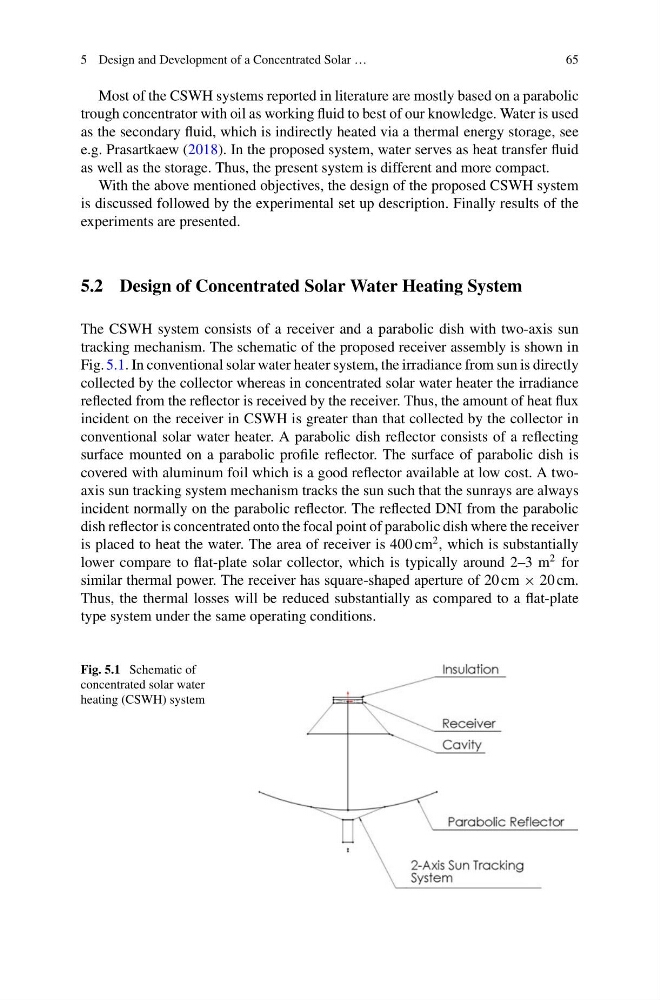
tracking mechanism. The schematic of the proposed receiver assembly is shown in
Fig. 5.1. In conventional solar water heater system, the irradiance from sun is directly
collected by the collector whereas in concentrated solar water heater the irradiance
reflected from the reflector is received by the receiver. Thus, the amount of heat flux
incident on the receiver in CSWH is greater than that collected by the collector in
conventional solar water heater. A parabolic dish reflector consists of a reflecting
surface mounted on a parabolic profile reflector. The surface of parabolic dish is
covered with aluminum foil which is a good reflector available at low cost. A twoaxis sun tracking system mechanism tracks the sun such that the sunrays are always
incident normally on the parabolic reflector. The reflected DNI from the parabolic
dish reflector is concentrated onto the focal point of parabolic dish where the receiver
is placed to heat the water. The area of receiver is 400 cm
2 , which is substantially
lower compare to flat-plate solar collector, which is typically around 2–3 m
2 for
similar thermal power. The receiver has square-shaped aperture of 20 cm × 20 cm.
Thus, the thermal losses will be reduced substantially as compared to a flat-plate
type system under the same operating conditions.
Fig. 5.1 Schematic of
concentrated solar water
heating (CSWH) system
65
Most of the CSWH systems reported in literature are mostly based on a parabolic
trough concentrator with oil as working fluid to best of our knowledge. Water is used
as the secondary fluid, which is indirectly heated via a thermal energy storage, see
e.g. Prasartkaew (2018). In the proposed system, water serves as heat transfer fluid
as well as the storage. Thus, the present system is different and more compact.
With the above mentioned objectives, the design of the proposed CSWH system
is discussed followed by the experimental set up description. Finally results of the
experiments are presented.
5.2 Design of Concentrated Solar Water Heating System
The CSWH system consists of a receiver and a parabolic dish with two-axis sun
tracking mechanism. The schematic of the proposed receiver assembly is shown in
Fig. 5.1. In conventional solar water heater system, the irradiance from sun is directly
collected by the collector whereas in concentrated solar water heater the irradiance
reflected from the reflector is received by the receiver. Thus, the amount of heat flux
incident on the receiver in CSWH is greater than that collected by the collector in
conventional solar water heater. A parabolic dish reflector consists of a reflecting
surface mounted on a parabolic profile reflector. The surface of parabolic dish is
covered with aluminum foil which is a good reflector available at low cost. A twoaxis sun tracking system mechanism tracks the sun such that the sunrays are always
incident normally on the parabolic reflector. The reflected DNI from the parabolic
dish reflector is concentrated onto the focal point of parabolic dish where the receiver
is placed to heat the water. The area of receiver is 400 cm
2 , which is substantially
lower compare to flat-plate solar collector, which is typically around 2–3 m
2 for
similar thermal power. The receiver has square-shaped aperture of 20 cm × 20 cm.
Thus, the thermal losses will be reduced substantially as compared to a flat-plate
type system under the same operating conditions.
Fig. 5.1 Schematic of
concentrated solar water
heating (CSWH) system