

40
S. F. Ali and D. Rakshit
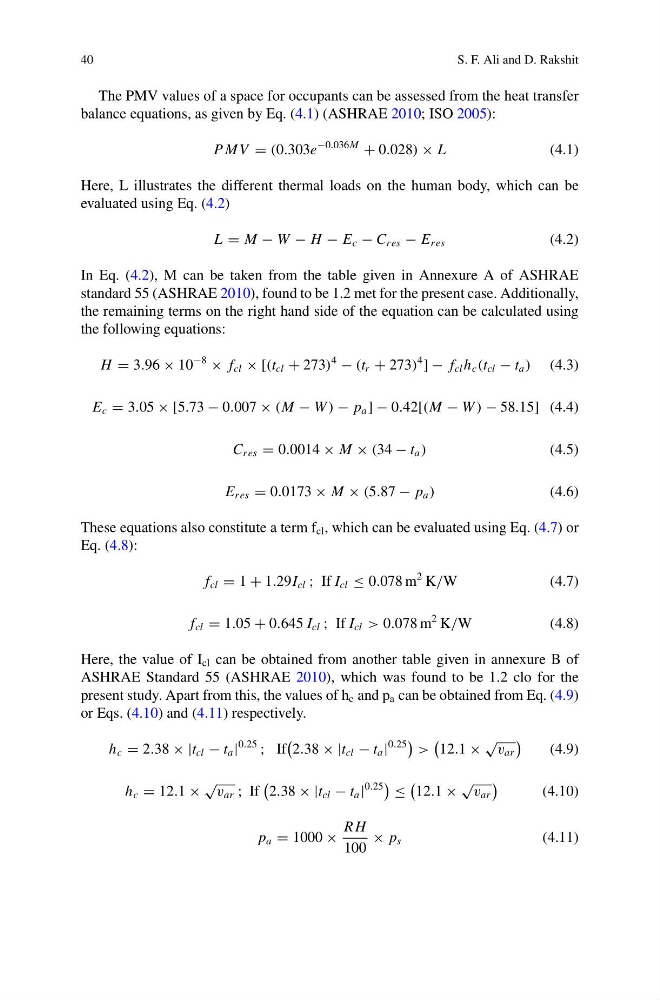
The PMV values of a space for occupants can be assessed from the heat transfer
balance equations, as given by Eq. (4.1) (ASHRAE 2010; ISO 2005):
P MV = (0.303e
−0.036M
+ 0.028) × L
(4.1)
Here, L illustrates the different thermal loads on the human body, which can be
evaluated using Eq. (4.2)
L = M − W − H − E c − C res − E res
(4.2)
In Eq. (4.2), M can be taken from the table given in Annexure A of ASHRAE
standard 55 (ASHRAE 2010), found to be 1.2 met for the present case. Additionally,
the remaining terms on the right hand side of the equation can be calculated using
the following equations:
H = 3.96 × 10
−8
× f cl × [(t cl + 273)
4
− (t r + 273)
4
] − f cl h c (t cl − t a ) (4.3)
E c = 3.05 × [5.73 − 0.007 × (M − W ) − p a ] − 0.42[(M − W ) − 58.15] (4.4)
C res = 0.0014 × M × (34 − t a )
(4.5)
E res = 0.0173 × M × (5.87 − p a )
(4.6)
These equations also constitute a term f cl , which can be evaluated using Eq. (4.7) or
Eq. (4.8):
f cl = 1 + 1.29I cl ; If I cl ≤ 0.078 m
2 K/W
(4.7)
f cl = 1.05 + 0.645 I cl ; If I cl > 0.078 m
2 K/W
(4.8)
Here, the value of I cl can be obtained from another table given in annexure B of
ASHRAE Standard 55 (ASHRAE 2010), which was found to be 1.2 clo for the
present study. Apart from this, the values of h c and p a can be obtained from Eq. (4.9)
or Eqs. (4.10) and (4.11) respectively.
h c = 2.38 × |t cl − t a |
0.25
; If
2.38 × |t cl − t a |
0.25
>
12.1 ×
√ v ar
(4.9)
h c = 12.1 ×
√ v ar ; If
2.38 × |t cl − t a |
0.25
≤
12.1 ×
√ v ar
(4.10)
p a = 1000 ×
R H
100
× p s
(4.11)
S. F. Ali and D. Rakshit
The PMV values of a space for occupants can be assessed from the heat transfer
balance equations, as given by Eq. (4.1) (ASHRAE 2010; ISO 2005):
P MV = (0.303e
−0.036M
+ 0.028) × L
(4.1)
Here, L illustrates the different thermal loads on the human body, which can be
evaluated using Eq. (4.2)
L = M − W − H − E c − C res − E res
(4.2)
In Eq. (4.2), M can be taken from the table given in Annexure A of ASHRAE
standard 55 (ASHRAE 2010), found to be 1.2 met for the present case. Additionally,
the remaining terms on the right hand side of the equation can be calculated using
the following equations:
H = 3.96 × 10
−8
× f cl × [(t cl + 273)
4
− (t r + 273)
4
] − f cl h c (t cl − t a ) (4.3)
E c = 3.05 × [5.73 − 0.007 × (M − W ) − p a ] − 0.42[(M − W ) − 58.15] (4.4)
C res = 0.0014 × M × (34 − t a )
(4.5)
E res = 0.0173 × M × (5.87 − p a )
(4.6)
These equations also constitute a term f cl , which can be evaluated using Eq. (4.7) or
Eq. (4.8):
f cl = 1 + 1.29I cl ; If I cl ≤ 0.078 m
2 K/W
(4.7)
f cl = 1.05 + 0.645 I cl ; If I cl > 0.078 m
2 K/W
(4.8)
Here, the value of I cl can be obtained from another table given in annexure B of
ASHRAE Standard 55 (ASHRAE 2010), which was found to be 1.2 clo for the
present study. Apart from this, the values of h c and p a can be obtained from Eq. (4.9)
or Eqs. (4.10) and (4.11) respectively.
h c = 2.38 × |t cl − t a |
0.25
; If
2.38 × |t cl − t a |
0.25
>
12.1 ×
√ v ar
(4.9)
h c = 12.1 ×
√ v ar ; If
2.38 × |t cl − t a |
0.25
≤
12.1 ×
√ v ar
(4.10)
p a = 1000 ×
R H
100
× p s
(4.11)