

4 Utilising Passive Design Strategies for Analysing Thermal …
39
gap. Standards recommend that a minimum of 80% of the occupants need to be
thermally satisfied with their environment (ASHRAE 2010; ISO 2005).
4.1.4 Thermal Comfort Evaluation
A variety of factors dictate the occupant comfort conditions, which may differ from
one person to another. These factors include rate of metabolism of human beings
(M), clothing insulation (f cl ), air speed (v ar ), air temperature (t a ), mean radiant temperature (t r ) and relative humidity (RH), which establish the heat exchange between
the occupants and surroundings.
Numerous models are available to determine the comfort level of the occupants,
formulated on the basis of the factors affecting it, such as Effective Temperature
(ET), Corrected Effective Temperature (CET), Operative Temperature (OT), Tropical
Summer Index (TSI), etc. (Auliciems and Szokolay 1997). However, two of the
most recognised models for determining thermally comfortable environment are the
Predicted Mean Vote (PMV) and the Percentage People Dissatisfied models, which
are also accepted as the standard indices for evaluating thermal comfort by ASHRAE
Standard 55 (ASHRAE 2010), and ISO 7730 (ISO 2005). Studies by researchers
such as Pourshaghaghy and Omidvari (2012), Azad et al. (2018), Nematchoua et al.
(2017), Rupp and Ghisi (2017), Katafygiotou and Serghides (2014), Calis and Kuru
(2017), Pazhoohesh and Zhang (2018), Stamou et al. (2007) etc., have successfully
utilised these PMV-PPD models for predicting the comfort conditions within the
indoor spaces.
Predicted Mean Vote (PMV). The standards (ASHRAE 2010; ISO 2005) describe
the predicted mean vote index for evaluating thermal comfort of the occupants in
a space, according to which, the condition of the comfort can be envisaged by the
PMV values. This index, developed by P. O. Fanger, represents a scale of thermal
perception, having 7 points representing sensations of the occupants. It spans from a
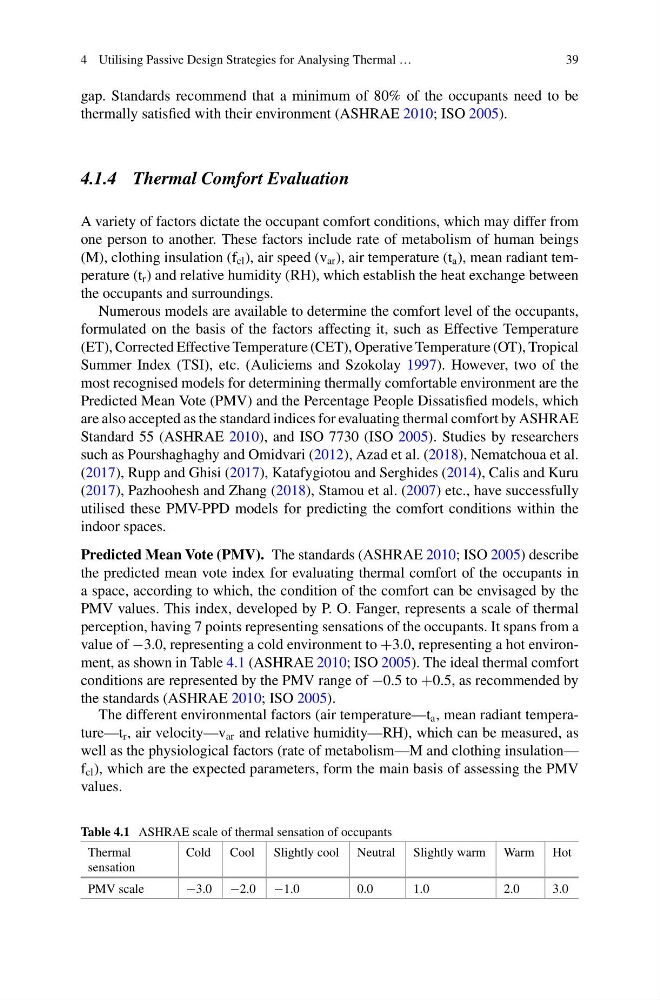
value of −3.0, representing a cold environment to +3.0, representing a hot environment, as shown in Table 4.1 (ASHRAE 2010; ISO 2005). The ideal thermal comfort
conditions are represented by the PMV range of −0.5 to +0.5, as recommended by
the standards (ASHRAE 2010; ISO 2005).
The different environmental factors (air temperature—t a , mean radiant temperature—t r , air velocity—v ar and relative humidity—RH), which can be measured, as
well as the physiological factors (rate of metabolism—M and clothing insulation—
f cl ), which are the expected parameters, form the main basis of assessing the PMV
values.
Table 4.1 ASHRAE scale of thermal sensation of occupants
Thermal
sensation
Cold
Cool
Slightly cool Neutral Slightly warm Warm Hot
PMV scale
−3.0 −2.0 −1.0
0.0
1.0
2.0
3.0
39
gap. Standards recommend that a minimum of 80% of the occupants need to be
thermally satisfied with their environment (ASHRAE 2010; ISO 2005).
4.1.4 Thermal Comfort Evaluation
A variety of factors dictate the occupant comfort conditions, which may differ from
one person to another. These factors include rate of metabolism of human beings
(M), clothing insulation (f cl ), air speed (v ar ), air temperature (t a ), mean radiant temperature (t r ) and relative humidity (RH), which establish the heat exchange between
the occupants and surroundings.
Numerous models are available to determine the comfort level of the occupants,
formulated on the basis of the factors affecting it, such as Effective Temperature
(ET), Corrected Effective Temperature (CET), Operative Temperature (OT), Tropical
Summer Index (TSI), etc. (Auliciems and Szokolay 1997). However, two of the
most recognised models for determining thermally comfortable environment are the
Predicted Mean Vote (PMV) and the Percentage People Dissatisfied models, which
are also accepted as the standard indices for evaluating thermal comfort by ASHRAE
Standard 55 (ASHRAE 2010), and ISO 7730 (ISO 2005). Studies by researchers
such as Pourshaghaghy and Omidvari (2012), Azad et al. (2018), Nematchoua et al.
(2017), Rupp and Ghisi (2017), Katafygiotou and Serghides (2014), Calis and Kuru
(2017), Pazhoohesh and Zhang (2018), Stamou et al. (2007) etc., have successfully
utilised these PMV-PPD models for predicting the comfort conditions within the
indoor spaces.
Predicted Mean Vote (PMV). The standards (ASHRAE 2010; ISO 2005) describe
the predicted mean vote index for evaluating thermal comfort of the occupants in
a space, according to which, the condition of the comfort can be envisaged by the
PMV values. This index, developed by P. O. Fanger, represents a scale of thermal
perception, having 7 points representing sensations of the occupants. It spans from a
value of −3.0, representing a cold environment to +3.0, representing a hot environment, as shown in Table 4.1 (ASHRAE 2010; ISO 2005). The ideal thermal comfort
conditions are represented by the PMV range of −0.5 to +0.5, as recommended by
the standards (ASHRAE 2010; ISO 2005).
The different environmental factors (air temperature—t a , mean radiant temperature—t r , air velocity—v ar and relative humidity—RH), which can be measured, as
well as the physiological factors (rate of metabolism—M and clothing insulation—
f cl ), which are the expected parameters, form the main basis of assessing the PMV
values.
Table 4.1 ASHRAE scale of thermal sensation of occupants
Thermal
sensation
Cold
Cool
Slightly cool Neutral Slightly warm Warm Hot
PMV scale
−3.0 −2.0 −1.0
0.0
1.0
2.0
3.0