

18 Interfacial Materials for Organic Solar Cells
387
PCE of only 1.6% (FF = 0.36). The PTE layer clearly alter the electron selectivity of ITO/PTE/TiO x electrode. The use of Ag instead of Au top electrode gave
a low absorption loss (Steim et al. 2008). The modification of ZnO surface by
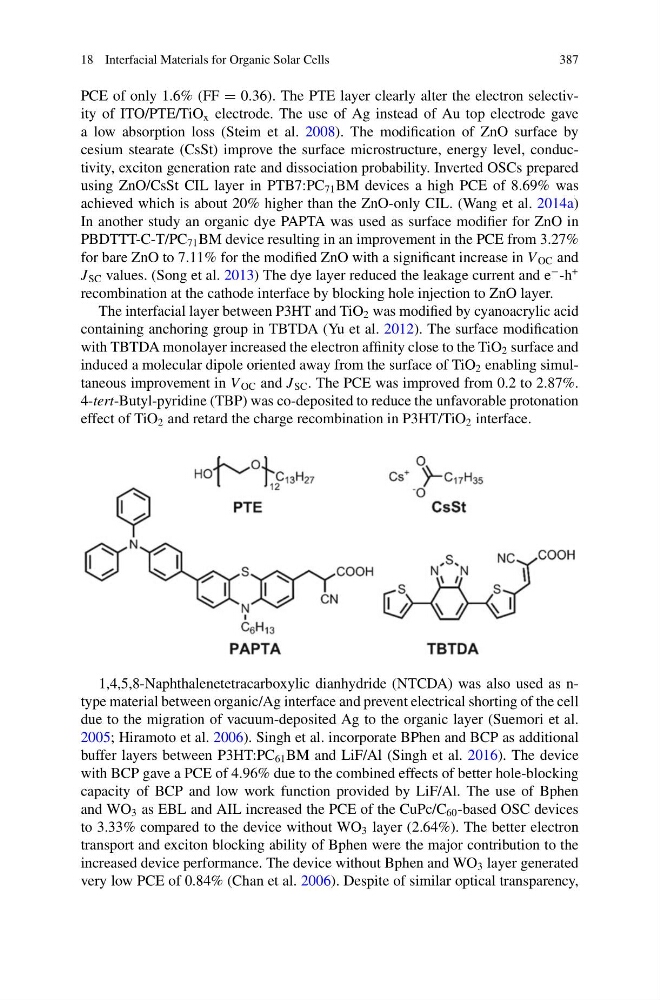
cesium stearate (CsSt) improve the surface microstructure, energy level, conductivity, exciton generation rate and dissociation probability. Inverted OSCs prepared
using ZnO/CsSt CIL layer in PTB7:PC 71 BM devices a high PCE of 8.69% was
achieved which is about 20% higher than the ZnO-only CIL. (Wang et al. 2014a)
In another study an organic dye PAPTA was used as surface modifier for ZnO in
PBDTTT-C-T/PC 71 BM device resulting in an improvement in the PCE from 3.27%
for bare ZnO to 7.11% for the modified ZnO with a significant increase in V OC and
J SC values. (Song et al. 2013) The dye layer reduced the leakage current and e
− -h
+
recombination at the cathode interface by blocking hole injection to ZnO layer.
The interfacial layer between P3HT and TiO 2 was modified by cyanoacrylic acid
containing anchoring group in TBTDA (Yu et al. 2012). The surface modification
with TBTDA monolayer increased the electron affinity close to the TiO 2 surface and
induced a molecular dipole oriented away from the surface of TiO 2 enabling simultaneous improvement in V OC and J SC . The PCE was improved from 0.2 to 2.87%.
4-tert-Butyl-pyridine (TBP) was co-deposited to reduce the unfavorable protonation
effect of TiO 2 and retard the charge recombination in P3HT/TiO 2 interface.
1,4,5,8-Naphthalenetetracarboxylic dianhydride (NTCDA) was also used as ntype material between organic/Ag interface and prevent electrical shorting of the cell
due to the migration of vacuum-deposited Ag to the organic layer (Suemori et al.
2005; Hiramoto et al. 2006). Singh et al. incorporate BPhen and BCP as additional
buffer layers between P3HT:PC 61 BM and LiF/Al (Singh et al. 2016). The device
with BCP gave a PCE of 4.96% due to the combined effects of better hole-blocking
capacity of BCP and low work function provided by LiF/Al. The use of Bphen
and WO 3 as EBL and AIL increased the PCE of the CuPc/C 60 -based OSC devices
to 3.33% compared to the device without WO 3 layer (2.64%). The better electron
transport and exciton blocking ability of Bphen were the major contribution to the
increased device performance. The device without Bphen and WO 3 layer generated
very low PCE of 0.84% (Chan et al. 2006). Despite of similar optical transparency,
387
PCE of only 1.6% (FF = 0.36). The PTE layer clearly alter the electron selectivity of ITO/PTE/TiO x electrode. The use of Ag instead of Au top electrode gave
a low absorption loss (Steim et al. 2008). The modification of ZnO surface by
cesium stearate (CsSt) improve the surface microstructure, energy level, conductivity, exciton generation rate and dissociation probability. Inverted OSCs prepared
using ZnO/CsSt CIL layer in PTB7:PC 71 BM devices a high PCE of 8.69% was
achieved which is about 20% higher than the ZnO-only CIL. (Wang et al. 2014a)
In another study an organic dye PAPTA was used as surface modifier for ZnO in
PBDTTT-C-T/PC 71 BM device resulting in an improvement in the PCE from 3.27%
for bare ZnO to 7.11% for the modified ZnO with a significant increase in V OC and
J SC values. (Song et al. 2013) The dye layer reduced the leakage current and e
− -h
+
recombination at the cathode interface by blocking hole injection to ZnO layer.
The interfacial layer between P3HT and TiO 2 was modified by cyanoacrylic acid
containing anchoring group in TBTDA (Yu et al. 2012). The surface modification
with TBTDA monolayer increased the electron affinity close to the TiO 2 surface and
induced a molecular dipole oriented away from the surface of TiO 2 enabling simultaneous improvement in V OC and J SC . The PCE was improved from 0.2 to 2.87%.
4-tert-Butyl-pyridine (TBP) was co-deposited to reduce the unfavorable protonation
effect of TiO 2 and retard the charge recombination in P3HT/TiO 2 interface.
1,4,5,8-Naphthalenetetracarboxylic dianhydride (NTCDA) was also used as ntype material between organic/Ag interface and prevent electrical shorting of the cell
due to the migration of vacuum-deposited Ag to the organic layer (Suemori et al.
2005; Hiramoto et al. 2006). Singh et al. incorporate BPhen and BCP as additional
buffer layers between P3HT:PC 61 BM and LiF/Al (Singh et al. 2016). The device
with BCP gave a PCE of 4.96% due to the combined effects of better hole-blocking
capacity of BCP and low work function provided by LiF/Al. The use of Bphen
and WO 3 as EBL and AIL increased the PCE of the CuPc/C 60 -based OSC devices
to 3.33% compared to the device without WO 3 layer (2.64%). The better electron
transport and exciton blocking ability of Bphen were the major contribution to the
increased device performance. The device without Bphen and WO 3 layer generated
very low PCE of 0.84% (Chan et al. 2006). Despite of similar optical transparency,