

388
A. Mishra
the electron mobility of Bphen is two order of magnitude higher compared to BCP
thus led to better electron transport.
Zhao et al. used amino-group containing small molecules such as dicyandiamide
(DCDA) and urea as CIL in P3HT:PC 61 BM BHJ solar cells. The PCE has been
enhanced from 3.35% for the reference device to 4.25% and 4.39% respectively,
due to increase in J SC and FF values (Zhao et al. 2014). Further investigation of
film morphologies revealed the interfacial dipole formation between the photoactive
layer and Al cathode which might have lowered the WF of Al and facilitate electron
extraction from PCBM. Also the amine groups can coordinate to the Al and prevent
its interaction with P3HT.
Nam et al. successfully used a combination of pyromellitic dianhydride
(PMDA)/LiF as CIL in P3HT:PC 61 BM BHJ devices which showed superior photovoltaic performance (PCE = 3.9%) compared to the device with single CILs PMDA
(PCE = 1.8%) or with only LiF (PCE = 3.3%) due to reduced leakage current and
series resistance (Nam et al. 2012).
The use of organic dipolar interlayers for interfacial tuning of the electroncollecting buffer layer and the photoactive layer has been projected as an efficient way to improve the overall device performance. In this respect, various
perylene derivatives have been used as CIL to modify the interface between
cathode and organic layer. Chen et al. demonstrated the modification of ITO
WF by coating with a cationic N,N
-bis[2-(trimethylammonium)ethylene]perylene3,4,9,10-tetracarboxyldiimide (PDIN
+ I
− ) and anionic PEDOT:PSS
– composite prepared by electrostatic layer by layer (eLbL) deposition technique to prepared
PDIN
+ I
− :PEDOT:PSS
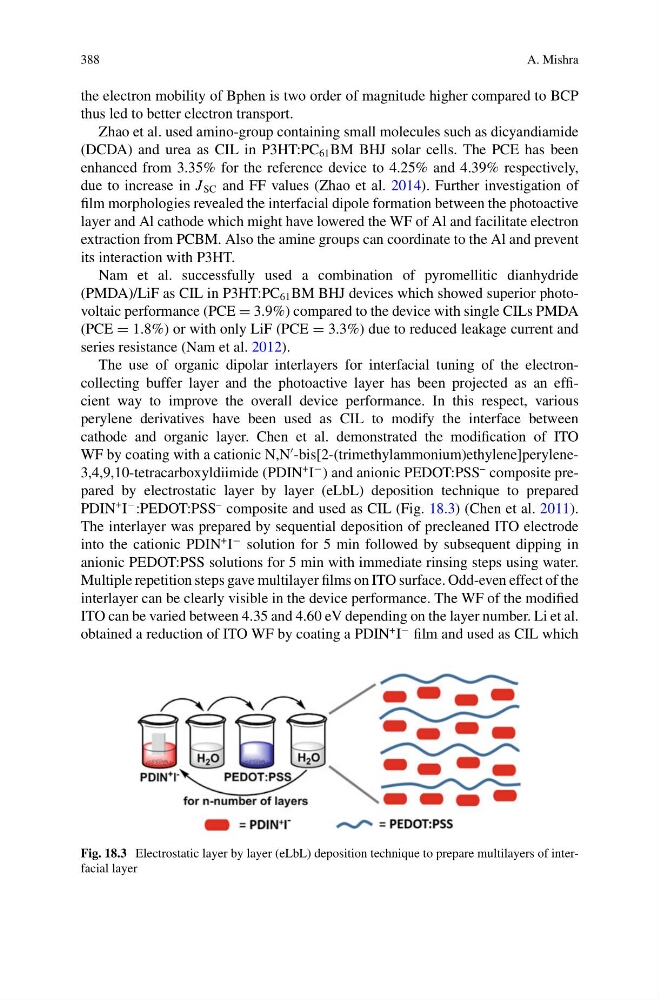
– composite and used as CIL (Fig. 18.3) (Chen et al. 2011).
The interlayer was prepared by sequential deposition of precleaned ITO electrode
into the cationic PDIN
+ I
− solution for 5 min followed by subsequent dipping in
anionic PEDOT:PSS solutions for 5 min with immediate rinsing steps using water.
Multiple repetition steps gave multilayer films on ITO surface. Odd-even effect of the
interlayer can be clearly visible in the device performance. The WF of the modified
ITO can be varied between 4.35 and 4.60 eV depending on the layer number. Li et al.
obtained a reduction of ITO WF by coating a PDIN
+ I
− film and used as CIL which
Fig. 18.3 Electrostatic layer by layer (eLbL) deposition technique to prepare multilayers of interfacial layer
A. Mishra
the electron mobility of Bphen is two order of magnitude higher compared to BCP
thus led to better electron transport.
Zhao et al. used amino-group containing small molecules such as dicyandiamide
(DCDA) and urea as CIL in P3HT:PC 61 BM BHJ solar cells. The PCE has been
enhanced from 3.35% for the reference device to 4.25% and 4.39% respectively,
due to increase in J SC and FF values (Zhao et al. 2014). Further investigation of
film morphologies revealed the interfacial dipole formation between the photoactive
layer and Al cathode which might have lowered the WF of Al and facilitate electron
extraction from PCBM. Also the amine groups can coordinate to the Al and prevent
its interaction with P3HT.
Nam et al. successfully used a combination of pyromellitic dianhydride
(PMDA)/LiF as CIL in P3HT:PC 61 BM BHJ devices which showed superior photovoltaic performance (PCE = 3.9%) compared to the device with single CILs PMDA
(PCE = 1.8%) or with only LiF (PCE = 3.3%) due to reduced leakage current and
series resistance (Nam et al. 2012).
The use of organic dipolar interlayers for interfacial tuning of the electroncollecting buffer layer and the photoactive layer has been projected as an efficient way to improve the overall device performance. In this respect, various
perylene derivatives have been used as CIL to modify the interface between
cathode and organic layer. Chen et al. demonstrated the modification of ITO
WF by coating with a cationic N,N
-bis[2-(trimethylammonium)ethylene]perylene3,4,9,10-tetracarboxyldiimide (PDIN
+ I
− ) and anionic PEDOT:PSS
– composite prepared by electrostatic layer by layer (eLbL) deposition technique to prepared
PDIN
+ I
− :PEDOT:PSS
– composite and used as CIL (Fig. 18.3) (Chen et al. 2011).
The interlayer was prepared by sequential deposition of precleaned ITO electrode
into the cationic PDIN
+ I
− solution for 5 min followed by subsequent dipping in
anionic PEDOT:PSS solutions for 5 min with immediate rinsing steps using water.
Multiple repetition steps gave multilayer films on ITO surface. Odd-even effect of the
interlayer can be clearly visible in the device performance. The WF of the modified
ITO can be varied between 4.35 and 4.60 eV depending on the layer number. Li et al.
obtained a reduction of ITO WF by coating a PDIN
+ I
− film and used as CIL which
Fig. 18.3 Electrostatic layer by layer (eLbL) deposition technique to prepare multilayers of interfacial layer