

386
A. Mishra
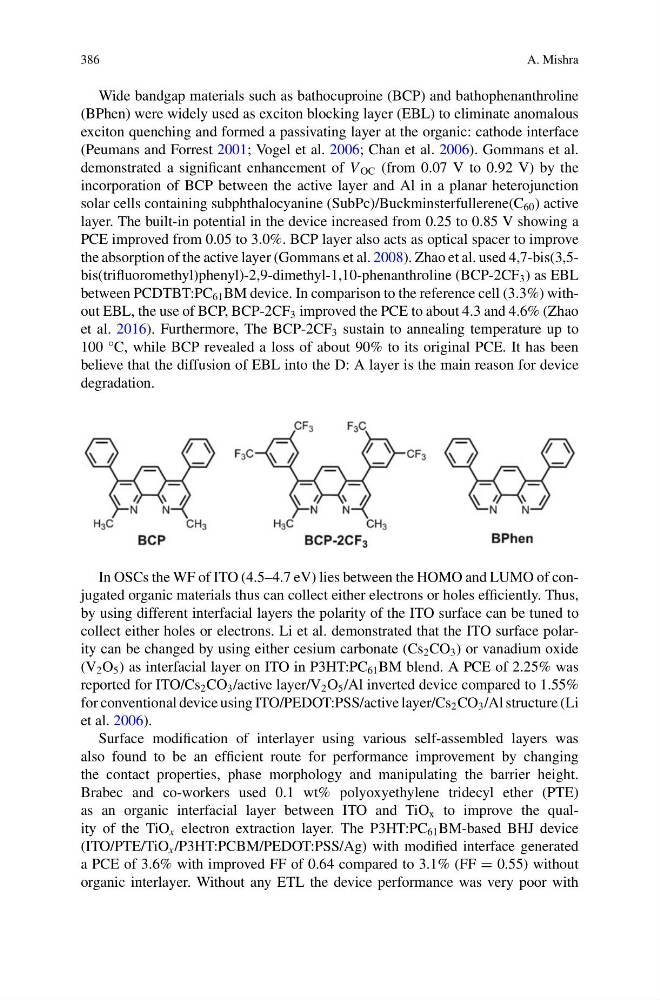
Wide bandgap materials such as bathocuproine (BCP) and bathophenanthroline
(BPhen) were widely used as exciton blocking layer (EBL) to eliminate anomalous
exciton quenching and formed a passivating layer at the organic: cathode interface
(Peumans and Forrest 2001; Vogel et al. 2006; Chan et al. 2006). Gommans et al.
demonstrated a significant enhancement of V OC (from 0.07 V to 0.92 V) by the
incorporation of BCP between the active layer and Al in a planar heterojunction
solar cells containing subphthalocyanine (SubPc)/Buckminsterfullerene(C 60 ) active
layer. The built-in potential in the device increased from 0.25 to 0.85 V showing a
PCE improved from 0.05 to 3.0%. BCP layer also acts as optical spacer to improve
the absorption of the active layer (Gommans et al. 2008). Zhao et al. used 4,7-bis(3,5bis(trifluoromethyl)phenyl)-2,9-dimethyl-1,10-phenanthroline (BCP-2CF 3 ) as EBL
between PCDTBT:PC 61 BM device. In comparison to the reference cell (3.3%) without EBL, the use of BCP, BCP-2CF 3 improved the PCE to about 4.3 and 4.6% (Zhao
et al. 2016). Furthermore, The BCP-2CF 3 sustain to annealing temperature up to
100 °C, while BCP revealed a loss of about 90% to its original PCE. It has been
believe that the diffusion of EBL into the D: A layer is the main reason for device
degradation.
In OSCs the WF of ITO (4.5–4.7 eV) lies between the HOMO and LUMO of conjugated organic materials thus can collect either electrons or holes efficiently. Thus,
by using different interfacial layers the polarity of the ITO surface can be tuned to
collect either holes or electrons. Li et al. demonstrated that the ITO surface polarity can be changed by using either cesium carbonate (Cs 2 CO 3 ) or vanadium oxide
(V 2 O 5 ) as interfacial layer on ITO in P3HT:PC 61 BM blend. A PCE of 2.25% was
reported for ITO/Cs 2 CO 3 /active layer/V 2 O 5 /Al inverted device compared to 1.55%
for conventional device using ITO/PEDOT:PSS/active layer/Cs 2 CO 3 /Al structure (Li
et al. 2006).
Surface modification of interlayer using various self-assembled layers was
also found to be an efficient route for performance improvement by changing
the contact properties, phase morphology and manipulating the barrier height.
Brabec and co-workers used 0.1 wt% polyoxyethylene tridecyl ether (PTE)
as an organic interfacial layer between ITO and TiO x to improve the quality of the TiO x electron extraction layer. The P3HT:PC 61 BM-based BHJ device
(ITO/PTE/TiO x /P3HT:PCBM/PEDOT:PSS/Ag) with modified interface generated
a PCE of 3.6% with improved FF of 0.64 compared to 3.1% (FF = 0.55) without
organic interlayer. Without any ETL the device performance was very poor with
A. Mishra
Wide bandgap materials such as bathocuproine (BCP) and bathophenanthroline
(BPhen) were widely used as exciton blocking layer (EBL) to eliminate anomalous
exciton quenching and formed a passivating layer at the organic: cathode interface
(Peumans and Forrest 2001; Vogel et al. 2006; Chan et al. 2006). Gommans et al.
demonstrated a significant enhancement of V OC (from 0.07 V to 0.92 V) by the
incorporation of BCP between the active layer and Al in a planar heterojunction
solar cells containing subphthalocyanine (SubPc)/Buckminsterfullerene(C 60 ) active
layer. The built-in potential in the device increased from 0.25 to 0.85 V showing a
PCE improved from 0.05 to 3.0%. BCP layer also acts as optical spacer to improve
the absorption of the active layer (Gommans et al. 2008). Zhao et al. used 4,7-bis(3,5bis(trifluoromethyl)phenyl)-2,9-dimethyl-1,10-phenanthroline (BCP-2CF 3 ) as EBL
between PCDTBT:PC 61 BM device. In comparison to the reference cell (3.3%) without EBL, the use of BCP, BCP-2CF 3 improved the PCE to about 4.3 and 4.6% (Zhao
et al. 2016). Furthermore, The BCP-2CF 3 sustain to annealing temperature up to
100 °C, while BCP revealed a loss of about 90% to its original PCE. It has been
believe that the diffusion of EBL into the D: A layer is the main reason for device
degradation.
In OSCs the WF of ITO (4.5–4.7 eV) lies between the HOMO and LUMO of conjugated organic materials thus can collect either electrons or holes efficiently. Thus,
by using different interfacial layers the polarity of the ITO surface can be tuned to
collect either holes or electrons. Li et al. demonstrated that the ITO surface polarity can be changed by using either cesium carbonate (Cs 2 CO 3 ) or vanadium oxide
(V 2 O 5 ) as interfacial layer on ITO in P3HT:PC 61 BM blend. A PCE of 2.25% was
reported for ITO/Cs 2 CO 3 /active layer/V 2 O 5 /Al inverted device compared to 1.55%
for conventional device using ITO/PEDOT:PSS/active layer/Cs 2 CO 3 /Al structure (Li
et al. 2006).
Surface modification of interlayer using various self-assembled layers was
also found to be an efficient route for performance improvement by changing
the contact properties, phase morphology and manipulating the barrier height.
Brabec and co-workers used 0.1 wt% polyoxyethylene tridecyl ether (PTE)
as an organic interfacial layer between ITO and TiO x to improve the quality of the TiO x electron extraction layer. The P3HT:PC 61 BM-based BHJ device
(ITO/PTE/TiO x /P3HT:PCBM/PEDOT:PSS/Ag) with modified interface generated
a PCE of 3.6% with improved FF of 0.64 compared to 3.1% (FF = 0.55) without
organic interlayer. Without any ETL the device performance was very poor with