

364
S. S. B. Gunasekera et al.
to prepare composites with conducting polymers; that have emerged as promising
candidates for CE materials (Saranya et al. 2015).
Graphene has emerged as promising CE material in DSCs with very good electrical
conductivity and high electrocatalytic activity (Rahman et al. 2016). The surface
functionalization of such carbon materials with conducting polymers have found to
enhance the electrocatalytic activity, as conducting polymers such as PANI, PPy and
PEDOT are promising conducting polymer candidates to replace Pt CEs in DSCs.
The use of reduced graphene oxide/PPy/PEDOT composite films as substitute
material in place of Pt CE in DSCs has been investigated by Sekkarapatti et al. Here
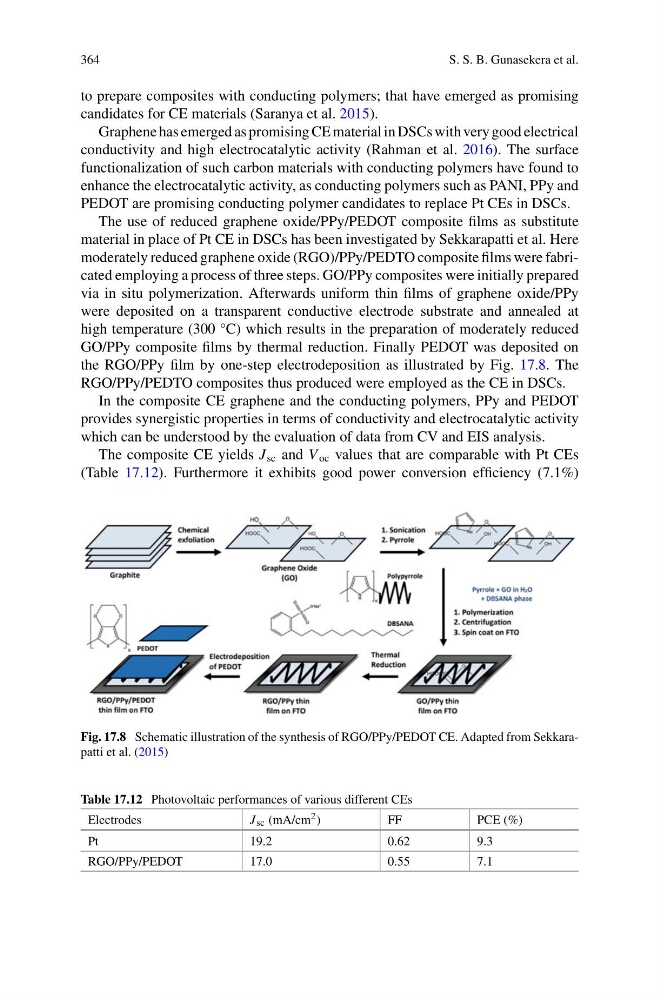
moderately reduced graphene oxide (RGO)/PPy/PEDTO composite films were fabricated employing a process of three steps. GO/PPy composites were initially prepared
via in situ polymerization. Afterwards uniform thin films of graphene oxide/PPy
were deposited on a transparent conductive electrode substrate and annealed at
high temperature (300 °C) which results in the preparation of moderately reduced
GO/PPy composite films by thermal reduction. Finally PEDOT was deposited on
the RGO/PPy film by one-step electrodeposition as illustrated by Fig. 17.8. The
RGO/PPy/PEDTO composites thus produced were employed as the CE in DSCs.
In the composite CE graphene and the conducting polymers, PPy and PEDOT
provides synergistic properties in terms of conductivity and electrocatalytic activity
which can be understood by the evaluation of data from CV and EIS analysis.
The composite CE yields J sc and V oc values that are comparable with Pt CEs
(Table 17.12). Furthermore it exhibits good power conversion efficiency (7.1%)
Fig. 17.8 Schematic illustration of the synthesis of RGO/PPy/PEDOT CE. Adapted from Sekkarapatti et al. (2015)
Table 17.12 Photovoltaic performances of various different CEs
Electrodes
J sc (mA/cm 2 )
FF
PCE (%)
Pt
19.2
0.62
9.3
RGO/PPy/PEDOT
17.0
0.55
7.1
S. S. B. Gunasekera et al.
to prepare composites with conducting polymers; that have emerged as promising
candidates for CE materials (Saranya et al. 2015).
Graphene has emerged as promising CE material in DSCs with very good electrical
conductivity and high electrocatalytic activity (Rahman et al. 2016). The surface
functionalization of such carbon materials with conducting polymers have found to
enhance the electrocatalytic activity, as conducting polymers such as PANI, PPy and
PEDOT are promising conducting polymer candidates to replace Pt CEs in DSCs.
The use of reduced graphene oxide/PPy/PEDOT composite films as substitute
material in place of Pt CE in DSCs has been investigated by Sekkarapatti et al. Here
moderately reduced graphene oxide (RGO)/PPy/PEDTO composite films were fabricated employing a process of three steps. GO/PPy composites were initially prepared
via in situ polymerization. Afterwards uniform thin films of graphene oxide/PPy
were deposited on a transparent conductive electrode substrate and annealed at
high temperature (300 °C) which results in the preparation of moderately reduced
GO/PPy composite films by thermal reduction. Finally PEDOT was deposited on
the RGO/PPy film by one-step electrodeposition as illustrated by Fig. 17.8. The
RGO/PPy/PEDTO composites thus produced were employed as the CE in DSCs.
In the composite CE graphene and the conducting polymers, PPy and PEDOT
provides synergistic properties in terms of conductivity and electrocatalytic activity
which can be understood by the evaluation of data from CV and EIS analysis.
The composite CE yields J sc and V oc values that are comparable with Pt CEs
(Table 17.12). Furthermore it exhibits good power conversion efficiency (7.1%)
Fig. 17.8 Schematic illustration of the synthesis of RGO/PPy/PEDOT CE. Adapted from Sekkarapatti et al. (2015)
Table 17.12 Photovoltaic performances of various different CEs
Electrodes
J sc (mA/cm 2 )
FF
PCE (%)
Pt
19.2
0.62
9.3
RGO/PPy/PEDOT
17.0
0.55
7.1