

17 Conducting Polymers as Cost Effective Counter Electrode …
365
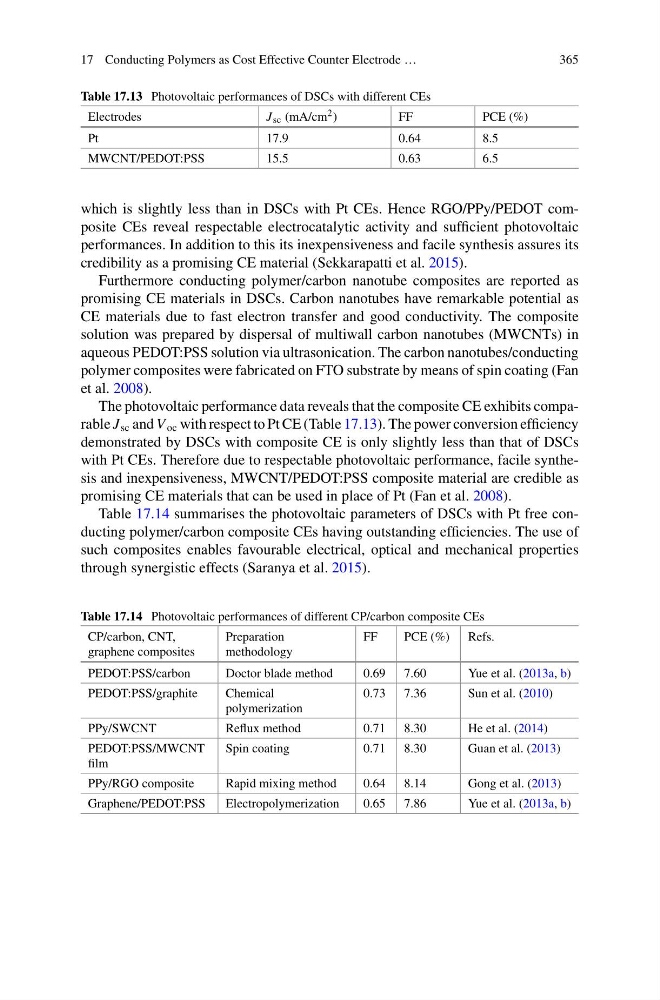
Table 17.13 Photovoltaic performances of DSCs with different CEs
Electrodes
J sc (mA/cm 2 )
FF
PCE (%)
Pt
17.9
0.64
8.5
MWCNT/PEDOT:PSS
15.5
0.63
6.5
which is slightly less than in DSCs with Pt CEs. Hence RGO/PPy/PEDOT composite CEs reveal respectable electrocatalytic activity and sufficient photovoltaic
performances. In addition to this its inexpensiveness and facile synthesis assures its
credibility as a promising CE material (Sekkarapatti et al. 2015).
Furthermore conducting polymer/carbon nanotube composites are reported as
promising CE materials in DSCs. Carbon nanotubes have remarkable potential as
CE materials due to fast electron transfer and good conductivity. The composite
solution was prepared by dispersal of multiwall carbon nanotubes (MWCNTs) in
aqueous PEDOT:PSS solution via ultrasonication. The carbon nanotubes/conducting
polymer composites were fabricated on FTO substrate by means of spin coating (Fan
et al. 2008).
The photovoltaic performance data reveals that the composite CE exhibits comparable J sc and V oc with respect to Pt CE (Table 17.13). The power conversion efficiency
demonstrated by DSCs with composite CE is only slightly less than that of DSCs
with Pt CEs. Therefore due to respectable photovoltaic performance, facile synthesis and inexpensiveness, MWCNT/PEDOT:PSS composite material are credible as
promising CE materials that can be used in place of Pt (Fan et al. 2008).
Table 17.14 summarises the photovoltaic parameters of DSCs with Pt free conducting polymer/carbon composite CEs having outstanding efficiencies. The use of
such composites enables favourable electrical, optical and mechanical properties
through synergistic effects (Saranya et al. 2015).
Table 17.14 Photovoltaic performances of different CP/carbon composite CEs
CP/carbon, CNT,
graphene composites
Preparation
methodology
FF
PCE (%) Refs.
PEDOT:PSS/carbon
Doctor blade method
0.69 7.60
Yue et al. (2013a, b)
PEDOT:PSS/graphite
Chemical
polymerization
0.73 7.36
Sun et al. (2010)
PPy/SWCNT
Reflux method
0.71 8.30
He et al. (2014)
PEDOT:PSS/MWCNT
film
Spin coating
0.71 8.30
Guan et al. (2013)
PPy/RGO composite
Rapid mixing method
0.64 8.14
Gong et al. (2013)
Graphene/PEDOT:PSS
Electropolymerization
0.65 7.86
Yue et al. (2013a, b)
365
Table 17.13 Photovoltaic performances of DSCs with different CEs
Electrodes
J sc (mA/cm 2 )
FF
PCE (%)
Pt
17.9
0.64
8.5
MWCNT/PEDOT:PSS
15.5
0.63
6.5
which is slightly less than in DSCs with Pt CEs. Hence RGO/PPy/PEDOT composite CEs reveal respectable electrocatalytic activity and sufficient photovoltaic
performances. In addition to this its inexpensiveness and facile synthesis assures its
credibility as a promising CE material (Sekkarapatti et al. 2015).
Furthermore conducting polymer/carbon nanotube composites are reported as
promising CE materials in DSCs. Carbon nanotubes have remarkable potential as
CE materials due to fast electron transfer and good conductivity. The composite
solution was prepared by dispersal of multiwall carbon nanotubes (MWCNTs) in
aqueous PEDOT:PSS solution via ultrasonication. The carbon nanotubes/conducting
polymer composites were fabricated on FTO substrate by means of spin coating (Fan
et al. 2008).
The photovoltaic performance data reveals that the composite CE exhibits comparable J sc and V oc with respect to Pt CE (Table 17.13). The power conversion efficiency
demonstrated by DSCs with composite CE is only slightly less than that of DSCs
with Pt CEs. Therefore due to respectable photovoltaic performance, facile synthesis and inexpensiveness, MWCNT/PEDOT:PSS composite material are credible as
promising CE materials that can be used in place of Pt (Fan et al. 2008).
Table 17.14 summarises the photovoltaic parameters of DSCs with Pt free conducting polymer/carbon composite CEs having outstanding efficiencies. The use of
such composites enables favourable electrical, optical and mechanical properties
through synergistic effects (Saranya et al. 2015).
Table 17.14 Photovoltaic performances of different CP/carbon composite CEs
CP/carbon, CNT,
graphene composites
Preparation
methodology
FF
PCE (%) Refs.
PEDOT:PSS/carbon
Doctor blade method
0.69 7.60
Yue et al. (2013a, b)
PEDOT:PSS/graphite
Chemical
polymerization
0.73 7.36
Sun et al. (2010)
PPy/SWCNT
Reflux method
0.71 8.30
He et al. (2014)
PEDOT:PSS/MWCNT
film
Spin coating
0.71 8.30
Guan et al. (2013)
PPy/RGO composite
Rapid mixing method
0.64 8.14
Gong et al. (2013)
Graphene/PEDOT:PSS
Electropolymerization
0.65 7.86
Yue et al. (2013a, b)