

17 Conducting Polymers as Cost Effective Counter Electrode …
361
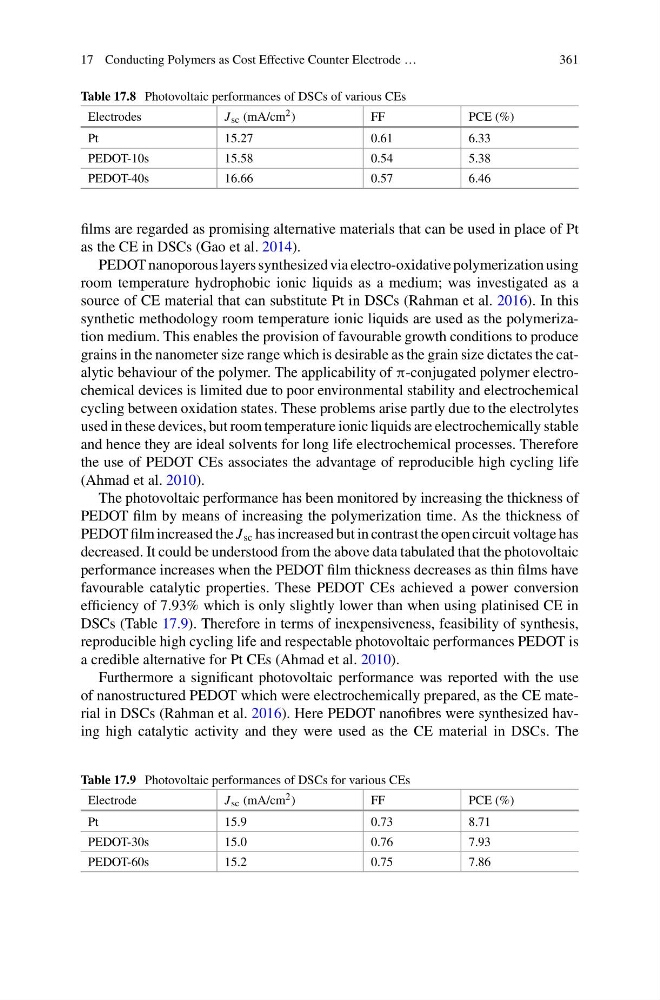
Table 17.8 Photovoltaic performances of DSCs of various CEs
Electrodes
J sc (mA/cm 2 )
FF
PCE (%)
Pt
15.27
0.61
6.33
PEDOT-10s
15.58
0.54
5.38
PEDOT-40s
16.66
0.57
6.46
films are regarded as promising alternative materials that can be used in place of Pt
as the CE in DSCs (Gao et al. 2014).
PEDOT nanoporous layers synthesized via electro-oxidative polymerization using
room temperature hydrophobic ionic liquids as a medium; was investigated as a
source of CE material that can substitute Pt in DSCs (Rahman et al. 2016). In this
synthetic methodology room temperature ionic liquids are used as the polymerization medium. This enables the provision of favourable growth conditions to produce
grains in the nanometer size range which is desirable as the grain size dictates the catalytic behaviour of the polymer. The applicability of π-conjugated polymer electrochemical devices is limited due to poor environmental stability and electrochemical
cycling between oxidation states. These problems arise partly due to the electrolytes
used in these devices, but room temperature ionic liquids are electrochemically stable
and hence they are ideal solvents for long life electrochemical processes. Therefore
the use of PEDOT CEs associates the advantage of reproducible high cycling life
(Ahmad et al. 2010).
The photovoltaic performance has been monitored by increasing the thickness of
PEDOT film by means of increasing the polymerization time. As the thickness of
PEDOT film increased the J sc has increased but in contrast the open circuit voltage has
decreased. It could be understood from the above data tabulated that the photovoltaic
performance increases when the PEDOT film thickness decreases as thin films have
favourable catalytic properties. These PEDOT CEs achieved a power conversion
efficiency of 7.93% which is only slightly lower than when using platinised CE in
DSCs (Table 17.9). Therefore in terms of inexpensiveness, feasibility of synthesis,
reproducible high cycling life and respectable photovoltaic performances PEDOT is
a credible alternative for Pt CEs (Ahmad et al. 2010).
Furthermore a significant photovoltaic performance was reported with the use
of nanostructured PEDOT which were electrochemically prepared, as the CE material in DSCs (Rahman et al. 2016). Here PEDOT nanofibres were synthesized having high catalytic activity and they were used as the CE material in DSCs. The
Table 17.9 Photovoltaic performances of DSCs for various CEs
Electrode
J sc (mA/cm 2 )
FF
PCE (%)
Pt
15.9
0.73
8.71
PEDOT-30s
15.0
0.76
7.93
PEDOT-60s
15.2
0.75
7.86
361
Table 17.8 Photovoltaic performances of DSCs of various CEs
Electrodes
J sc (mA/cm 2 )
FF
PCE (%)
Pt
15.27
0.61
6.33
PEDOT-10s
15.58
0.54
5.38
PEDOT-40s
16.66
0.57
6.46
films are regarded as promising alternative materials that can be used in place of Pt
as the CE in DSCs (Gao et al. 2014).
PEDOT nanoporous layers synthesized via electro-oxidative polymerization using
room temperature hydrophobic ionic liquids as a medium; was investigated as a
source of CE material that can substitute Pt in DSCs (Rahman et al. 2016). In this
synthetic methodology room temperature ionic liquids are used as the polymerization medium. This enables the provision of favourable growth conditions to produce
grains in the nanometer size range which is desirable as the grain size dictates the catalytic behaviour of the polymer. The applicability of π-conjugated polymer electrochemical devices is limited due to poor environmental stability and electrochemical
cycling between oxidation states. These problems arise partly due to the electrolytes
used in these devices, but room temperature ionic liquids are electrochemically stable
and hence they are ideal solvents for long life electrochemical processes. Therefore
the use of PEDOT CEs associates the advantage of reproducible high cycling life
(Ahmad et al. 2010).
The photovoltaic performance has been monitored by increasing the thickness of
PEDOT film by means of increasing the polymerization time. As the thickness of
PEDOT film increased the J sc has increased but in contrast the open circuit voltage has
decreased. It could be understood from the above data tabulated that the photovoltaic
performance increases when the PEDOT film thickness decreases as thin films have
favourable catalytic properties. These PEDOT CEs achieved a power conversion
efficiency of 7.93% which is only slightly lower than when using platinised CE in
DSCs (Table 17.9). Therefore in terms of inexpensiveness, feasibility of synthesis,
reproducible high cycling life and respectable photovoltaic performances PEDOT is
a credible alternative for Pt CEs (Ahmad et al. 2010).
Furthermore a significant photovoltaic performance was reported with the use
of nanostructured PEDOT which were electrochemically prepared, as the CE material in DSCs (Rahman et al. 2016). Here PEDOT nanofibres were synthesized having high catalytic activity and they were used as the CE material in DSCs. The
Table 17.9 Photovoltaic performances of DSCs for various CEs
Electrode
J sc (mA/cm 2 )
FF
PCE (%)
Pt
15.9
0.73
8.71
PEDOT-30s
15.0
0.76
7.93
PEDOT-60s
15.2
0.75
7.86