

360
S. S. B. Gunasekera et al.
tend to yield comparatively lower efficiencies associated with higher R ct and lower
conductivity (Saranya et al. 2015). But despite the lower efficiencies relative to Pt
CEs its applicability as a CE material is preferred due to cost effectiveness and facile
synthesis.
17.2.3 Poly(3,4-Ethylenedioxythiophene)/(PEDOT) as a CE
in DSCs
PEDOT is another type of conducting polymer which is extensively studied as a
substitute for Pt CE material. It is an efficient catalyst in DSCs due to its nanoporous
structure, high conductivity at room temperature, electrochemical reversibility and
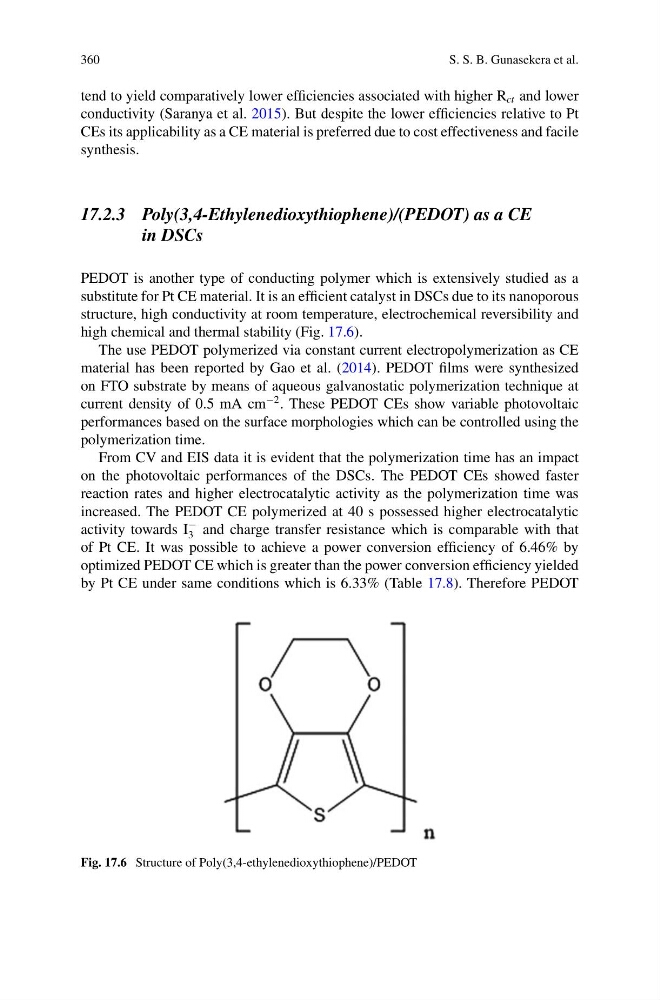
high chemical and thermal stability (Fig. 17.6).
The use PEDOT polymerized via constant current electropolymerization as CE
material has been reported by Gao et al. (2014). PEDOT films were synthesized
on FTO substrate by means of aqueous galvanostatic polymerization technique at
current density of 0.5 mA cm
−2 . These PEDOT CEs show variable photovoltaic
performances based on the surface morphologies which can be controlled using the
polymerization time.
From CV and EIS data it is evident that the polymerization time has an impact
on the photovoltaic performances of the DSCs. The PEDOT CEs showed faster
reaction rates and higher electrocatalytic activity as the polymerization time was
increased. The PEDOT CE polymerized at 40 s possessed higher electrocatalytic
activity towards I
−
3 and charge transfer resistance which is comparable with that
of Pt CE. It was possible to achieve a power conversion efficiency of 6.46% by
optimized PEDOT CE which is greater than the power conversion efficiency yielded
by Pt CE under same conditions which is 6.33% (Table 17.8). Therefore PEDOT
Fig. 17.6 Structure of Poly(3,4-ethylenedioxythiophene)/PEDOT
S. S. B. Gunasekera et al.
tend to yield comparatively lower efficiencies associated with higher R ct and lower
conductivity (Saranya et al. 2015). But despite the lower efficiencies relative to Pt
CEs its applicability as a CE material is preferred due to cost effectiveness and facile
synthesis.
17.2.3 Poly(3,4-Ethylenedioxythiophene)/(PEDOT) as a CE
in DSCs
PEDOT is another type of conducting polymer which is extensively studied as a
substitute for Pt CE material. It is an efficient catalyst in DSCs due to its nanoporous
structure, high conductivity at room temperature, electrochemical reversibility and
high chemical and thermal stability (Fig. 17.6).
The use PEDOT polymerized via constant current electropolymerization as CE
material has been reported by Gao et al. (2014). PEDOT films were synthesized
on FTO substrate by means of aqueous galvanostatic polymerization technique at
current density of 0.5 mA cm
−2 . These PEDOT CEs show variable photovoltaic
performances based on the surface morphologies which can be controlled using the
polymerization time.
From CV and EIS data it is evident that the polymerization time has an impact
on the photovoltaic performances of the DSCs. The PEDOT CEs showed faster
reaction rates and higher electrocatalytic activity as the polymerization time was
increased. The PEDOT CE polymerized at 40 s possessed higher electrocatalytic
activity towards I
−
3 and charge transfer resistance which is comparable with that
of Pt CE. It was possible to achieve a power conversion efficiency of 6.46% by
optimized PEDOT CE which is greater than the power conversion efficiency yielded
by Pt CE under same conditions which is 6.33% (Table 17.8). Therefore PEDOT
Fig. 17.6 Structure of Poly(3,4-ethylenedioxythiophene)/PEDOT