

17 Conducting Polymers as Cost Effective Counter Electrode …
359
facile synthesis and most importantly the ability to prepare flexible DSCs consisting
of FTO free CEs (Peng et al 2013).
Therefore it is possible to understand that PPy is a credible substitute material
for Pt as the CE in DSCs and the performance of PPy based CEs depends on factors
such as method of polymer synthesis and conditions, type of dopant anions, type of
oxidant species used and film morphology (Peng et al. 2013).
Furthermore the use of PPy CEs in quasi solid state DSCs has been investigated
by Makris et al. Quasi-solid state DSCs have been constructed using nanocrystalline
titania, ureasil based nanoconposite gel electrolyte and PPy functionalized CE. PPy
was electrodeposited on FTO substrate under potentiostatic conditions using the
pyrrole precursor monomer in aqueous medium thus synthesizing PPy functionalized
CE.
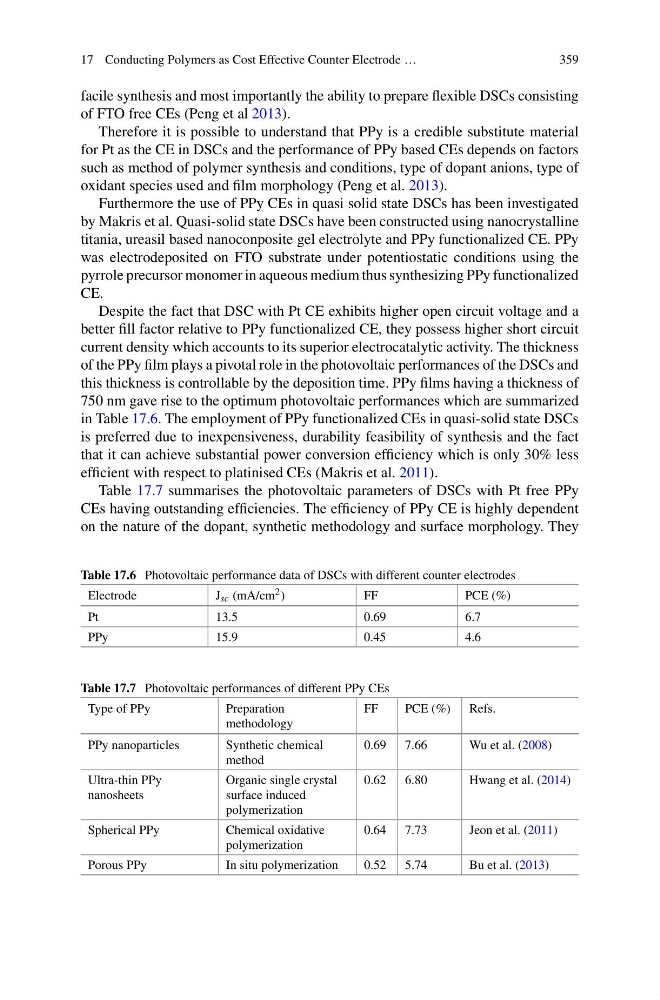
Despite the fact that DSC with Pt CE exhibits higher open circuit voltage and a
better fill factor relative to PPy functionalized CE, they possess higher short circuit
current density which accounts to its superior electrocatalytic activity. The thickness
of the PPy film plays a pivotal role in the photovoltaic performances of the DSCs and
this thickness is controllable by the deposition time. PPy films having a thickness of
750 nm gave rise to the optimum photovoltaic performances which are summarized
in Table 17.6. The employment of PPy functionalized CEs in quasi-solid state DSCs
is preferred due to inexpensiveness, durability feasibility of synthesis and the fact
that it can achieve substantial power conversion efficiency which is only 30% less
efficient with respect to platinised CEs (Makris et al. 2011).
Table 17.7 summarises the photovoltaic parameters of DSCs with Pt free PPy
CEs having outstanding efficiencies. The efficiency of PPy CE is highly dependent
on the nature of the dopant, synthetic methodology and surface morphology. They
Table 17.6 Photovoltaic performance data of DSCs with different counter electrodes
Electrode
J sc (mA/cm 2 )
FF
PCE (%)
Pt
13.5
0.69
6.7
PPy
15.9
0.45
4.6
Table 17.7 Photovoltaic performances of different PPy CEs
Type of PPy
Preparation
methodology
FF
PCE (%) Refs.
PPy nanoparticles
Synthetic chemical
method
0.69 7.66
Wu et al. (2008)
Ultra-thin PPy
nanosheets
Organic single crystal
surface induced
polymerization
0.62 6.80
Hwang et al. (2014)
Spherical PPy
Chemical oxidative
polymerization
0.64 7.73
Jeon et al. (2011)
Porous PPy
In situ polymerization
0.52 5.74
Bu et al. (2013)
359
facile synthesis and most importantly the ability to prepare flexible DSCs consisting
of FTO free CEs (Peng et al 2013).
Therefore it is possible to understand that PPy is a credible substitute material
for Pt as the CE in DSCs and the performance of PPy based CEs depends on factors
such as method of polymer synthesis and conditions, type of dopant anions, type of
oxidant species used and film morphology (Peng et al. 2013).
Furthermore the use of PPy CEs in quasi solid state DSCs has been investigated
by Makris et al. Quasi-solid state DSCs have been constructed using nanocrystalline
titania, ureasil based nanoconposite gel electrolyte and PPy functionalized CE. PPy
was electrodeposited on FTO substrate under potentiostatic conditions using the
pyrrole precursor monomer in aqueous medium thus synthesizing PPy functionalized
CE.
Despite the fact that DSC with Pt CE exhibits higher open circuit voltage and a
better fill factor relative to PPy functionalized CE, they possess higher short circuit
current density which accounts to its superior electrocatalytic activity. The thickness
of the PPy film plays a pivotal role in the photovoltaic performances of the DSCs and
this thickness is controllable by the deposition time. PPy films having a thickness of
750 nm gave rise to the optimum photovoltaic performances which are summarized
in Table 17.6. The employment of PPy functionalized CEs in quasi-solid state DSCs
is preferred due to inexpensiveness, durability feasibility of synthesis and the fact
that it can achieve substantial power conversion efficiency which is only 30% less
efficient with respect to platinised CEs (Makris et al. 2011).
Table 17.7 summarises the photovoltaic parameters of DSCs with Pt free PPy
CEs having outstanding efficiencies. The efficiency of PPy CE is highly dependent
on the nature of the dopant, synthetic methodology and surface morphology. They
Table 17.6 Photovoltaic performance data of DSCs with different counter electrodes
Electrode
J sc (mA/cm 2 )
FF
PCE (%)
Pt
13.5
0.69
6.7
PPy
15.9
0.45
4.6
Table 17.7 Photovoltaic performances of different PPy CEs
Type of PPy
Preparation
methodology
FF
PCE (%) Refs.
PPy nanoparticles
Synthetic chemical
method
0.69 7.66
Wu et al. (2008)
Ultra-thin PPy
nanosheets
Organic single crystal
surface induced
polymerization
0.62 6.80
Hwang et al. (2014)
Spherical PPy
Chemical oxidative
polymerization
0.64 7.73
Jeon et al. (2011)
Porous PPy
In situ polymerization
0.52 5.74
Bu et al. (2013)