

358
S. S. B. Gunasekera et al.
There has been a recorded increase in the power conversion efficiency in VPP-PPy
CEs when the Fe-TsO oxidant concentration is increased from 5% (PCE of 2.8%)
to 20% (PCE of 3.4%). From cyclic voltammetry it has been revealed that VPP-PPy
possess high electrocatalytic activity for I
− /I
−
3 redox system. Despite its lower power
conversion efficiency its substitution of Pt CE is favoured due to its cost effectiveness
and facile synthesis (Xia et al. 2011).
Furthermore traditional electrochemical polymerization methods are employed
to synthesize PPy to be used as a CE in DSCs. The use of potentiostatic mode of
polymerization at 1.2 V (vs. Ag/AgCl) for polymerization of pyrrole in acetonitrile
solution to prepare EP-PPy had been investigated. This enables the synthesis of PPy
particles around the size of 300 nm and assures full coverage of FTO substrate.
PPy CE prepared by electropolymerization exhibits a power conversion efficiency
of 3.2% which is comparable with regard to optimized VPP-PPy CE’s power conversion efficiency. Although its power conversion efficiency is less than that of Pt
CE material they show good catalytic behaviour with respectable J sc . In terms of
electropolymerization the use of bulky sized inert doping anions such as ClO
−
4 are
preferred in the preparation of PPy, due to their high mobility which contributes to
achieve high current density. In addition to its respectable photovoltaic performances;
feasibility of electropolymerization synthesis and inexpensiveness contributes to the
credibility of EP-PPy as a substitute material for CEs (Xia et al. 2011).
The use of novel self-assembled PPy nanotube membrane as CE material in Pt-free
DSCs has been reported by Peng et al. (2013). Free standing paper like membranes
composed of PPy nanotubes have been synthesized and used to prepare FTO and
Pt free CEs. Usually PPy CE is fabricated by deposition of the polymer on FTO
substrate and in situ polymerization and both these methods require FTO substrate.
This method allows the preparation of FTO free CEs consisting of PPy nanofibres
only, hence flexible DSCs with considerable mechanical properties. This facile synthetic methodology involves heating of pulp like homogenous suspensions at low
temperature followed by doping in HCl solution. Finally the PPy nanotubes allowed
to self-assemble into paper like flexible PPy membranes under a vacuum atmosphere
at high temperature (Rahman et al. 2016).
The high surface area of the PPy nanofibres and good electrolyte penetration in
the poriferous PPy membrane contributes to the respectable electrocatalytic activity
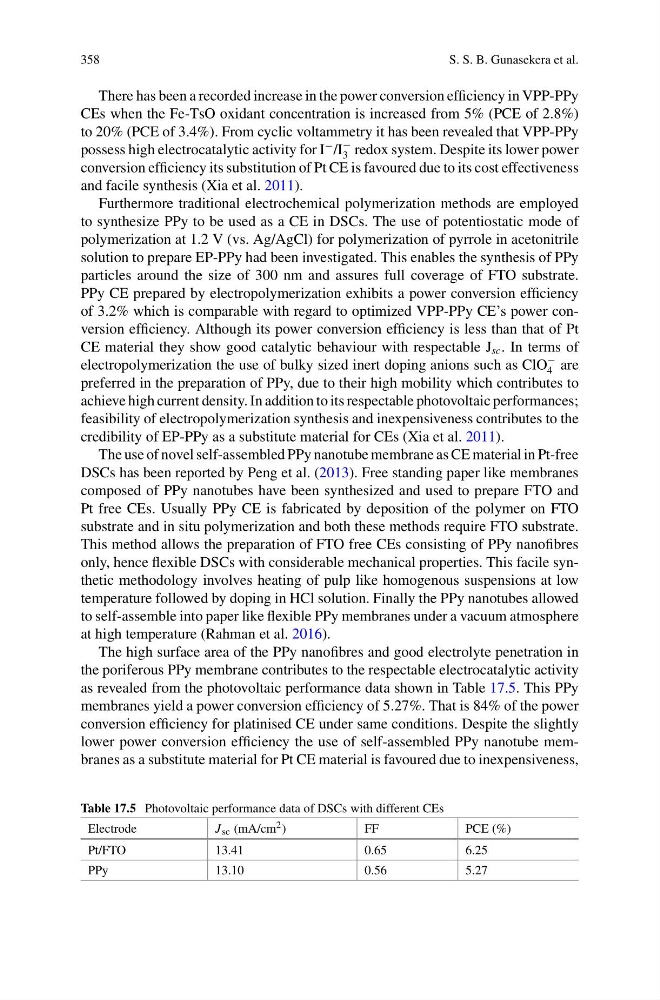
as revealed from the photovoltaic performance data shown in Table 17.5. This PPy
membranes yield a power conversion efficiency of 5.27%. That is 84% of the power
conversion efficiency for platinised CE under same conditions. Despite the slightly
lower power conversion efficiency the use of self-assembled PPy nanotube membranes as a substitute material for Pt CE material is favoured due to inexpensiveness,
Table 17.5 Photovoltaic performance data of DSCs with different CEs
Electrode
J sc (mA/cm 2 )
FF
PCE (%)
Pt/FTO
13.41
0.65
6.25
PPy
13.10
0.56
5.27
S. S. B. Gunasekera et al.
There has been a recorded increase in the power conversion efficiency in VPP-PPy
CEs when the Fe-TsO oxidant concentration is increased from 5% (PCE of 2.8%)
to 20% (PCE of 3.4%). From cyclic voltammetry it has been revealed that VPP-PPy
possess high electrocatalytic activity for I
− /I
−
3 redox system. Despite its lower power
conversion efficiency its substitution of Pt CE is favoured due to its cost effectiveness
and facile synthesis (Xia et al. 2011).
Furthermore traditional electrochemical polymerization methods are employed
to synthesize PPy to be used as a CE in DSCs. The use of potentiostatic mode of
polymerization at 1.2 V (vs. Ag/AgCl) for polymerization of pyrrole in acetonitrile
solution to prepare EP-PPy had been investigated. This enables the synthesis of PPy
particles around the size of 300 nm and assures full coverage of FTO substrate.
PPy CE prepared by electropolymerization exhibits a power conversion efficiency
of 3.2% which is comparable with regard to optimized VPP-PPy CE’s power conversion efficiency. Although its power conversion efficiency is less than that of Pt
CE material they show good catalytic behaviour with respectable J sc . In terms of
electropolymerization the use of bulky sized inert doping anions such as ClO
−
4 are
preferred in the preparation of PPy, due to their high mobility which contributes to
achieve high current density. In addition to its respectable photovoltaic performances;
feasibility of electropolymerization synthesis and inexpensiveness contributes to the
credibility of EP-PPy as a substitute material for CEs (Xia et al. 2011).
The use of novel self-assembled PPy nanotube membrane as CE material in Pt-free
DSCs has been reported by Peng et al. (2013). Free standing paper like membranes
composed of PPy nanotubes have been synthesized and used to prepare FTO and
Pt free CEs. Usually PPy CE is fabricated by deposition of the polymer on FTO
substrate and in situ polymerization and both these methods require FTO substrate.
This method allows the preparation of FTO free CEs consisting of PPy nanofibres
only, hence flexible DSCs with considerable mechanical properties. This facile synthetic methodology involves heating of pulp like homogenous suspensions at low
temperature followed by doping in HCl solution. Finally the PPy nanotubes allowed
to self-assemble into paper like flexible PPy membranes under a vacuum atmosphere
at high temperature (Rahman et al. 2016).
The high surface area of the PPy nanofibres and good electrolyte penetration in
the poriferous PPy membrane contributes to the respectable electrocatalytic activity
as revealed from the photovoltaic performance data shown in Table 17.5. This PPy
membranes yield a power conversion efficiency of 5.27%. That is 84% of the power
conversion efficiency for platinised CE under same conditions. Despite the slightly
lower power conversion efficiency the use of self-assembled PPy nanotube membranes as a substitute material for Pt CE material is favoured due to inexpensiveness,
Table 17.5 Photovoltaic performance data of DSCs with different CEs
Electrode
J sc (mA/cm 2 )
FF
PCE (%)
Pt/FTO
13.41
0.65
6.25
PPy
13.10
0.56
5.27