

17 Conducting Polymers as Cost Effective Counter Electrode …
357
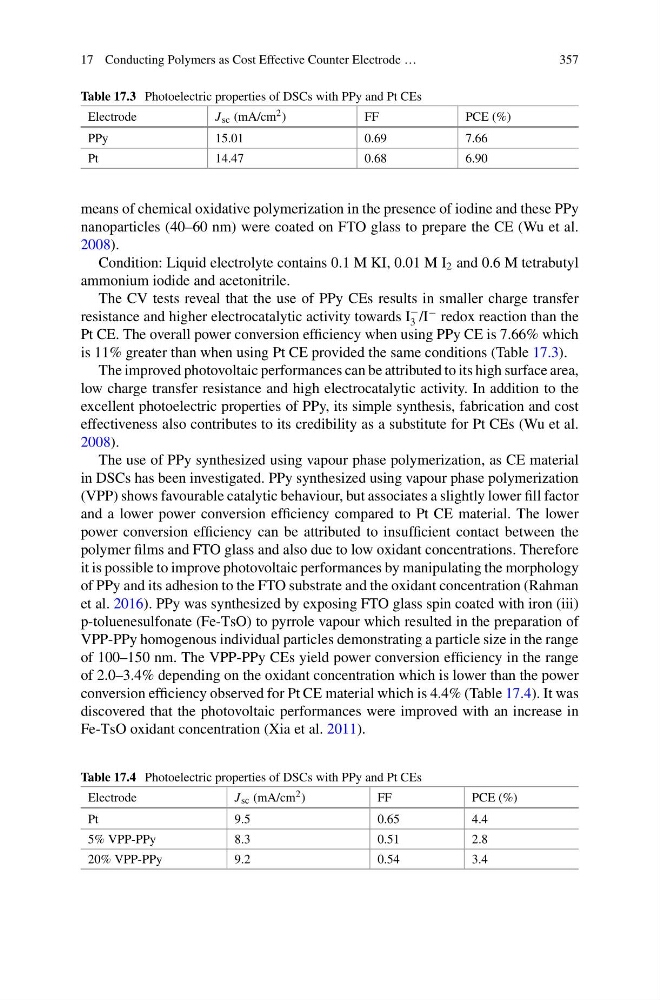
Table 17.3 Photoelectric properties of DSCs with PPy and Pt CEs
Electrode
J sc (mA/cm 2 )
FF
PCE (%)
PPy
15.01
0.69
7.66
Pt
14.47
0.68
6.90
means of chemical oxidative polymerization in the presence of iodine and these PPy
nanoparticles (40–60 nm) were coated on FTO glass to prepare the CE (Wu et al.
2008).
Condition: Liquid electrolyte contains 0.1 M KI, 0.01 M I 2 and 0.6 M tetrabutyl
ammonium iodide and acetonitrile.
The CV tests reveal that the use of PPy CEs results in smaller charge transfer
resistance and higher electrocatalytic activity towards I
−
3 /I
− redox reaction than the
Pt CE. The overall power conversion efficiency when using PPy CE is 7.66% which
is 11% greater than when using Pt CE provided the same conditions (Table 17.3).
The improved photovoltaic performances can be attributed to its high surface area,
low charge transfer resistance and high electrocatalytic activity. In addition to the
excellent photoelectric properties of PPy, its simple synthesis, fabrication and cost
effectiveness also contributes to its credibility as a substitute for Pt CEs (Wu et al.
2008).
The use of PPy synthesized using vapour phase polymerization, as CE material
in DSCs has been investigated. PPy synthesized using vapour phase polymerization
(VPP) shows favourable catalytic behaviour, but associates a slightly lower fill factor
and a lower power conversion efficiency compared to Pt CE material. The lower
power conversion efficiency can be attributed to insufficient contact between the
polymer films and FTO glass and also due to low oxidant concentrations. Therefore
it is possible to improve photovoltaic performances by manipulating the morphology
of PPy and its adhesion to the FTO substrate and the oxidant concentration (Rahman
et al. 2016). PPy was synthesized by exposing FTO glass spin coated with iron (iii)
p-toluenesulfonate (Fe-TsO) to pyrrole vapour which resulted in the preparation of
VPP-PPy homogenous individual particles demonstrating a particle size in the range
of 100–150 nm. The VPP-PPy CEs yield power conversion efficiency in the range
of 2.0–3.4% depending on the oxidant concentration which is lower than the power
conversion efficiency observed for Pt CE material which is 4.4% (Table 17.4). It was
discovered that the photovoltaic performances were improved with an increase in
Fe-TsO oxidant concentration (Xia et al. 2011).
Table 17.4 Photoelectric properties of DSCs with PPy and Pt CEs
Electrode
J sc (mA/cm 2 )
FF
PCE (%)
Pt
9.5
0.65
4.4
5% VPP-PPy
8.3
0.51
2.8
20% VPP-PPy
9.2
0.54
3.4
357
Table 17.3 Photoelectric properties of DSCs with PPy and Pt CEs
Electrode
J sc (mA/cm 2 )
FF
PCE (%)
PPy
15.01
0.69
7.66
Pt
14.47
0.68
6.90
means of chemical oxidative polymerization in the presence of iodine and these PPy
nanoparticles (40–60 nm) were coated on FTO glass to prepare the CE (Wu et al.
2008).
Condition: Liquid electrolyte contains 0.1 M KI, 0.01 M I 2 and 0.6 M tetrabutyl
ammonium iodide and acetonitrile.
The CV tests reveal that the use of PPy CEs results in smaller charge transfer
resistance and higher electrocatalytic activity towards I
−
3 /I
− redox reaction than the
Pt CE. The overall power conversion efficiency when using PPy CE is 7.66% which
is 11% greater than when using Pt CE provided the same conditions (Table 17.3).
The improved photovoltaic performances can be attributed to its high surface area,
low charge transfer resistance and high electrocatalytic activity. In addition to the
excellent photoelectric properties of PPy, its simple synthesis, fabrication and cost
effectiveness also contributes to its credibility as a substitute for Pt CEs (Wu et al.
2008).
The use of PPy synthesized using vapour phase polymerization, as CE material
in DSCs has been investigated. PPy synthesized using vapour phase polymerization
(VPP) shows favourable catalytic behaviour, but associates a slightly lower fill factor
and a lower power conversion efficiency compared to Pt CE material. The lower
power conversion efficiency can be attributed to insufficient contact between the
polymer films and FTO glass and also due to low oxidant concentrations. Therefore
it is possible to improve photovoltaic performances by manipulating the morphology
of PPy and its adhesion to the FTO substrate and the oxidant concentration (Rahman
et al. 2016). PPy was synthesized by exposing FTO glass spin coated with iron (iii)
p-toluenesulfonate (Fe-TsO) to pyrrole vapour which resulted in the preparation of
VPP-PPy homogenous individual particles demonstrating a particle size in the range
of 100–150 nm. The VPP-PPy CEs yield power conversion efficiency in the range
of 2.0–3.4% depending on the oxidant concentration which is lower than the power
conversion efficiency observed for Pt CE material which is 4.4% (Table 17.4). It was
discovered that the photovoltaic performances were improved with an increase in
Fe-TsO oxidant concentration (Xia et al. 2011).
Table 17.4 Photoelectric properties of DSCs with PPy and Pt CEs
Electrode
J sc (mA/cm 2 )
FF
PCE (%)
Pt
9.5
0.65
4.4
5% VPP-PPy
8.3
0.51
2.8
20% VPP-PPy
9.2
0.54
3.4