

356
S. S. B. Gunasekera et al.
Table 17.2 Photovoltaic performances of different PANI CEs
Type of PANI
Preparation
methodology
FF
PCE (%)
Refs.
Microporous PANI
Oxidative
polymerization
0.69
7.15
Li et al. (2008)
Transparent PANI
Chemical deposition
0.65
8.35
Wu et al. (2014)
H 2 SO 4 doped PANI
Chemical deposition
0.59
7.30
Xu et al. (2014a, b)
PANI film
Technique employing
Hexafluoro-isopropanol
(HFIP) solution
0.67
8.80
Chiang et al. (2013)
film with appreciable conductivity and surface area. Therefore when considering the
use of dopants in efficiency enhancement, both its ability to enhance conductivity and
act as a pore former increasing surface area; needs to be taken into account (Saranya
et al. 2015).
17.2.2 Polypyrrole (PPy) as a CE in DSCs
PPy is another substitute material that can be used in place of Pt as the CE. Besides its
good mechanical, chemical stability and high conductivity, PPy shows good catalytic
behaviour for I
−
3 reduction when used as the CE but have slightly lower fill factor
and lower power conversion efficiency with regard to Pt CE (Rahman et al. 2016;
MacDiarmid 1997). However by means of controlling the morphology of the PPy
CE it is possible to improve the power conversion efficiency. The use of PPy as
a CE material is also favoured due to simple preparation procedure and low cost
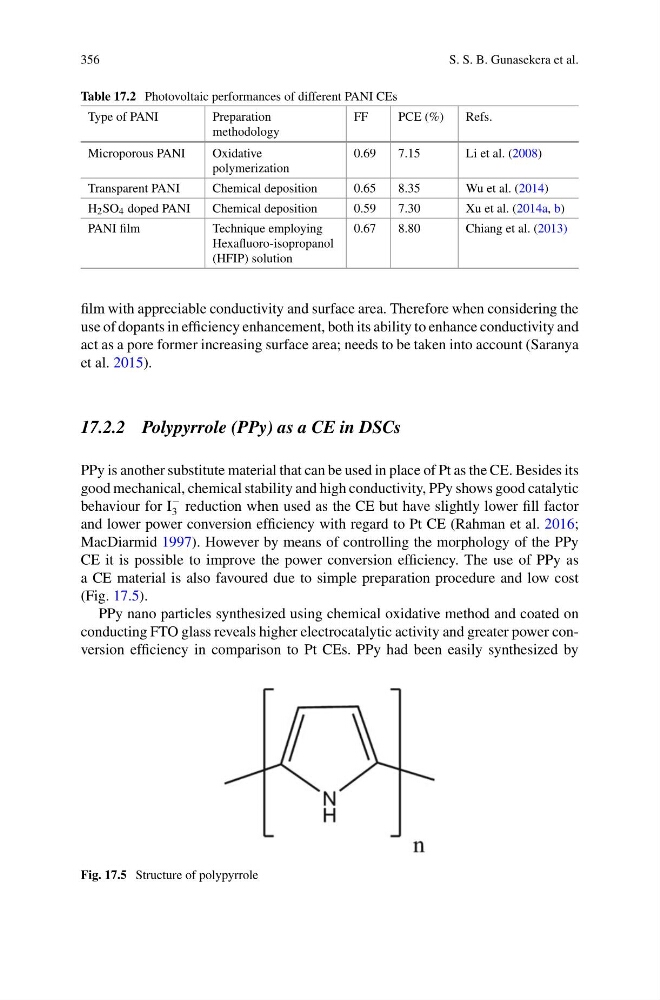
(Fig. 17.5).
PPy nano particles synthesized using chemical oxidative method and coated on
conducting FTO glass reveals higher electrocatalytic activity and greater power conversion efficiency in comparison to Pt CEs. PPy had been easily synthesized by
Fig. 17.5 Structure of polypyrrole
S. S. B. Gunasekera et al.
Table 17.2 Photovoltaic performances of different PANI CEs
Type of PANI
Preparation
methodology
FF
PCE (%)
Refs.
Microporous PANI
Oxidative
polymerization
0.69
7.15
Li et al. (2008)
Transparent PANI
Chemical deposition
0.65
8.35
Wu et al. (2014)
H 2 SO 4 doped PANI
Chemical deposition
0.59
7.30
Xu et al. (2014a, b)
PANI film
Technique employing
Hexafluoro-isopropanol
(HFIP) solution
0.67
8.80
Chiang et al. (2013)
film with appreciable conductivity and surface area. Therefore when considering the
use of dopants in efficiency enhancement, both its ability to enhance conductivity and
act as a pore former increasing surface area; needs to be taken into account (Saranya
et al. 2015).
17.2.2 Polypyrrole (PPy) as a CE in DSCs
PPy is another substitute material that can be used in place of Pt as the CE. Besides its
good mechanical, chemical stability and high conductivity, PPy shows good catalytic
behaviour for I
−
3 reduction when used as the CE but have slightly lower fill factor
and lower power conversion efficiency with regard to Pt CE (Rahman et al. 2016;
MacDiarmid 1997). However by means of controlling the morphology of the PPy
CE it is possible to improve the power conversion efficiency. The use of PPy as
a CE material is also favoured due to simple preparation procedure and low cost
(Fig. 17.5).
PPy nano particles synthesized using chemical oxidative method and coated on
conducting FTO glass reveals higher electrocatalytic activity and greater power conversion efficiency in comparison to Pt CEs. PPy had been easily synthesized by
Fig. 17.5 Structure of polypyrrole