

17 Conducting Polymers as Cost Effective Counter Electrode …
355
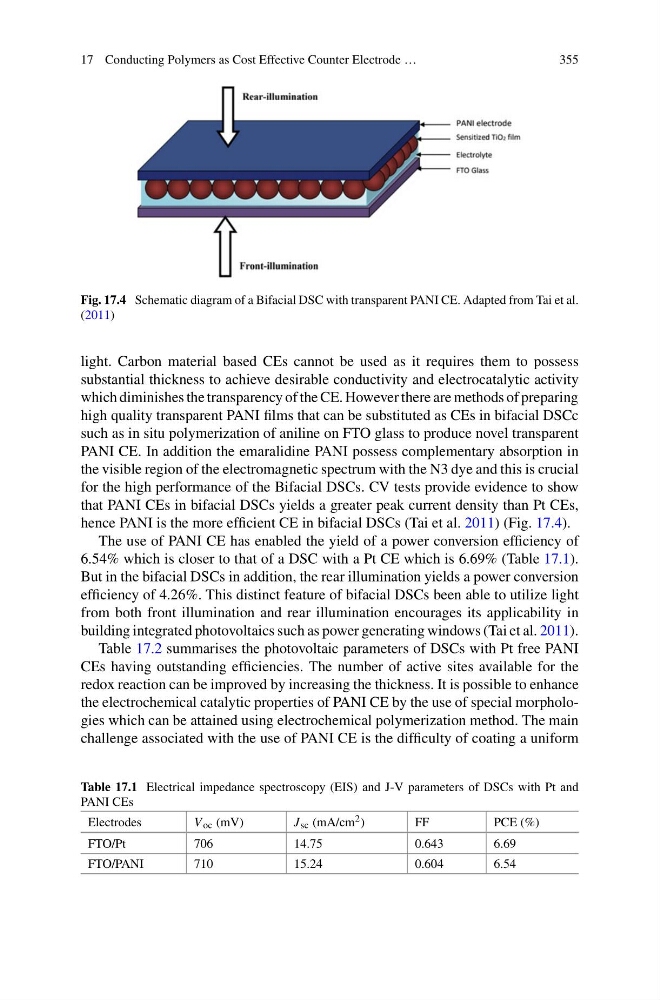
Fig. 17.4 Schematic diagram of a Bifacial DSC with transparent PANI CE. Adapted from Tai et al.
(2011)
light. Carbon material based CEs cannot be used as it requires them to possess
substantial thickness to achieve desirable conductivity and electrocatalytic activity
which diminishes the transparency of the CE. However there are methods of preparing
high quality transparent PANI films that can be substituted as CEs in bifacial DSCc
such as in situ polymerization of aniline on FTO glass to produce novel transparent
PANI CE. In addition the emaralidine PANI possess complementary absorption in
the visible region of the electromagnetic spectrum with the N3 dye and this is crucial
for the high performance of the Bifacial DSCs. CV tests provide evidence to show
that PANI CEs in bifacial DSCs yields a greater peak current density than Pt CEs,
hence PANI is the more efficient CE in bifacial DSCs (Tai et al. 2011) (Fig. 17.4).
The use of PANI CE has enabled the yield of a power conversion efficiency of
6.54% which is closer to that of a DSC with a Pt CE which is 6.69% (Table 17.1).
But in the bifacial DSCs in addition, the rear illumination yields a power conversion
efficiency of 4.26%. This distinct feature of bifacial DSCs been able to utilize light
from both front illumination and rear illumination encourages its applicability in
building integrated photovoltaics such as power generating windows (Tai et al. 2011).
Table 17.2 summarises the photovoltaic parameters of DSCs with Pt free PANI
CEs having outstanding efficiencies. The number of active sites available for the
redox reaction can be improved by increasing the thickness. It is possible to enhance
the electrochemical catalytic properties of PANI CE by the use of special morphologies which can be attained using electrochemical polymerization method. The main
challenge associated with the use of PANI CE is the difficulty of coating a uniform
Table 17.1 Electrical impedance spectroscopy (EIS) and J-V parameters of DSCs with Pt and
PANI CEs
Electrodes
V oc (mV)
J sc (mA/cm 2 )
FF
PCE (%)
FTO/Pt
706
14.75
0.643
6.69
FTO/PANI
710
15.24
0.604
6.54
355
Fig. 17.4 Schematic diagram of a Bifacial DSC with transparent PANI CE. Adapted from Tai et al.
(2011)
light. Carbon material based CEs cannot be used as it requires them to possess
substantial thickness to achieve desirable conductivity and electrocatalytic activity
which diminishes the transparency of the CE. However there are methods of preparing
high quality transparent PANI films that can be substituted as CEs in bifacial DSCc
such as in situ polymerization of aniline on FTO glass to produce novel transparent
PANI CE. In addition the emaralidine PANI possess complementary absorption in
the visible region of the electromagnetic spectrum with the N3 dye and this is crucial
for the high performance of the Bifacial DSCs. CV tests provide evidence to show
that PANI CEs in bifacial DSCs yields a greater peak current density than Pt CEs,
hence PANI is the more efficient CE in bifacial DSCs (Tai et al. 2011) (Fig. 17.4).
The use of PANI CE has enabled the yield of a power conversion efficiency of
6.54% which is closer to that of a DSC with a Pt CE which is 6.69% (Table 17.1).
But in the bifacial DSCs in addition, the rear illumination yields a power conversion
efficiency of 4.26%. This distinct feature of bifacial DSCs been able to utilize light
from both front illumination and rear illumination encourages its applicability in
building integrated photovoltaics such as power generating windows (Tai et al. 2011).
Table 17.2 summarises the photovoltaic parameters of DSCs with Pt free PANI
CEs having outstanding efficiencies. The number of active sites available for the
redox reaction can be improved by increasing the thickness. It is possible to enhance
the electrochemical catalytic properties of PANI CE by the use of special morphologies which can be attained using electrochemical polymerization method. The main
challenge associated with the use of PANI CE is the difficulty of coating a uniform
Table 17.1 Electrical impedance spectroscopy (EIS) and J-V parameters of DSCs with Pt and
PANI CEs
Electrodes
V oc (mV)
J sc (mA/cm 2 )
FF
PCE (%)
FTO/Pt
706
14.75
0.643
6.69
FTO/PANI
710
15.24
0.604
6.54