

326
S. Peiris et al.
A study conducted by Zhu and coworkers has revealed how the bridging ligand
could be modified to develop p-DSCs with a higher performance. Increasing the number of ter-thiophene groups in between triphenylamine and carboxylic acid resulted
in power conversion efficiency of 0.19%, V OC of 144 mV, J SC of 4.01 mA cm
−2 and
FF of 0.33. The author proposed that ter-thiophene groups strongly affect the hole
injection and prevent charge recombination, increasing power conversion efficiency.
The investigators designed hexyl chains on the bridged thiophene rings that could
avoid dye aggregation on the NiO film and block the electrolyte from approaching
the surface of NiO; minimizing recombination between nickel oxide, electrolyte and
semiconductor (Zhu et al. 2014).
It was reported that inclusion of Boradiazaindacene (bodipy) sensitizer is compatible with NiO based p-DSCs (Lefebvre et al. 2014). Bodipy dyes have large
extinction coefficients, tunable absorption properties (i.e. to optically match photoanodes in tandem cells) and electrochemical stability. A further step for the improvement of charge separation has been taken by Lefebvre and coworkers. They have
achieved an increase in charge-separated state lifetime of three orders of magnitude,
by using triphenylamine-donor bodipy-acceptor design (JSC = 3 mA cm
−2 , IPCE
= 28%). The investigators state that further increase of yield and lifetime of the
charge-separated state could be achieved by altering the electronic coupling through
modifying the substituents on the bodipy (Lefebvre et al. 2014).
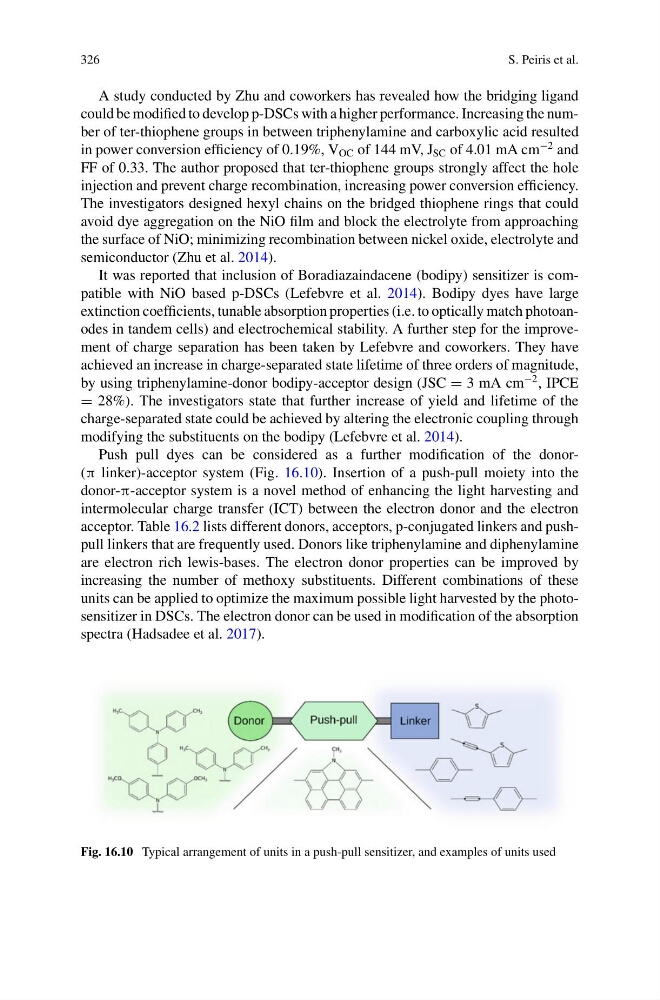
Push pull dyes can be considered as a further modification of the donor(π linker)-acceptor system (Fig. 16.10). Insertion of a push-pull moiety into the
donor-π-acceptor system is a novel method of enhancing the light harvesting and
intermolecular charge transfer (ICT) between the electron donor and the electron
acceptor. Table 16.2 lists different donors, acceptors, p-conjugated linkers and pushpull linkers that are frequently used. Donors like triphenylamine and diphenylamine
are electron rich lewis-bases. The electron donor properties can be improved by
increasing the number of methoxy substituents. Different combinations of these
units can be applied to optimize the maximum possible light harvested by the photosensitizer in DSCs. The electron donor can be used in modification of the absorption
spectra (Hadsadee et al. 2017).
Fig. 16.10 Typical arrangement of units in a push-pull sensitizer, and examples of units used
S. Peiris et al.
A study conducted by Zhu and coworkers has revealed how the bridging ligand
could be modified to develop p-DSCs with a higher performance. Increasing the number of ter-thiophene groups in between triphenylamine and carboxylic acid resulted
in power conversion efficiency of 0.19%, V OC of 144 mV, J SC of 4.01 mA cm
−2 and
FF of 0.33. The author proposed that ter-thiophene groups strongly affect the hole
injection and prevent charge recombination, increasing power conversion efficiency.
The investigators designed hexyl chains on the bridged thiophene rings that could
avoid dye aggregation on the NiO film and block the electrolyte from approaching
the surface of NiO; minimizing recombination between nickel oxide, electrolyte and
semiconductor (Zhu et al. 2014).
It was reported that inclusion of Boradiazaindacene (bodipy) sensitizer is compatible with NiO based p-DSCs (Lefebvre et al. 2014). Bodipy dyes have large
extinction coefficients, tunable absorption properties (i.e. to optically match photoanodes in tandem cells) and electrochemical stability. A further step for the improvement of charge separation has been taken by Lefebvre and coworkers. They have
achieved an increase in charge-separated state lifetime of three orders of magnitude,
by using triphenylamine-donor bodipy-acceptor design (JSC = 3 mA cm
−2 , IPCE
= 28%). The investigators state that further increase of yield and lifetime of the
charge-separated state could be achieved by altering the electronic coupling through
modifying the substituents on the bodipy (Lefebvre et al. 2014).
Push pull dyes can be considered as a further modification of the donor(π linker)-acceptor system (Fig. 16.10). Insertion of a push-pull moiety into the
donor-π-acceptor system is a novel method of enhancing the light harvesting and
intermolecular charge transfer (ICT) between the electron donor and the electron
acceptor. Table 16.2 lists different donors, acceptors, p-conjugated linkers and pushpull linkers that are frequently used. Donors like triphenylamine and diphenylamine
are electron rich lewis-bases. The electron donor properties can be improved by
increasing the number of methoxy substituents. Different combinations of these
units can be applied to optimize the maximum possible light harvested by the photosensitizer in DSCs. The electron donor can be used in modification of the absorption
spectra (Hadsadee et al. 2017).
Fig. 16.10 Typical arrangement of units in a push-pull sensitizer, and examples of units used