

16 p-Type Dye Sensitized Solar Cells …
325
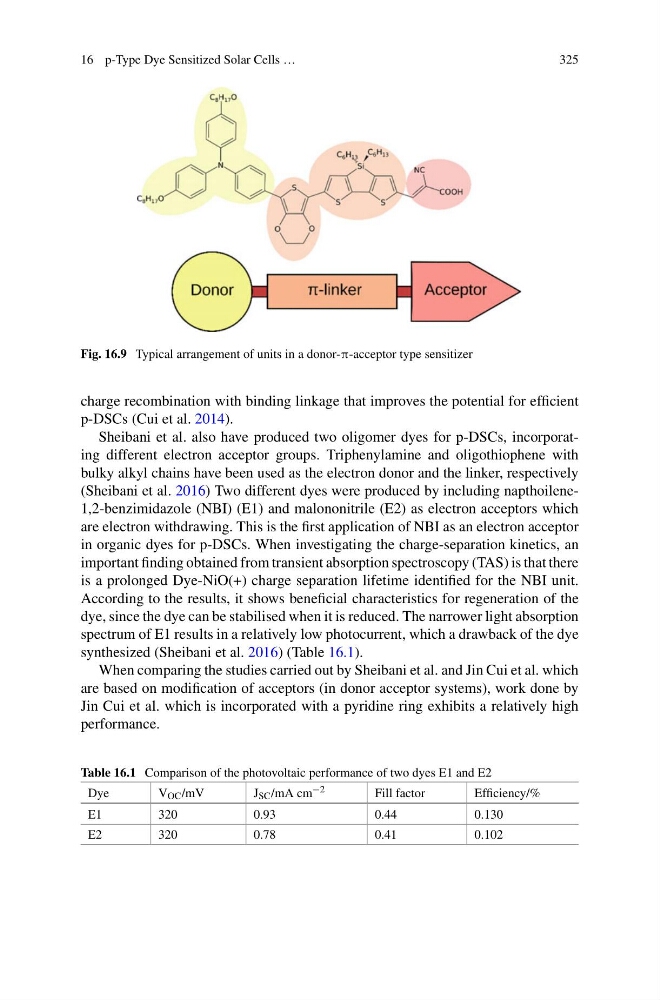
Fig. 16.9 Typical arrangement of units in a donor-π-acceptor type sensitizer
charge recombination with binding linkage that improves the potential for efficient
p-DSCs (Cui et al. 2014).
Sheibani et al. also have produced two oligomer dyes for p-DSCs, incorporating different electron acceptor groups. Triphenylamine and oligothiophene with
bulky alkyl chains have been used as the electron donor and the linker, respectively
(Sheibani et al. 2016) Two different dyes were produced by including napthoilene1,2-benzimidazole (NBI) (E1) and malononitrile (E2) as electron acceptors which
are electron withdrawing. This is the first application of NBI as an electron acceptor
in organic dyes for p-DSCs. When investigating the charge-separation kinetics, an
important finding obtained from transient absorption spectroscopy (TAS) is that there
is a prolonged Dye-NiO(+) charge separation lifetime identified for the NBI unit.
According to the results, it shows beneficial characteristics for regeneration of the
dye, since the dye can be stabilised when it is reduced. The narrower light absorption
spectrum of E1 results in a relatively low photocurrent, which a drawback of the dye
synthesized (Sheibani et al. 2016) (Table 16.1).
When comparing the studies carried out by Sheibani et al. and Jin Cui et al. which
are based on modification of acceptors (in donor acceptor systems), work done by
Jin Cui et al. which is incorporated with a pyridine ring exhibits a relatively high
performance.
Table 16.1 Comparison of the photovoltaic performance of two dyes E1 and E2
Dye
V OC /mV
J SC /mA cm −2
Fill factor
Efficiency/%
E1
320
0.93
0.44
0.130
E2
320
0.78
0.41
0.102
325
Fig. 16.9 Typical arrangement of units in a donor-π-acceptor type sensitizer
charge recombination with binding linkage that improves the potential for efficient
p-DSCs (Cui et al. 2014).
Sheibani et al. also have produced two oligomer dyes for p-DSCs, incorporating different electron acceptor groups. Triphenylamine and oligothiophene with
bulky alkyl chains have been used as the electron donor and the linker, respectively
(Sheibani et al. 2016) Two different dyes were produced by including napthoilene1,2-benzimidazole (NBI) (E1) and malononitrile (E2) as electron acceptors which
are electron withdrawing. This is the first application of NBI as an electron acceptor
in organic dyes for p-DSCs. When investigating the charge-separation kinetics, an
important finding obtained from transient absorption spectroscopy (TAS) is that there
is a prolonged Dye-NiO(+) charge separation lifetime identified for the NBI unit.
According to the results, it shows beneficial characteristics for regeneration of the
dye, since the dye can be stabilised when it is reduced. The narrower light absorption
spectrum of E1 results in a relatively low photocurrent, which a drawback of the dye
synthesized (Sheibani et al. 2016) (Table 16.1).
When comparing the studies carried out by Sheibani et al. and Jin Cui et al. which
are based on modification of acceptors (in donor acceptor systems), work done by
Jin Cui et al. which is incorporated with a pyridine ring exhibits a relatively high
performance.
Table 16.1 Comparison of the photovoltaic performance of two dyes E1 and E2
Dye
V OC /mV
J SC /mA cm −2
Fill factor
Efficiency/%
E1
320
0.93
0.44
0.130
E2
320
0.78
0.41
0.102