

16 p-Type Dye Sensitized Solar Cells …
327
Table 16.2 Examples representing Donors, Acceptors and linker
Donors
Triarylamine, indoline, perylene, fluorine, coumarin, carbazole,
di(p-carboxyphenyl) amine
Acceptors
Cyanoacrylic acid, carboxylic acid, perylene monoamide
p-conjugated linkers Thiophene, phenyl group
Push-Pull linkers
N-annulated perylene base
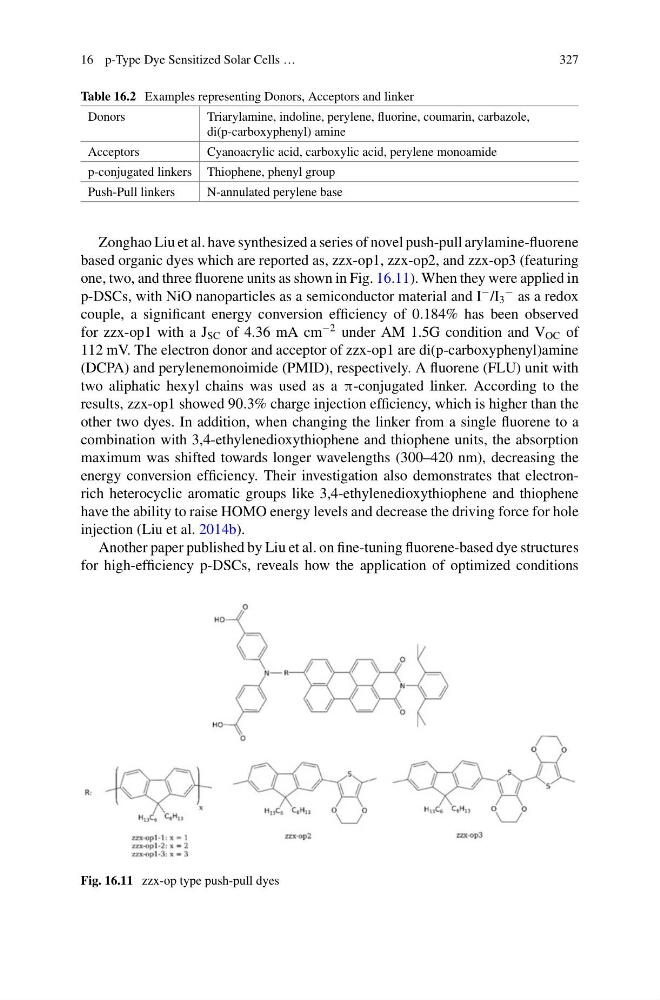
Zonghao Liu et al. have synthesized a series of novel push-pull arylamine-fluorene
based organic dyes which are reported as, zzx-op1, zzx-op2, and zzx-op3 (featuring
one, two, and three fluorene units as shown in Fig. 16.11). When they were applied in
p-DSCs, with NiO nanoparticles as a semiconductor material and I
− /I 3
− as a redox
couple, a significant energy conversion efficiency of 0.184% has been observed
for zzx-op1 with a J SC of 4.36 mA cm
−2 under AM 1.5G condition and V OC of
112 mV. The electron donor and acceptor of zzx-op1 are di(p-carboxyphenyl)amine
(DCPA) and perylenemonoimide (PMID), respectively. A fluorene (FLU) unit with
two aliphatic hexyl chains was used as a π-conjugated linker. According to the
results, zzx-op1 showed 90.3% charge injection efficiency, which is higher than the
other two dyes. In addition, when changing the linker from a single fluorene to a
combination with 3,4-ethylenedioxythiophene and thiophene units, the absorption
maximum was shifted towards longer wavelengths (300–420 nm), decreasing the
energy conversion efficiency. Their investigation also demonstrates that electronrich heterocyclic aromatic groups like 3,4-ethylenedioxythiophene and thiophene
have the ability to raise HOMO energy levels and decrease the driving force for hole
injection (Liu et al. 2014b).
Another paper published by Liu et al. on fine-tuning fluorene-based dye structures
for high-efficiency p-DSCs, reveals how the application of optimized conditions
Fig. 16.11 zzx-op type push-pull dyes
327
Table 16.2 Examples representing Donors, Acceptors and linker
Donors
Triarylamine, indoline, perylene, fluorine, coumarin, carbazole,
di(p-carboxyphenyl) amine
Acceptors
Cyanoacrylic acid, carboxylic acid, perylene monoamide
p-conjugated linkers Thiophene, phenyl group
Push-Pull linkers
N-annulated perylene base
Zonghao Liu et al. have synthesized a series of novel push-pull arylamine-fluorene
based organic dyes which are reported as, zzx-op1, zzx-op2, and zzx-op3 (featuring
one, two, and three fluorene units as shown in Fig. 16.11). When they were applied in
p-DSCs, with NiO nanoparticles as a semiconductor material and I
− /I 3
− as a redox
couple, a significant energy conversion efficiency of 0.184% has been observed
for zzx-op1 with a J SC of 4.36 mA cm
−2 under AM 1.5G condition and V OC of
112 mV. The electron donor and acceptor of zzx-op1 are di(p-carboxyphenyl)amine
(DCPA) and perylenemonoimide (PMID), respectively. A fluorene (FLU) unit with
two aliphatic hexyl chains was used as a π-conjugated linker. According to the
results, zzx-op1 showed 90.3% charge injection efficiency, which is higher than the
other two dyes. In addition, when changing the linker from a single fluorene to a
combination with 3,4-ethylenedioxythiophene and thiophene units, the absorption
maximum was shifted towards longer wavelengths (300–420 nm), decreasing the
energy conversion efficiency. Their investigation also demonstrates that electronrich heterocyclic aromatic groups like 3,4-ethylenedioxythiophene and thiophene
have the ability to raise HOMO energy levels and decrease the driving force for hole
injection (Liu et al. 2014b).
Another paper published by Liu et al. on fine-tuning fluorene-based dye structures
for high-efficiency p-DSCs, reveals how the application of optimized conditions
Fig. 16.11 zzx-op type push-pull dyes