

322
S. Peiris et al.
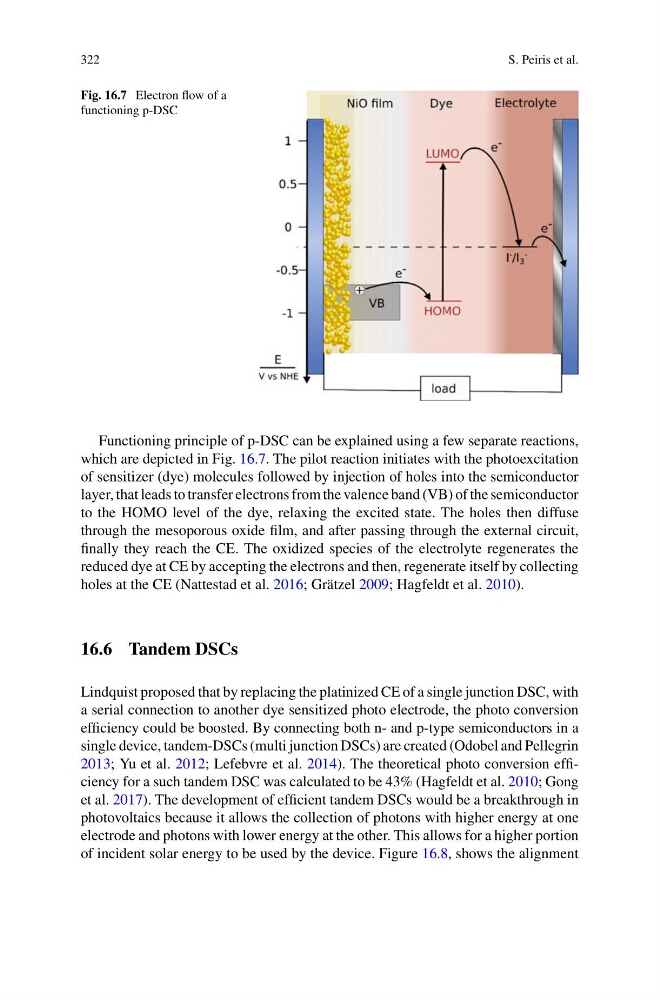
Fig. 16.7 Electron flow of a
functioning p-DSC
Functioning principle of p-DSC can be explained using a few separate reactions,
which are depicted in Fig. 16.7. The pilot reaction initiates with the photoexcitation
of sensitizer (dye) molecules followed by injection of holes into the semiconductor
layer, that leads to transfer electrons from the valence band (VB) of the semiconductor
to the HOMO level of the dye, relaxing the excited state. The holes then diffuse
through the mesoporous oxide film, and after passing through the external circuit,
finally they reach the CE. The oxidized species of the electrolyte regenerates the
reduced dye at CE by accepting the electrons and then, regenerate itself by collecting
holes at the CE (Nattestad et al. 2016; Grätzel 2009; Hagfeldt et al. 2010).
16.6 Tandem DSCs
Lindquist proposed that by replacing the platinized CE of a single junction DSC, with
a serial connection to another dye sensitized photo electrode, the photo conversion
efficiency could be boosted. By connecting both n- and p-type semiconductors in a
single device, tandem-DSCs (multi junction DSCs) are created (Odobel and Pellegrin
2013; Yu et al. 2012; Lefebvre et al. 2014). The theoretical photo conversion efficiency for a such tandem DSC was calculated to be 43% (Hagfeldt et al. 2010; Gong
et al. 2017). The development of efficient tandem DSCs would be a breakthrough in
photovoltaics because it allows the collection of photons with higher energy at one
electrode and photons with lower energy at the other. This allows for a higher portion
of incident solar energy to be used by the device. Figure 16.8, shows the alignment
S. Peiris et al.
Fig. 16.7 Electron flow of a
functioning p-DSC
Functioning principle of p-DSC can be explained using a few separate reactions,
which are depicted in Fig. 16.7. The pilot reaction initiates with the photoexcitation
of sensitizer (dye) molecules followed by injection of holes into the semiconductor
layer, that leads to transfer electrons from the valence band (VB) of the semiconductor
to the HOMO level of the dye, relaxing the excited state. The holes then diffuse
through the mesoporous oxide film, and after passing through the external circuit,
finally they reach the CE. The oxidized species of the electrolyte regenerates the
reduced dye at CE by accepting the electrons and then, regenerate itself by collecting
holes at the CE (Nattestad et al. 2016; Grätzel 2009; Hagfeldt et al. 2010).
16.6 Tandem DSCs
Lindquist proposed that by replacing the platinized CE of a single junction DSC, with
a serial connection to another dye sensitized photo electrode, the photo conversion
efficiency could be boosted. By connecting both n- and p-type semiconductors in a
single device, tandem-DSCs (multi junction DSCs) are created (Odobel and Pellegrin
2013; Yu et al. 2012; Lefebvre et al. 2014). The theoretical photo conversion efficiency for a such tandem DSC was calculated to be 43% (Hagfeldt et al. 2010; Gong
et al. 2017). The development of efficient tandem DSCs would be a breakthrough in
photovoltaics because it allows the collection of photons with higher energy at one
electrode and photons with lower energy at the other. This allows for a higher portion
of incident solar energy to be used by the device. Figure 16.8, shows the alignment