

16 p-Type Dye Sensitized Solar Cells …
323
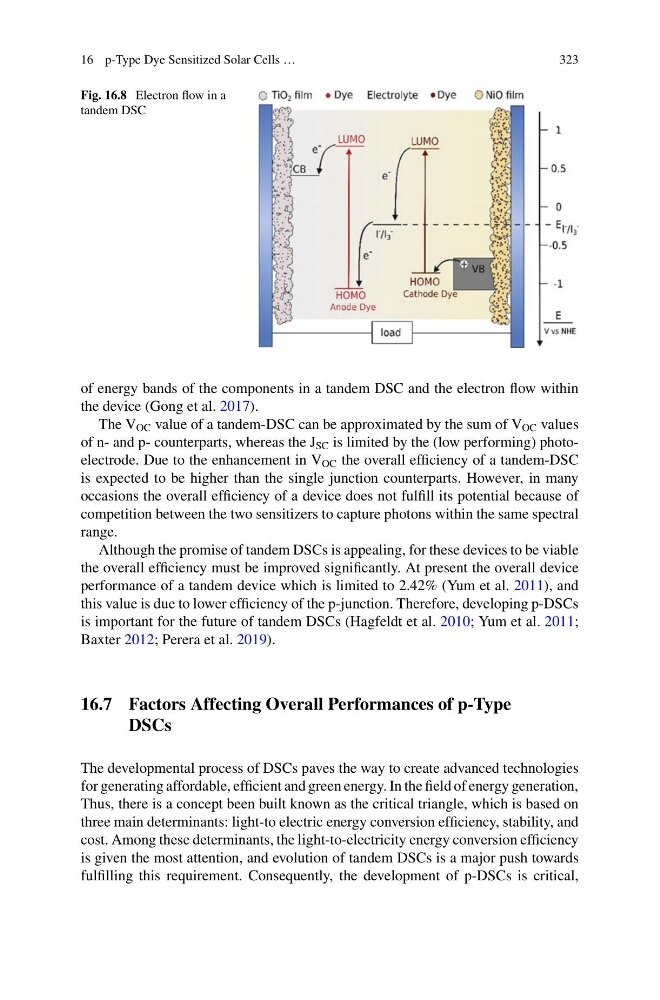
Fig. 16.8 Electron flow in a
tandem DSC
of energy bands of the components in a tandem DSC and the electron flow within
the device (Gong et al. 2017).
The V OC value of a tandem-DSC can be approximated by the sum of V OC values
of n- and p- counterparts, whereas the J SC is limited by the (low performing) photoelectrode. Due to the enhancement in V OC the overall efficiency of a tandem-DSC
is expected to be higher than the single junction counterparts. However, in many
occasions the overall efficiency of a device does not fulfill its potential because of
competition between the two sensitizers to capture photons within the same spectral
range.
Although the promise of tandem DSCs is appealing, for these devices to be viable
the overall efficiency must be improved significantly. At present the overall device
performance of a tandem device which is limited to 2.42% (Yum et al. 2011), and
this value is due to lower efficiency of the p-junction. Therefore, developing p-DSCs
is important for the future of tandem DSCs (Hagfeldt et al. 2010; Yum et al. 2011;
Baxter 2012; Perera et al. 2019).
16.7 Factors Affecting Overall Performances of p-Type
DSCs
The developmental process of DSCs paves the way to create advanced technologies
for generating affordable, efficient and green energy. In the field of energy generation,
Thus, there is a concept been built known as the critical triangle, which is based on
three main determinants: light-to electric energy conversion efficiency, stability, and
cost. Among these determinants, the light-to-electricity energy conversion efficiency
is given the most attention, and evolution of tandem DSCs is a major push towards
fulfilling this requirement. Consequently, the development of p-DSCs is critical,
323
Fig. 16.8 Electron flow in a
tandem DSC
of energy bands of the components in a tandem DSC and the electron flow within
the device (Gong et al. 2017).
The V OC value of a tandem-DSC can be approximated by the sum of V OC values
of n- and p- counterparts, whereas the J SC is limited by the (low performing) photoelectrode. Due to the enhancement in V OC the overall efficiency of a tandem-DSC
is expected to be higher than the single junction counterparts. However, in many
occasions the overall efficiency of a device does not fulfill its potential because of
competition between the two sensitizers to capture photons within the same spectral
range.
Although the promise of tandem DSCs is appealing, for these devices to be viable
the overall efficiency must be improved significantly. At present the overall device
performance of a tandem device which is limited to 2.42% (Yum et al. 2011), and
this value is due to lower efficiency of the p-junction. Therefore, developing p-DSCs
is important for the future of tandem DSCs (Hagfeldt et al. 2010; Yum et al. 2011;
Baxter 2012; Perera et al. 2019).
16.7 Factors Affecting Overall Performances of p-Type
DSCs
The developmental process of DSCs paves the way to create advanced technologies
for generating affordable, efficient and green energy. In the field of energy generation,
Thus, there is a concept been built known as the critical triangle, which is based on
three main determinants: light-to electric energy conversion efficiency, stability, and
cost. Among these determinants, the light-to-electricity energy conversion efficiency
is given the most attention, and evolution of tandem DSCs is a major push towards
fulfilling this requirement. Consequently, the development of p-DSCs is critical,