

16 p-Type Dye Sensitized Solar Cells …
321
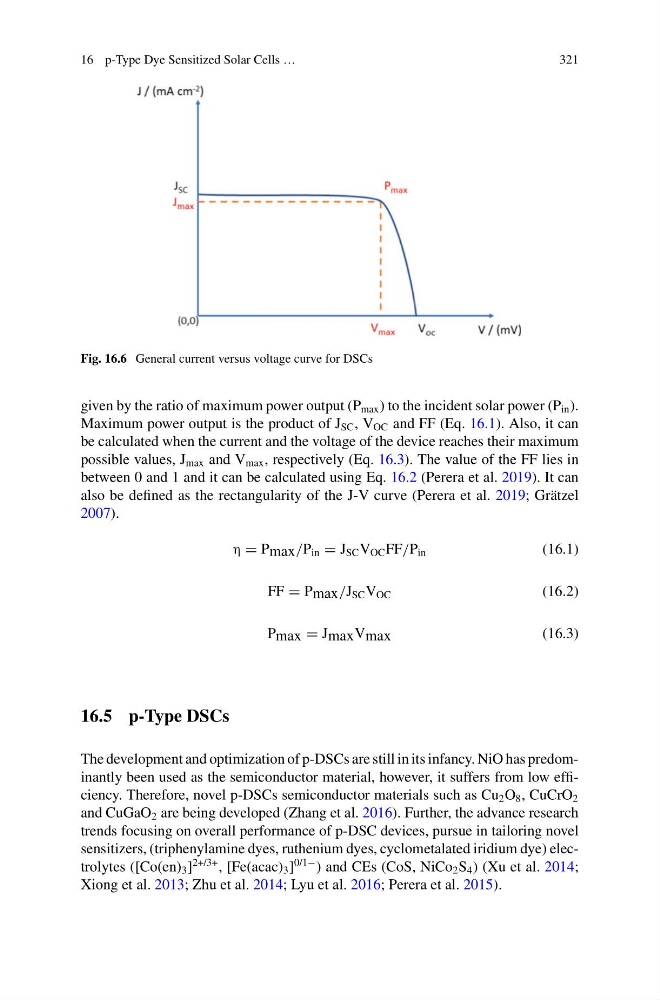
Fig. 16.6 General current versus voltage curve for DSCs
given by the ratio of maximum power output (P max ) to the incident solar power (P in ).
Maximum power output is the product of J SC , V OC and FF (Eq. 16.1). Also, it can
be calculated when the current and the voltage of the device reaches their maximum
possible values, J max and V max , respectively (Eq. 16.3). The value of the FF lies in
between 0 and 1 and it can be calculated using Eq. 16.2 (Perera et al. 2019). It can
also be defined as the rectangularity of the J-V curve (Perera et al. 2019; Grätzel
2007).
η = P max /P in = J SC V OC FF/P in
(16.1)
FF = P max /J SC V OC
(16.2)
P max = J max V max
(16.3)
16.5 p-Type DSCs
The development and optimization of p-DSCs are still in its infancy. NiO has predominantly been used as the semiconductor material, however, it suffers from low efficiency. Therefore, novel p-DSCs semiconductor materials such as Cu 2 O 8 , CuCrO 2
and CuGaO 2 are being developed (Zhang et al. 2016). Further, the advance research
trends focusing on overall performance of p-DSC devices, pursue in tailoring novel
sensitizers, (triphenylamine dyes, ruthenium dyes, cyclometalated iridium dye) electrolytes ([Co(en) 3 ]
2+/3+ , [Fe(acac) 3 ]
0/1− ) and CEs (CoS, NiCo 2 S 4 ) (Xu et al. 2014;
Xiong et al. 2013; Zhu et al. 2014; Lyu et al. 2016; Perera et al. 2015).
321
Fig. 16.6 General current versus voltage curve for DSCs
given by the ratio of maximum power output (P max ) to the incident solar power (P in ).
Maximum power output is the product of J SC , V OC and FF (Eq. 16.1). Also, it can
be calculated when the current and the voltage of the device reaches their maximum
possible values, J max and V max , respectively (Eq. 16.3). The value of the FF lies in
between 0 and 1 and it can be calculated using Eq. 16.2 (Perera et al. 2019). It can
also be defined as the rectangularity of the J-V curve (Perera et al. 2019; Grätzel
2007).
η = P max /P in = J SC V OC FF/P in
(16.1)
FF = P max /J SC V OC
(16.2)
P max = J max V max
(16.3)
16.5 p-Type DSCs
The development and optimization of p-DSCs are still in its infancy. NiO has predominantly been used as the semiconductor material, however, it suffers from low efficiency. Therefore, novel p-DSCs semiconductor materials such as Cu 2 O 8 , CuCrO 2
and CuGaO 2 are being developed (Zhang et al. 2016). Further, the advance research
trends focusing on overall performance of p-DSC devices, pursue in tailoring novel
sensitizers, (triphenylamine dyes, ruthenium dyes, cyclometalated iridium dye) electrolytes ([Co(en) 3 ]
2+/3+ , [Fe(acac) 3 ]
0/1− ) and CEs (CoS, NiCo 2 S 4 ) (Xu et al. 2014;
Xiong et al. 2013; Zhu et al. 2014; Lyu et al. 2016; Perera et al. 2015).