

13 Review on PCM Application for Cooling Load Reduction …
263
Twi
Tsol
x
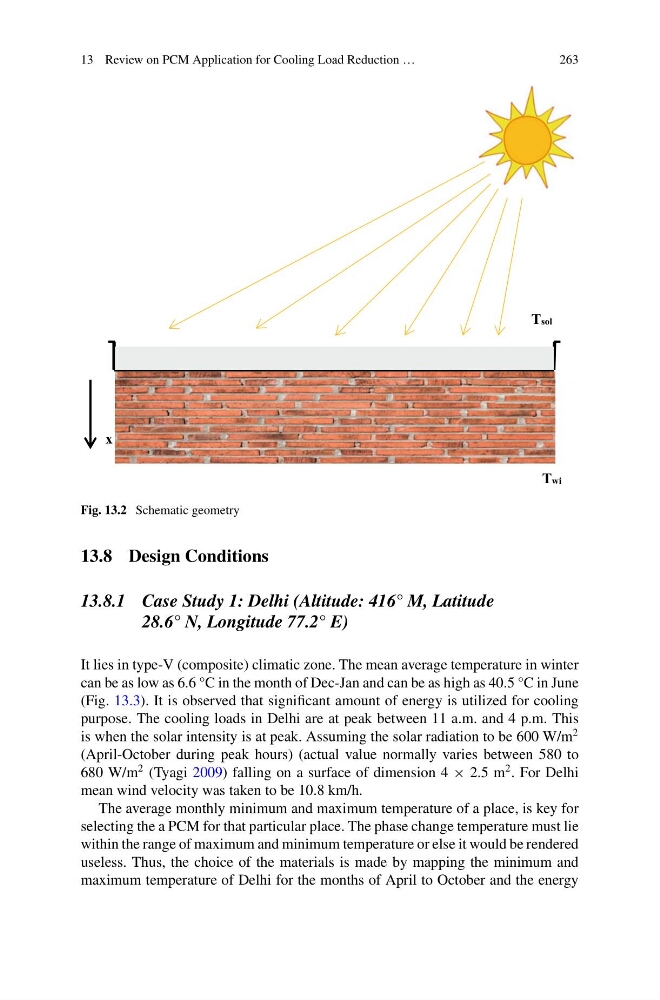
Fig. 13.2 Schematic geometry
13.8 Design Conditions
13.8.1 Case Study 1: Delhi (Altitude: 416° M, Latitude
28.6° N, Longitude 77.2° E)
It lies in type-V (composite) climatic zone. The mean average temperature in winter
can be as low as 6.6 °C in the month of Dec-Jan and can be as high as 40.5 °C in June
(Fig. 13.3). It is observed that significant amount of energy is utilized for cooling
purpose. The cooling loads in Delhi are at peak between 11 a.m. and 4 p.m. This
is when the solar intensity is at peak. Assuming the solar radiation to be 600 W/m
2
(April-October during peak hours) (actual value normally varies between 580 to
680 W/m
2 (Tyagi 2009) falling on a surface of dimension 4 × 2.5 m
2 . For Delhi
mean wind velocity was taken to be 10.8 km/h.
The average monthly minimum and maximum temperature of a place, is key for
selecting the a PCM for that particular place. The phase change temperature must lie
within the range of maximum and minimum temperature or else it would be rendered
useless. Thus, the choice of the materials is made by mapping the minimum and
maximum temperature of Delhi for the months of April to October and the energy
263
Twi
Tsol
x
Fig. 13.2 Schematic geometry
13.8 Design Conditions
13.8.1 Case Study 1: Delhi (Altitude: 416° M, Latitude
28.6° N, Longitude 77.2° E)
It lies in type-V (composite) climatic zone. The mean average temperature in winter
can be as low as 6.6 °C in the month of Dec-Jan and can be as high as 40.5 °C in June
(Fig. 13.3). It is observed that significant amount of energy is utilized for cooling
purpose. The cooling loads in Delhi are at peak between 11 a.m. and 4 p.m. This
is when the solar intensity is at peak. Assuming the solar radiation to be 600 W/m
2
(April-October during peak hours) (actual value normally varies between 580 to
680 W/m
2 (Tyagi 2009) falling on a surface of dimension 4 × 2.5 m
2 . For Delhi
mean wind velocity was taken to be 10.8 km/h.
The average monthly minimum and maximum temperature of a place, is key for
selecting the a PCM for that particular place. The phase change temperature must lie
within the range of maximum and minimum temperature or else it would be rendered
useless. Thus, the choice of the materials is made by mapping the minimum and
maximum temperature of Delhi for the months of April to October and the energy