

262
R. Saxena et al.
is focused towards assessing the PCMs suitability for different Indian conditions,
find the impact of PCM incorporation within the building envelop. Before carrying
out a detailed analysis first it is necessary to assess the potential PCMs that may be
suitable for application, this is referred to as PCM mapping. This chapter assesses
the average temperature of the place for different places followed by mapping of
PCMs for different climatic conditions in India.
The weather of a place is determined based on its climatic conditions i.e. temperature, solar radiation falling, humidity, wind speed etc. Location, altitude, time of day
and year, orientation are other important parameters which affect the solar radiation
thereby controlling the temperature of a building. For example, buildings on a south
facing slope in Leh will receive more radiation compared to other orientations.
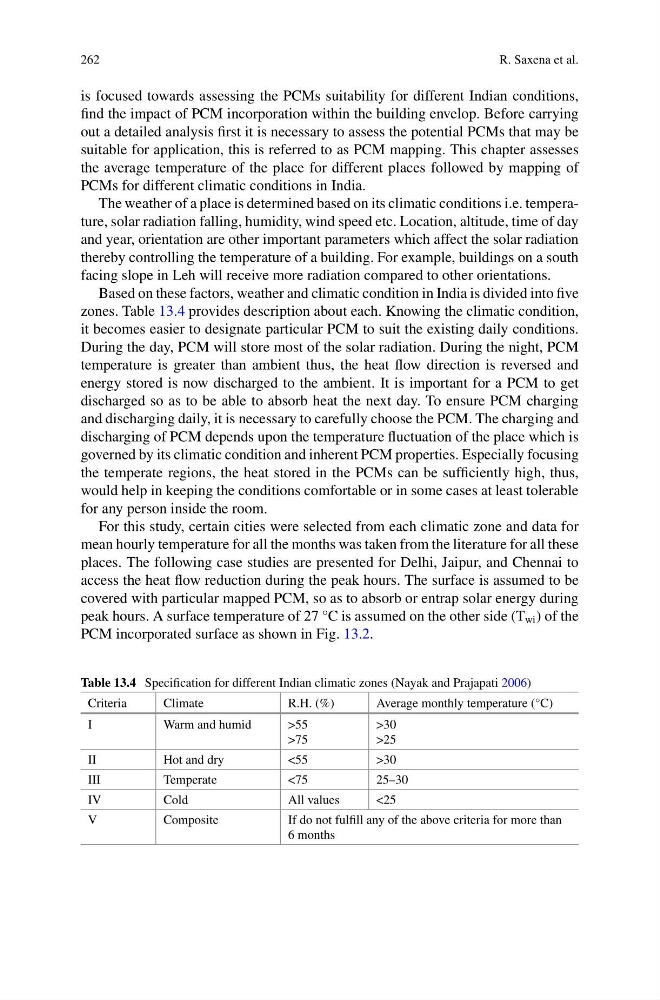
Based on these factors, weather and climatic condition in India is divided into five
zones. Table 13.4 provides description about each. Knowing the climatic condition,
it becomes easier to designate particular PCM to suit the existing daily conditions.
During the day, PCM will store most of the solar radiation. During the night, PCM
temperature is greater than ambient thus, the heat flow direction is reversed and
energy stored is now discharged to the ambient. It is important for a PCM to get
discharged so as to be able to absorb heat the next day. To ensure PCM charging
and discharging daily, it is necessary to carefully choose the PCM. The charging and
discharging of PCM depends upon the temperature fluctuation of the place which is
governed by its climatic condition and inherent PCM properties. Especially focusing
the temperate regions, the heat stored in the PCMs can be sufficiently high, thus,
would help in keeping the conditions comfortable or in some cases at least tolerable
for any person inside the room.
For this study, certain cities were selected from each climatic zone and data for
mean hourly temperature for all the months was taken from the literature for all these
places. The following case studies are presented for Delhi, Jaipur, and Chennai to
access the heat flow reduction during the peak hours. The surface is assumed to be
covered with particular mapped PCM, so as to absorb or entrap solar energy during
peak hours. A surface temperature of 27 °C is assumed on the other side (T wi ) of the
PCM incorporated surface as shown in Fig. 13.2.
Table 13.4 Specification for different Indian climatic zones (Nayak and Prajapati 2006)
Criteria
Climate
R.H. (%)
Average monthly temperature (°C)
I
Warm and humid
>55
>75
>30
>25
II
Hot and dry
<55
>30
III
Temperate
<75
25–30
IV
Cold
All values
<25
V
Composite
If do not fulfill any of the above criteria for more than
6 months
R. Saxena et al.
is focused towards assessing the PCMs suitability for different Indian conditions,
find the impact of PCM incorporation within the building envelop. Before carrying
out a detailed analysis first it is necessary to assess the potential PCMs that may be
suitable for application, this is referred to as PCM mapping. This chapter assesses
the average temperature of the place for different places followed by mapping of
PCMs for different climatic conditions in India.
The weather of a place is determined based on its climatic conditions i.e. temperature, solar radiation falling, humidity, wind speed etc. Location, altitude, time of day
and year, orientation are other important parameters which affect the solar radiation
thereby controlling the temperature of a building. For example, buildings on a south
facing slope in Leh will receive more radiation compared to other orientations.
Based on these factors, weather and climatic condition in India is divided into five
zones. Table 13.4 provides description about each. Knowing the climatic condition,
it becomes easier to designate particular PCM to suit the existing daily conditions.
During the day, PCM will store most of the solar radiation. During the night, PCM
temperature is greater than ambient thus, the heat flow direction is reversed and
energy stored is now discharged to the ambient. It is important for a PCM to get
discharged so as to be able to absorb heat the next day. To ensure PCM charging
and discharging daily, it is necessary to carefully choose the PCM. The charging and
discharging of PCM depends upon the temperature fluctuation of the place which is
governed by its climatic condition and inherent PCM properties. Especially focusing
the temperate regions, the heat stored in the PCMs can be sufficiently high, thus,
would help in keeping the conditions comfortable or in some cases at least tolerable
for any person inside the room.
For this study, certain cities were selected from each climatic zone and data for
mean hourly temperature for all the months was taken from the literature for all these
places. The following case studies are presented for Delhi, Jaipur, and Chennai to
access the heat flow reduction during the peak hours. The surface is assumed to be
covered with particular mapped PCM, so as to absorb or entrap solar energy during
peak hours. A surface temperature of 27 °C is assumed on the other side (T wi ) of the
PCM incorporated surface as shown in Fig. 13.2.
Table 13.4 Specification for different Indian climatic zones (Nayak and Prajapati 2006)
Criteria
Climate
R.H. (%)
Average monthly temperature (°C)
I
Warm and humid
>55
>75
>30
>25
II
Hot and dry
<55
>30
III
Temperate
<75
25–30
IV
Cold
All values
<25
V
Composite
If do not fulfill any of the above criteria for more than
6 months