

13 Review on PCM Application for Cooling Load Reduction …
261
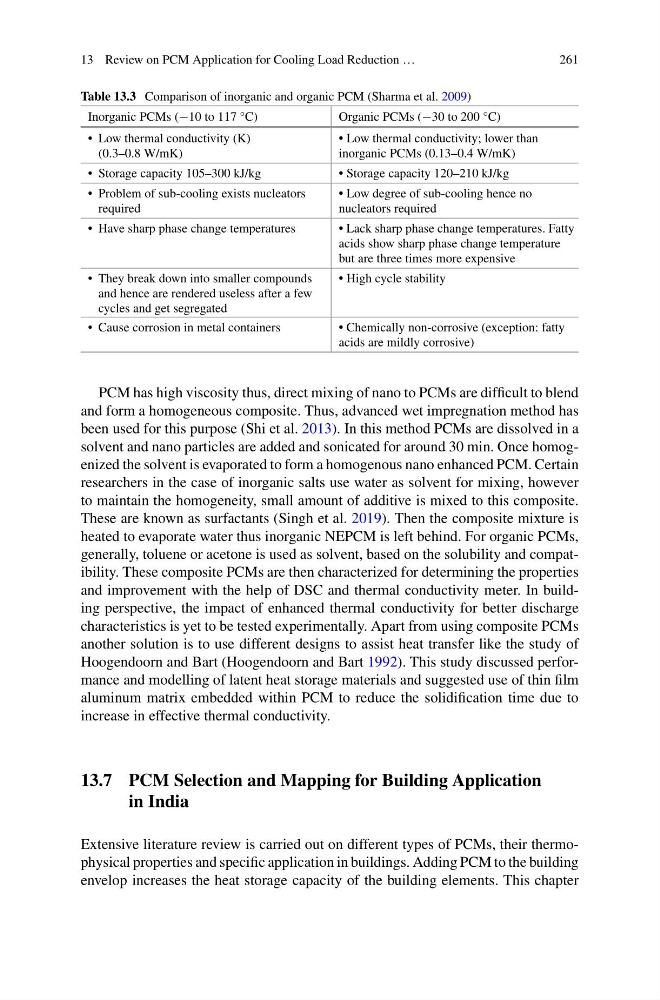
Table 13.3 Comparison of inorganic and organic PCM (Sharma et al. 2009)
Inorganic PCMs (−10 to 117 °C)
Organic PCMs (−30 to 200 °C)
• Low thermal conductivity (K)
(0.3–0.8 W/mK)
• Low thermal conductivity; lower than
inorganic PCMs (0.13–0.4 W/mK)
• Storage capacity 105–300 kJ/kg
• Storage capacity 120–210 kJ/kg
• Problem of sub-cooling exists nucleators
required
• Low degree of sub-cooling hence no
nucleators required
• Have sharp phase change temperatures
• Lack sharp phase change temperatures. Fatty
acids show sharp phase change temperature
but are three times more expensive
• They break down into smaller compounds
and hence are rendered useless after a few
cycles and get segregated
• High cycle stability
• Cause corrosion in metal containers
• Chemically non-corrosive (exception: fatty
acids are mildly corrosive)
PCM has high viscosity thus, direct mixing of nano to PCMs are difficult to blend
and form a homogeneous composite. Thus, advanced wet impregnation method has
been used for this purpose (Shi et al. 2013). In this method PCMs are dissolved in a
solvent and nano particles are added and sonicated for around 30 min. Once homogenized the solvent is evaporated to form a homogenous nano enhanced PCM. Certain
researchers in the case of inorganic salts use water as solvent for mixing, however
to maintain the homogeneity, small amount of additive is mixed to this composite.
These are known as surfactants (Singh et al. 2019). Then the composite mixture is
heated to evaporate water thus inorganic NEPCM is left behind. For organic PCMs,
generally, toluene or acetone is used as solvent, based on the solubility and compatibility. These composite PCMs are then characterized for determining the properties
and improvement with the help of DSC and thermal conductivity meter. In building perspective, the impact of enhanced thermal conductivity for better discharge
characteristics is yet to be tested experimentally. Apart from using composite PCMs
another solution is to use different designs to assist heat transfer like the study of
Hoogendoorn and Bart (Hoogendoorn and Bart 1992). This study discussed performance and modelling of latent heat storage materials and suggested use of thin film
aluminum matrix embedded within PCM to reduce the solidification time due to
increase in effective thermal conductivity.
13.7 PCM Selection and Mapping for Building Application
in India
Extensive literature review is carried out on different types of PCMs, their thermophysical properties and specific application in buildings. Adding PCM to the building
envelop increases the heat storage capacity of the building elements. This chapter
261
Table 13.3 Comparison of inorganic and organic PCM (Sharma et al. 2009)
Inorganic PCMs (−10 to 117 °C)
Organic PCMs (−30 to 200 °C)
• Low thermal conductivity (K)
(0.3–0.8 W/mK)
• Low thermal conductivity; lower than
inorganic PCMs (0.13–0.4 W/mK)
• Storage capacity 105–300 kJ/kg
• Storage capacity 120–210 kJ/kg
• Problem of sub-cooling exists nucleators
required
• Low degree of sub-cooling hence no
nucleators required
• Have sharp phase change temperatures
• Lack sharp phase change temperatures. Fatty
acids show sharp phase change temperature
but are three times more expensive
• They break down into smaller compounds
and hence are rendered useless after a few
cycles and get segregated
• High cycle stability
• Cause corrosion in metal containers
• Chemically non-corrosive (exception: fatty
acids are mildly corrosive)
PCM has high viscosity thus, direct mixing of nano to PCMs are difficult to blend
and form a homogeneous composite. Thus, advanced wet impregnation method has
been used for this purpose (Shi et al. 2013). In this method PCMs are dissolved in a
solvent and nano particles are added and sonicated for around 30 min. Once homogenized the solvent is evaporated to form a homogenous nano enhanced PCM. Certain
researchers in the case of inorganic salts use water as solvent for mixing, however
to maintain the homogeneity, small amount of additive is mixed to this composite.
These are known as surfactants (Singh et al. 2019). Then the composite mixture is
heated to evaporate water thus inorganic NEPCM is left behind. For organic PCMs,
generally, toluene or acetone is used as solvent, based on the solubility and compatibility. These composite PCMs are then characterized for determining the properties
and improvement with the help of DSC and thermal conductivity meter. In building perspective, the impact of enhanced thermal conductivity for better discharge
characteristics is yet to be tested experimentally. Apart from using composite PCMs
another solution is to use different designs to assist heat transfer like the study of
Hoogendoorn and Bart (Hoogendoorn and Bart 1992). This study discussed performance and modelling of latent heat storage materials and suggested use of thin film
aluminum matrix embedded within PCM to reduce the solidification time due to
increase in effective thermal conductivity.
13.7 PCM Selection and Mapping for Building Application
in India
Extensive literature review is carried out on different types of PCMs, their thermophysical properties and specific application in buildings. Adding PCM to the building
envelop increases the heat storage capacity of the building elements. This chapter