

172
Md. A. Islam and B. B. Saha
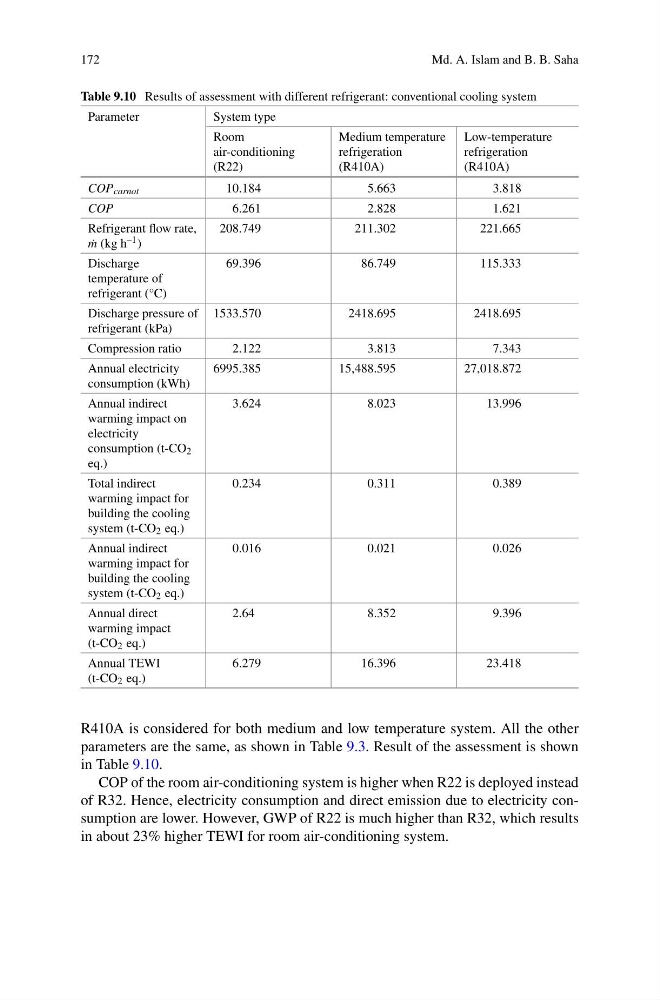
Table 9.10 Results of assessment with different refrigerant: conventional cooling system
Parameter
System type
Room
air-conditioning
(R22)
Medium temperature
refrigeration
(R410A)
Low-temperature
refrigeration
(R410A)
COP carnot
10.184
5.663
3.818
COP
6.261
2.828
1.621
Refrigerant flow rate,
˙
m (kg h –1 )
208.749
211.302
221.665
Discharge
temperature of
refrigerant (°C)
69.396
86.749
115.333
Discharge pressure of
refrigerant (kPa)
1533.570
2418.695
2418.695
Compression ratio
2.122
3.813
7.343
Annual electricity
consumption (kWh)
6995.385
15,488.595
27,018.872
Annual indirect
warming impact on
electricity
consumption (t-CO 2
eq.)
3.624
8.023
13.996
Total indirect
warming impact for
building the cooling
system (t-CO 2 eq.)
0.234
0.311
0.389
Annual indirect
warming impact for
building the cooling
system (t-CO 2 eq.)
0.016
0.021
0.026
Annual direct
warming impact
(t-CO 2 eq.)
2.64
8.352
9.396
Annual TEWI
(t-CO 2 eq.)
6.279
16.396
23.418
R410A is considered for both medium and low temperature system. All the other
parameters are the same, as shown in Table 9.3. Result of the assessment is shown
in Table 9.10.
COP of the room air-conditioning system is higher when R22 is deployed instead
of R32. Hence, electricity consumption and direct emission due to electricity consumption are lower. However, GWP of R22 is much higher than R32, which results
in about 23% higher TEWI for room air-conditioning system.
Md. A. Islam and B. B. Saha
Table 9.10 Results of assessment with different refrigerant: conventional cooling system
Parameter
System type
Room
air-conditioning
(R22)
Medium temperature
refrigeration
(R410A)
Low-temperature
refrigeration
(R410A)
COP carnot
10.184
5.663
3.818
COP
6.261
2.828
1.621
Refrigerant flow rate,
˙
m (kg h –1 )
208.749
211.302
221.665
Discharge
temperature of
refrigerant (°C)
69.396
86.749
115.333
Discharge pressure of
refrigerant (kPa)
1533.570
2418.695
2418.695
Compression ratio
2.122
3.813
7.343
Annual electricity
consumption (kWh)
6995.385
15,488.595
27,018.872
Annual indirect
warming impact on
electricity
consumption (t-CO 2
eq.)
3.624
8.023
13.996
Total indirect
warming impact for
building the cooling
system (t-CO 2 eq.)
0.234
0.311
0.389
Annual indirect
warming impact for
building the cooling
system (t-CO 2 eq.)
0.016
0.021
0.026
Annual direct
warming impact
(t-CO 2 eq.)
2.64
8.352
9.396
Annual TEWI
(t-CO 2 eq.)
6.279
16.396
23.418
R410A is considered for both medium and low temperature system. All the other
parameters are the same, as shown in Table 9.3. Result of the assessment is shown
in Table 9.10.
COP of the room air-conditioning system is higher when R22 is deployed instead
of R32. Hence, electricity consumption and direct emission due to electricity consumption are lower. However, GWP of R22 is much higher than R32, which results
in about 23% higher TEWI for room air-conditioning system.