

9 TEWI Assessment of Conventional and Solar Powered Cooling Systems
171
Table 9.9 Emission sensitivity with leakage rate
System type
Emission
Annual leakage rate from the initial amount
L a = 5% L a = 10% L a = 15% L a = 20%
Room
air-conditioning
system (R32)
Direct emission
(t-CO 2 eq.)
0.338
0.675
1.013
1.350
TEWI (t-CO 2 eq.)
4.141
4.479
4.816
5.154
Change of TEWI
−14.02% −7.00%
0
+7.02%
Medium
temperature
refrigeration
(R134a)
Direct emission
(t-CO 2 eq.)
1.3
2.6
3.9
5.2
TEWI (t-CO 2 eq.)
8.812
10.112
11.412
12.712
Change of TEWI
−22.78% −11.39% 0
+11.39%
Low temperature
refrigeration
(R404A)
Direct emission
(t-CO 2 eq.)
5.883
11.766
17.649
23.532
TEWI (t-CO 2 eq.)
20.646
26.529
31.346
38.295
Change of TEWI
−36.30% −18.15% 0
+18.15%
system-manufacturing process. When the difference between evaporation and condensation temperature is large, the compression ratio is high, which leads to a higher
leakage rate. Besides, each refrigerant possesses different pressure at the operating
conditions. Hence, the leakage rate also depends on the selected refrigerant type.
Moreover, the leakage rate depends on the sealing method of refrigerant compression chamber and airtightness of the refrigerant flowing channels. This part is solely
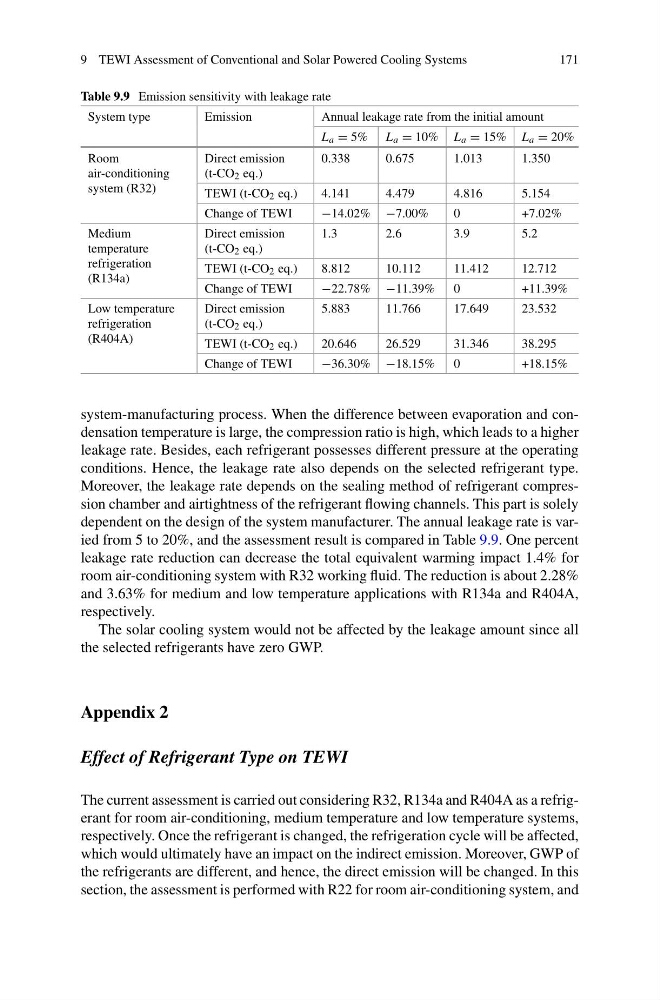
dependent on the design of the system manufacturer. The annual leakage rate is varied from 5 to 20%, and the assessment result is compared in Table 9.9. One percent
leakage rate reduction can decrease the total equivalent warming impact 1.4% for
room air-conditioning system with R32 working fluid. The reduction is about 2.28%
and 3.63% for medium and low temperature applications with R134a and R404A,
respectively.
The solar cooling system would not be affected by the leakage amount since all
the selected refrigerants have zero GWP.
Appendix 2
Effect of Refrigerant Type on TEWI
The current assessment is carried out considering R32, R134a and R404A as a refrigerant for room air-conditioning, medium temperature and low temperature systems,
respectively. Once the refrigerant is changed, the refrigeration cycle will be affected,
which would ultimately have an impact on the indirect emission. Moreover, GWP of
the refrigerants are different, and hence, the direct emission will be changed. In this
section, the assessment is performed with R22 for room air-conditioning system, and
171
Table 9.9 Emission sensitivity with leakage rate
System type
Emission
Annual leakage rate from the initial amount
L a = 5% L a = 10% L a = 15% L a = 20%
Room
air-conditioning
system (R32)
Direct emission
(t-CO 2 eq.)
0.338
0.675
1.013
1.350
TEWI (t-CO 2 eq.)
4.141
4.479
4.816
5.154
Change of TEWI
−14.02% −7.00%
0
+7.02%
Medium
temperature
refrigeration
(R134a)
Direct emission
(t-CO 2 eq.)
1.3
2.6
3.9
5.2
TEWI (t-CO 2 eq.)
8.812
10.112
11.412
12.712
Change of TEWI
−22.78% −11.39% 0
+11.39%
Low temperature
refrigeration
(R404A)
Direct emission
(t-CO 2 eq.)
5.883
11.766
17.649
23.532
TEWI (t-CO 2 eq.)
20.646
26.529
31.346
38.295
Change of TEWI
−36.30% −18.15% 0
+18.15%
system-manufacturing process. When the difference between evaporation and condensation temperature is large, the compression ratio is high, which leads to a higher
leakage rate. Besides, each refrigerant possesses different pressure at the operating
conditions. Hence, the leakage rate also depends on the selected refrigerant type.
Moreover, the leakage rate depends on the sealing method of refrigerant compression chamber and airtightness of the refrigerant flowing channels. This part is solely
dependent on the design of the system manufacturer. The annual leakage rate is varied from 5 to 20%, and the assessment result is compared in Table 9.9. One percent
leakage rate reduction can decrease the total equivalent warming impact 1.4% for
room air-conditioning system with R32 working fluid. The reduction is about 2.28%
and 3.63% for medium and low temperature applications with R134a and R404A,
respectively.
The solar cooling system would not be affected by the leakage amount since all
the selected refrigerants have zero GWP.
Appendix 2
Effect of Refrigerant Type on TEWI
The current assessment is carried out considering R32, R134a and R404A as a refrigerant for room air-conditioning, medium temperature and low temperature systems,
respectively. Once the refrigerant is changed, the refrigeration cycle will be affected,
which would ultimately have an impact on the indirect emission. Moreover, GWP of
the refrigerants are different, and hence, the direct emission will be changed. In this
section, the assessment is performed with R22 for room air-conditioning system, and