

9 TEWI Assessment of Conventional and Solar Powered Cooling Systems
155
A cooling system is mostly made with metals such as stainless steel, aluminium,
and copper. These materials production requires a lot of energy which indirectly
contribute to global warming.
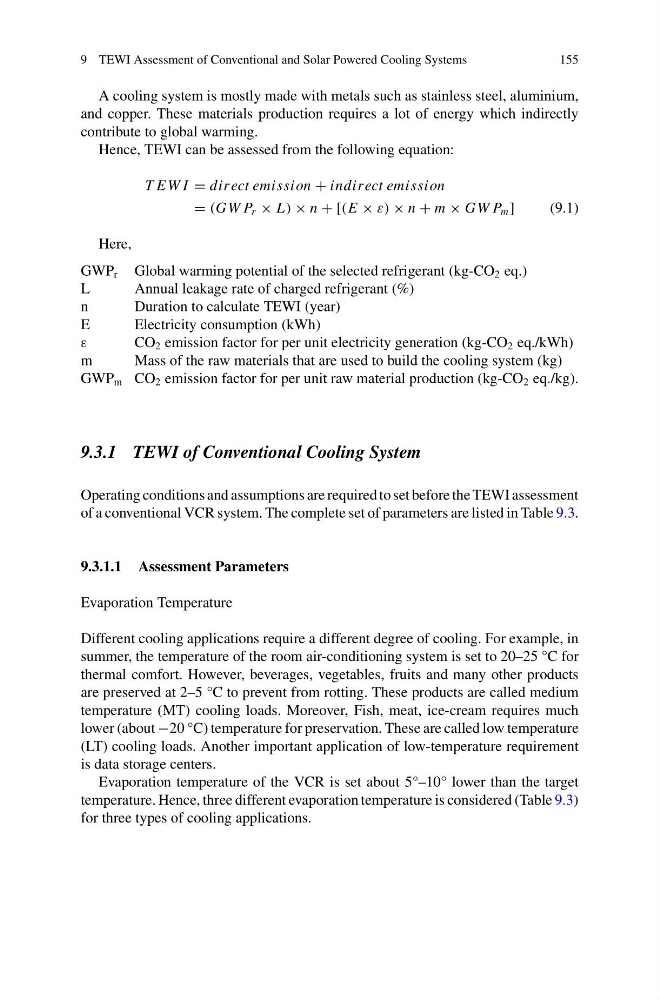
Hence, TEWI can be assessed from the following equation:
T EW I = direct emission + indirect emission
= (GW P r × L) × n + [(E × ε) × n + m × GW P m ]
(9.1)
Here,
GWP r Global warming potential of the selected refrigerant (kg-CO 2 eq.)
L
Annual leakage rate of charged refrigerant (%)
n
Duration to calculate TEWI (year)
E
Electricity consumption (kWh)
ε
CO 2 emission factor for per unit electricity generation (kg-CO 2 eq./kWh)
m
Mass of the raw materials that are used to build the cooling system (kg)
GWP m CO 2 emission factor for per unit raw material production (kg-CO 2 eq./kg).
9.3.1 TEWI of Conventional Cooling System
Operating conditions and assumptions are required to set before the TEWI assessment
of a conventional VCR system. The complete set of parameters are listed in Table 9.3.
9.3.1.1 Assessment Parameters
Evaporation Temperature
Different cooling applications require a different degree of cooling. For example, in
summer, the temperature of the room air-conditioning system is set to 20–25 °C for
thermal comfort. However, beverages, vegetables, fruits and many other products
are preserved at 2–5 °C to prevent from rotting. These products are called medium
temperature (MT) cooling loads. Moreover, Fish, meat, ice-cream requires much
lower (about −20 °C) temperature for preservation. These are called low temperature
(LT) cooling loads. Another important application of low-temperature requirement
is data storage centers.
Evaporation temperature of the VCR is set about 5°–10° lower than the target
temperature. Hence, three different evaporation temperature is considered (Table 9.3)
for three types of cooling applications.
155
A cooling system is mostly made with metals such as stainless steel, aluminium,
and copper. These materials production requires a lot of energy which indirectly
contribute to global warming.
Hence, TEWI can be assessed from the following equation:
T EW I = direct emission + indirect emission
= (GW P r × L) × n + [(E × ε) × n + m × GW P m ]
(9.1)
Here,
GWP r Global warming potential of the selected refrigerant (kg-CO 2 eq.)
L
Annual leakage rate of charged refrigerant (%)
n
Duration to calculate TEWI (year)
E
Electricity consumption (kWh)
ε
CO 2 emission factor for per unit electricity generation (kg-CO 2 eq./kWh)
m
Mass of the raw materials that are used to build the cooling system (kg)
GWP m CO 2 emission factor for per unit raw material production (kg-CO 2 eq./kg).
9.3.1 TEWI of Conventional Cooling System
Operating conditions and assumptions are required to set before the TEWI assessment
of a conventional VCR system. The complete set of parameters are listed in Table 9.3.
9.3.1.1 Assessment Parameters
Evaporation Temperature
Different cooling applications require a different degree of cooling. For example, in
summer, the temperature of the room air-conditioning system is set to 20–25 °C for
thermal comfort. However, beverages, vegetables, fruits and many other products
are preserved at 2–5 °C to prevent from rotting. These products are called medium
temperature (MT) cooling loads. Moreover, Fish, meat, ice-cream requires much
lower (about −20 °C) temperature for preservation. These are called low temperature
(LT) cooling loads. Another important application of low-temperature requirement
is data storage centers.
Evaporation temperature of the VCR is set about 5°–10° lower than the target
temperature. Hence, three different evaporation temperature is considered (Table 9.3)
for three types of cooling applications.