

154
Md. A. Islam and B. B. Saha
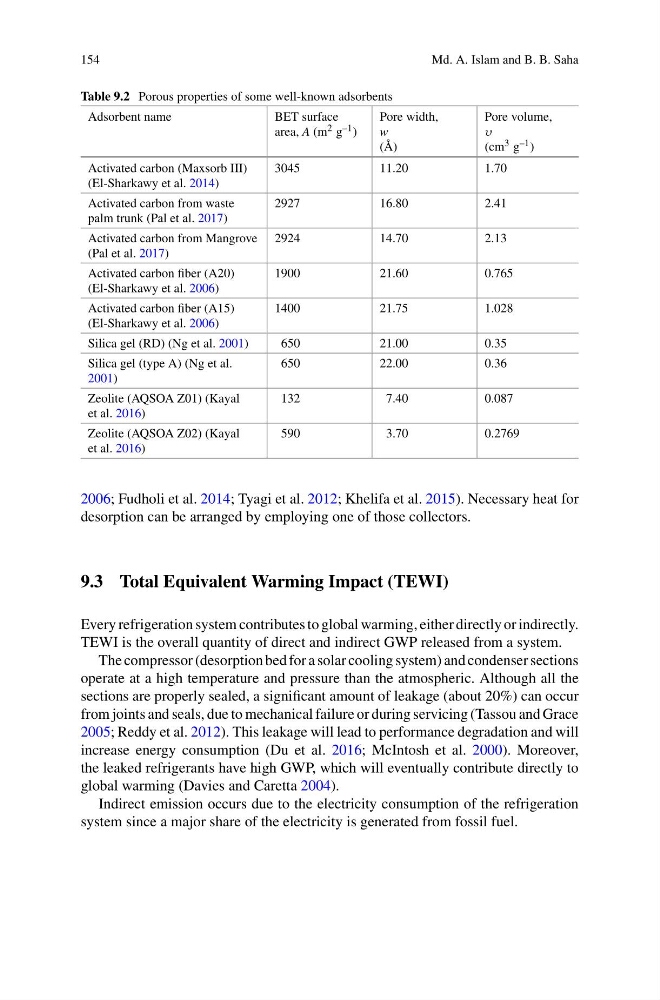
Table 9.2 Porous properties of some well-known adsorbents
Adsorbent name
BET surface
area, A (m 2 g –1 )
Pore width,
w
(Å)
Pore volume,
υ
(cm 3 g –1 )
Activated carbon (Maxsorb III)
(El-Sharkawy et al. 2014)
3045
11.20
1.70
Activated carbon from waste
palm trunk (Pal et al. 2017)
2927
16.80
2.41
Activated carbon from Mangrove
(Pal et al. 2017)
2924
14.70
2.13
Activated carbon fiber (A20)
(El-Sharkawy et al. 2006)
1900
21.60
0.765
Activated carbon fiber (A15)
(El-Sharkawy et al. 2006)
1400
21.75
1.028
Silica gel (RD) (Ng et al. 2001)
650
21.00
0.35
Silica gel (type A) (Ng et al.
2001)
650
22.00
0.36
Zeolite (AQSOA Z01) (Kayal
et al. 2016)
132
7.40
0.087
Zeolite (AQSOA Z02) (Kayal
et al. 2016)
590
3.70
0.2769
2006; Fudholi et al. 2014; Tyagi et al. 2012; Khelifa et al. 2015). Necessary heat for
desorption can be arranged by employing one of those collectors.
9.3 Total Equivalent Warming Impact (TEWI)
Every refrigeration system contributes to global warming, either directly or indirectly.
TEWI is the overall quantity of direct and indirect GWP released from a system.
The compressor (desorption bed for a solar cooling system) and condenser sections
operate at a high temperature and pressure than the atmospheric. Although all the
sections are properly sealed, a significant amount of leakage (about 20%) can occur
from joints and seals, due to mechanical failure or during servicing (Tassou and Grace
2005; Reddy et al. 2012). This leakage will lead to performance degradation and will
increase energy consumption (Du et al. 2016; McIntosh et al. 2000). Moreover,
the leaked refrigerants have high GWP, which will eventually contribute directly to
global warming (Davies and Caretta 2004).
Indirect emission occurs due to the electricity consumption of the refrigeration
system since a major share of the electricity is generated from fossil fuel.
Md. A. Islam and B. B. Saha
Table 9.2 Porous properties of some well-known adsorbents
Adsorbent name
BET surface
area, A (m 2 g –1 )
Pore width,
w
(Å)
Pore volume,
υ
(cm 3 g –1 )
Activated carbon (Maxsorb III)
(El-Sharkawy et al. 2014)
3045
11.20
1.70
Activated carbon from waste
palm trunk (Pal et al. 2017)
2927
16.80
2.41
Activated carbon from Mangrove
(Pal et al. 2017)
2924
14.70
2.13
Activated carbon fiber (A20)
(El-Sharkawy et al. 2006)
1900
21.60
0.765
Activated carbon fiber (A15)
(El-Sharkawy et al. 2006)
1400
21.75
1.028
Silica gel (RD) (Ng et al. 2001)
650
21.00
0.35
Silica gel (type A) (Ng et al.
2001)
650
22.00
0.36
Zeolite (AQSOA Z01) (Kayal
et al. 2016)
132
7.40
0.087
Zeolite (AQSOA Z02) (Kayal
et al. 2016)
590
3.70
0.2769
2006; Fudholi et al. 2014; Tyagi et al. 2012; Khelifa et al. 2015). Necessary heat for
desorption can be arranged by employing one of those collectors.
9.3 Total Equivalent Warming Impact (TEWI)
Every refrigeration system contributes to global warming, either directly or indirectly.
TEWI is the overall quantity of direct and indirect GWP released from a system.
The compressor (desorption bed for a solar cooling system) and condenser sections
operate at a high temperature and pressure than the atmospheric. Although all the
sections are properly sealed, a significant amount of leakage (about 20%) can occur
from joints and seals, due to mechanical failure or during servicing (Tassou and Grace
2005; Reddy et al. 2012). This leakage will lead to performance degradation and will
increase energy consumption (Du et al. 2016; McIntosh et al. 2000). Moreover,
the leaked refrigerants have high GWP, which will eventually contribute directly to
global warming (Davies and Caretta 2004).
Indirect emission occurs due to the electricity consumption of the refrigeration
system since a major share of the electricity is generated from fossil fuel.