

156
Md. A. Islam and B. B. Saha
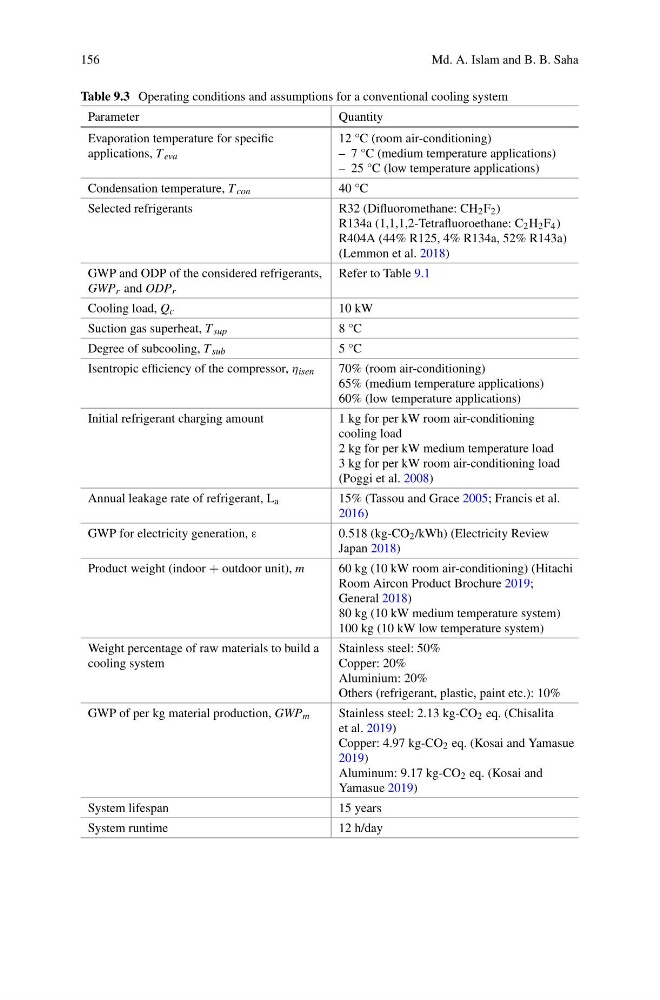
Table 9.3 Operating conditions and assumptions for a conventional cooling system
Parameter
Quantity
Evaporation temperature for specific
applications, T eva
12 °C (room air-conditioning)
– 7 °C (medium temperature applications)
– 25 °C (low temperature applications)
Condensation temperature, T con
40 °C
Selected refrigerants
R32 (Difluoromethane: CH 2 F 2 )
R134a (1,1,1,2-Tetrafluoroethane: C 2 H 2 F 4 )
R404A (44% R125, 4% R134a, 52% R143a)
(Lemmon et al. 2018)
GWP and ODP of the considered refrigerants,
GWP r and ODP r
Refer to Table 9.1
Cooling load, Q c
10 kW
Suction gas superheat, T sup
8 °C
Degree of subcooling, T sub
5 °C
Isentropic efficiency of the compressor, η isen
70% (room air-conditioning)
65% (medium temperature applications)
60% (low temperature applications)
Initial refrigerant charging amount
1 kg for per kW room air-conditioning
cooling load
2 kg for per kW medium temperature load
3 kg for per kW room air-conditioning load
(Poggi et al. 2008)
Annual leakage rate of refrigerant, L a
15% (Tassou and Grace 2005; Francis et al.
2016)
GWP for electricity generation, ε
0.518 (kg-CO 2 /kWh) (Electricity Review
Japan 2018)
Product weight (indoor + outdoor unit), m
60 kg (10 kW room air-conditioning) (Hitachi
Room Aircon Product Brochure 2019;
General 2018)
80 kg (10 kW medium temperature system)
100 kg (10 kW low temperature system)
Weight percentage of raw materials to build a
cooling system
Stainless steel: 50%
Copper: 20%
Aluminium: 20%
Others (refrigerant, plastic, paint etc.): 10%
GWP of per kg material production, GWP m
Stainless steel: 2.13 kg-CO 2 eq. (Chisalita
et al. 2019)
Copper: 4.97 kg-CO 2 eq. (Kosai and Yamasue
2019)
Aluminum: 9.17 kg-CO 2 eq. (Kosai and
Yamasue 2019)
System lifespan
15 years
System runtime
12 h/day
Md. A. Islam and B. B. Saha
Table 9.3 Operating conditions and assumptions for a conventional cooling system
Parameter
Quantity
Evaporation temperature for specific
applications, T eva
12 °C (room air-conditioning)
– 7 °C (medium temperature applications)
– 25 °C (low temperature applications)
Condensation temperature, T con
40 °C
Selected refrigerants
R32 (Difluoromethane: CH 2 F 2 )
R134a (1,1,1,2-Tetrafluoroethane: C 2 H 2 F 4 )
R404A (44% R125, 4% R134a, 52% R143a)
(Lemmon et al. 2018)
GWP and ODP of the considered refrigerants,
GWP r and ODP r
Refer to Table 9.1
Cooling load, Q c
10 kW
Suction gas superheat, T sup
8 °C
Degree of subcooling, T sub
5 °C
Isentropic efficiency of the compressor, η isen
70% (room air-conditioning)
65% (medium temperature applications)
60% (low temperature applications)
Initial refrigerant charging amount
1 kg for per kW room air-conditioning
cooling load
2 kg for per kW medium temperature load
3 kg for per kW room air-conditioning load
(Poggi et al. 2008)
Annual leakage rate of refrigerant, L a
15% (Tassou and Grace 2005; Francis et al.
2016)
GWP for electricity generation, ε
0.518 (kg-CO 2 /kWh) (Electricity Review
Japan 2018)
Product weight (indoor + outdoor unit), m
60 kg (10 kW room air-conditioning) (Hitachi
Room Aircon Product Brochure 2019;
General 2018)
80 kg (10 kW medium temperature system)
100 kg (10 kW low temperature system)
Weight percentage of raw materials to build a
cooling system
Stainless steel: 50%
Copper: 20%
Aluminium: 20%
Others (refrigerant, plastic, paint etc.): 10%
GWP of per kg material production, GWP m
Stainless steel: 2.13 kg-CO 2 eq. (Chisalita
et al. 2019)
Copper: 4.97 kg-CO 2 eq. (Kosai and Yamasue
2019)
Aluminum: 9.17 kg-CO 2 eq. (Kosai and
Yamasue 2019)
System lifespan
15 years
System runtime
12 h/day