

134
M. Muttakin et al.
where k s a v is the overall mass transfer coefficient. Due to the spherical shape of silica
gel adsorbent, the overall mass transfer coefficient can be written as,
k s a v =
15D s
R 2
p
,
where D s is the diffusion time constant, and R p is the adsorbent particle radius. D s
depends on the temperature T, following equation,
D s = D so exp
−E a
RT
where D so is the pre-exponential constant, E a is the activation energy, and R is the universal gas constant. The values of D so and E a can be obtained from the experimental
data by plotting lnD s against 1/T as described by the equation stated below,
ln D s − ln D so =
−E a
RT
This plot is known as the Arrhenius plot. The slop yields −E a /R and the intercept
provides the constant, D so . Hence, for an adsorption chiller comprising silica gel—
water pair, Eq. (8.31) can be rewritten as,
dw
dt
=
15D so
R 2
p
exp
−E a
RT
(w ∗ −w)
(8.32)
8.5.3 Model Equations of the Chiller
The energy balance equations of different components (beds, evaporator, condenser)
can be generalized as follows,
MC p
H.E x
dT k
dt
= M bed h ads
dw
dt
+
˙
mC p (T in − T out )
H.E x. f luid
(8.33)
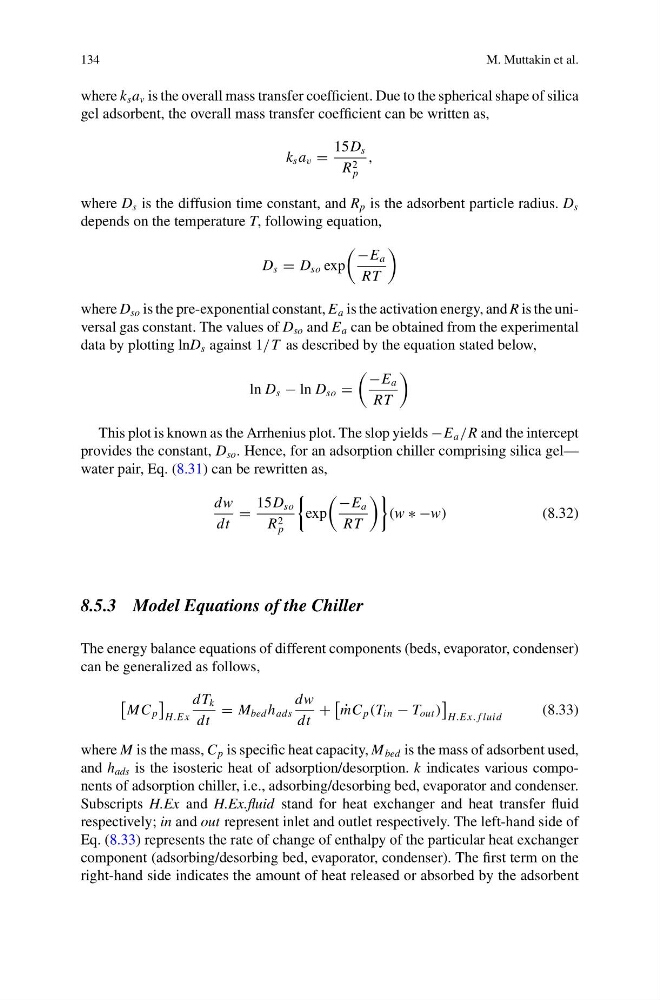
where M is the mass, C p is specific heat capacity, M bed is the mass of adsorbent used,
and h ads is the isosteric heat of adsorption/desorption. k indicates various components of adsorption chiller, i.e., adsorbing/desorbing bed, evaporator and condenser.
Subscripts H.Ex and H.Ex.fluid stand for heat exchanger and heat transfer fluid
respectively; in and out represent inlet and outlet respectively. The left-hand side of
Eq. (8.33) represents the rate of change of enthalpy of the particular heat exchanger
component (adsorbing/desorbing bed, evaporator, condenser). The first term on the
right-hand side indicates the amount of heat released or absorbed by the adsorbent
M. Muttakin et al.
where k s a v is the overall mass transfer coefficient. Due to the spherical shape of silica
gel adsorbent, the overall mass transfer coefficient can be written as,
k s a v =
15D s
R 2
p
,
where D s is the diffusion time constant, and R p is the adsorbent particle radius. D s
depends on the temperature T, following equation,
D s = D so exp
−E a
RT
where D so is the pre-exponential constant, E a is the activation energy, and R is the universal gas constant. The values of D so and E a can be obtained from the experimental
data by plotting lnD s against 1/T as described by the equation stated below,
ln D s − ln D so =
−E a
RT
This plot is known as the Arrhenius plot. The slop yields −E a /R and the intercept
provides the constant, D so . Hence, for an adsorption chiller comprising silica gel—
water pair, Eq. (8.31) can be rewritten as,
dw
dt
=
15D so
R 2
p
exp
−E a
RT
(w ∗ −w)
(8.32)
8.5.3 Model Equations of the Chiller
The energy balance equations of different components (beds, evaporator, condenser)
can be generalized as follows,
MC p
H.E x
dT k
dt
= M bed h ads
dw
dt
+
˙
mC p (T in − T out )
H.E x. f luid
(8.33)
where M is the mass, C p is specific heat capacity, M bed is the mass of adsorbent used,
and h ads is the isosteric heat of adsorption/desorption. k indicates various components of adsorption chiller, i.e., adsorbing/desorbing bed, evaporator and condenser.
Subscripts H.Ex and H.Ex.fluid stand for heat exchanger and heat transfer fluid
respectively; in and out represent inlet and outlet respectively. The left-hand side of
Eq. (8.33) represents the rate of change of enthalpy of the particular heat exchanger
component (adsorbing/desorbing bed, evaporator, condenser). The first term on the
right-hand side indicates the amount of heat released or absorbed by the adsorbent