

8 Solar Thermal-Powered Adsorption Chiller
133
8.5.2 Model Equations for the Adsorbent—Adsorbate Pair
Prior to modelling different components (beds, evaporator, condenser) of an adsorption chiller, it is required to define the models of two most important parameters of
an adsorbent—adsorbate pair; these are isotherm and kinetics.
8.5.2.1 Isotherm Model
Adsorption isotherm defines the maximum amount of adsorbate that can be adsorbed
by the adsorbent at a particular pressure. The values of isotherm parameters are determined by correlating the experimental data of equilibrium uptake with the model.
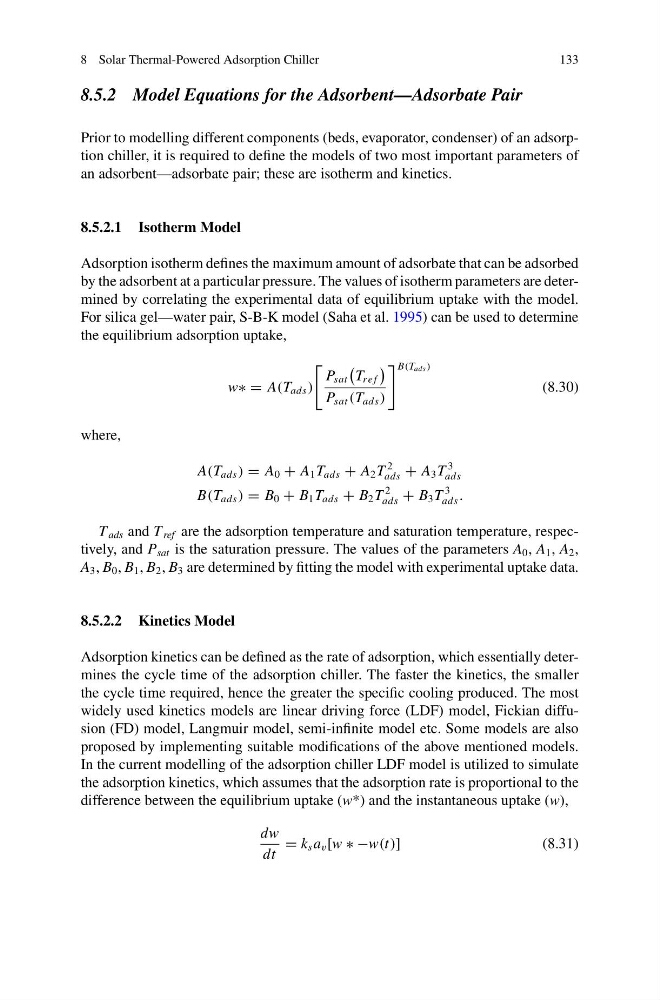
For silica gel—water pair, S-B-K model (Saha et al. 1995) can be used to determine
the equilibrium adsorption uptake,
w∗ = A(T ads )
P sat
T re f
P sat (T ads )
B(T ads )
(8.30)
where,
A(T ads ) = A 0 + A 1 T ads + A 2 T
2
ads + A 3 T
3
ads
B(T ads ) = B 0 + B 1 T ads + B 2 T
2
ads + B 3 T
3
ads .
T ads and T ref are the adsorption temperature and saturation temperature, respectively, and P sat is the saturation pressure. The values of the parameters A 0 , A 1 , A 2 ,
A 3 , B 0 , B 1 , B 2 , B 3 are determined by fitting the model with experimental uptake data.
8.5.2.2 Kinetics Model
Adsorption kinetics can be defined as the rate of adsorption, which essentially determines the cycle time of the adsorption chiller. The faster the kinetics, the smaller
the cycle time required, hence the greater the specific cooling produced. The most
widely used kinetics models are linear driving force (LDF) model, Fickian diffusion (FD) model, Langmuir model, semi-infinite model etc. Some models are also
proposed by implementing suitable modifications of the above mentioned models.
In the current modelling of the adsorption chiller LDF model is utilized to simulate
the adsorption kinetics, which assumes that the adsorption rate is proportional to the
difference between the equilibrium uptake (w*) and the instantaneous uptake (w),
dw
dt
= k s a v [w ∗ −w(t)]
(8.31)
133
8.5.2 Model Equations for the Adsorbent—Adsorbate Pair
Prior to modelling different components (beds, evaporator, condenser) of an adsorption chiller, it is required to define the models of two most important parameters of
an adsorbent—adsorbate pair; these are isotherm and kinetics.
8.5.2.1 Isotherm Model
Adsorption isotherm defines the maximum amount of adsorbate that can be adsorbed
by the adsorbent at a particular pressure. The values of isotherm parameters are determined by correlating the experimental data of equilibrium uptake with the model.
For silica gel—water pair, S-B-K model (Saha et al. 1995) can be used to determine
the equilibrium adsorption uptake,
w∗ = A(T ads )
P sat
T re f
P sat (T ads )
B(T ads )
(8.30)
where,
A(T ads ) = A 0 + A 1 T ads + A 2 T
2
ads + A 3 T
3
ads
B(T ads ) = B 0 + B 1 T ads + B 2 T
2
ads + B 3 T
3
ads .
T ads and T ref are the adsorption temperature and saturation temperature, respectively, and P sat is the saturation pressure. The values of the parameters A 0 , A 1 , A 2 ,
A 3 , B 0 , B 1 , B 2 , B 3 are determined by fitting the model with experimental uptake data.
8.5.2.2 Kinetics Model
Adsorption kinetics can be defined as the rate of adsorption, which essentially determines the cycle time of the adsorption chiller. The faster the kinetics, the smaller
the cycle time required, hence the greater the specific cooling produced. The most
widely used kinetics models are linear driving force (LDF) model, Fickian diffusion (FD) model, Langmuir model, semi-infinite model etc. Some models are also
proposed by implementing suitable modifications of the above mentioned models.
In the current modelling of the adsorption chiller LDF model is utilized to simulate
the adsorption kinetics, which assumes that the adsorption rate is proportional to the
difference between the equilibrium uptake (w*) and the instantaneous uptake (w),
dw
dt
= k s a v [w ∗ −w(t)]
(8.31)