

98
K. V. S. Teja et al.
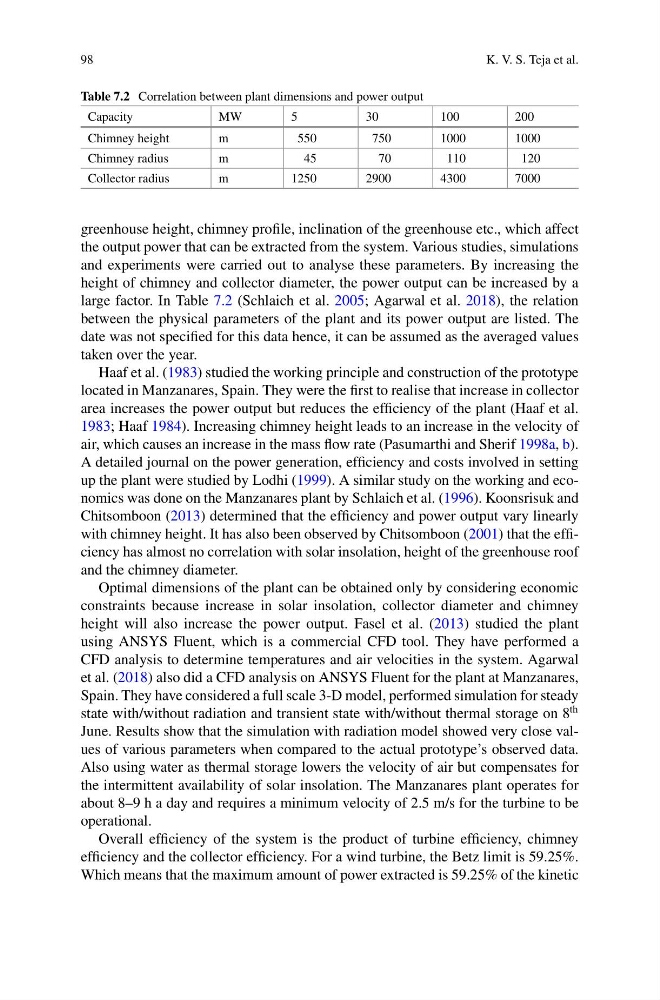
Table 7.2 Correlation between plant dimensions and power output
Capacity
MW
5
30
100
200
Chimney height
m
550
750
1000
1000
Chimney radius
m
45
70
110
120
Collector radius
m
1250
2900
4300
7000
greenhouse height, chimney profile, inclination of the greenhouse etc., which affect
the output power that can be extracted from the system. Various studies, simulations
and experiments were carried out to analyse these parameters. By increasing the
height of chimney and collector diameter, the power output can be increased by a
large factor. In Table 7.2 (Schlaich et al. 2005; Agarwal et al. 2018), the relation
between the physical parameters of the plant and its power output are listed. The
date was not specified for this data hence, it can be assumed as the averaged values
taken over the year.
Haaf et al. (1983) studied the working principle and construction of the prototype
located in Manzanares, Spain. They were the first to realise that increase in collector
area increases the power output but reduces the efficiency of the plant (Haaf et al.
1983; Haaf 1984). Increasing chimney height leads to an increase in the velocity of
air, which causes an increase in the mass flow rate (Pasumarthi and Sherif 1998a, b).
A detailed journal on the power generation, efficiency and costs involved in setting
up the plant were studied by Lodhi (1999). A similar study on the working and economics was done on the Manzanares plant by Schlaich et al. (1996). Koonsrisuk and
Chitsomboon (2013) determined that the efficiency and power output vary linearly
with chimney height. It has also been observed by Chitsomboon (2001) that the efficiency has almost no correlation with solar insolation, height of the greenhouse roof
and the chimney diameter.
Optimal dimensions of the plant can be obtained only by considering economic
constraints because increase in solar insolation, collector diameter and chimney
height will also increase the power output. Fasel et al. (2013) studied the plant
using ANSYS Fluent, which is a commercial CFD tool. They have performed a
CFD analysis to determine temperatures and air velocities in the system. Agarwal
et al. (2018) also did a CFD analysis on ANSYS Fluent for the plant at Manzanares,
Spain. They have considered a full scale 3-D model, performed simulation for steady
state with/without radiation and transient state with/without thermal storage on 8
th
June. Results show that the simulation with radiation model showed very close values of various parameters when compared to the actual prototype’s observed data.
Also using water as thermal storage lowers the velocity of air but compensates for
the intermittent availability of solar insolation. The Manzanares plant operates for
about 8–9 h a day and requires a minimum velocity of 2.5 m/s for the turbine to be
operational.
Overall efficiency of the system is the product of turbine efficiency, chimney
efficiency and the collector efficiency. For a wind turbine, the Betz limit is 59.25%.
Which means that the maximum amount of power extracted is 59.25% of the kinetic
K. V. S. Teja et al.
Table 7.2 Correlation between plant dimensions and power output
Capacity
MW
5
30
100
200
Chimney height
m
550
750
1000
1000
Chimney radius
m
45
70
110
120
Collector radius
m
1250
2900
4300
7000
greenhouse height, chimney profile, inclination of the greenhouse etc., which affect
the output power that can be extracted from the system. Various studies, simulations
and experiments were carried out to analyse these parameters. By increasing the
height of chimney and collector diameter, the power output can be increased by a
large factor. In Table 7.2 (Schlaich et al. 2005; Agarwal et al. 2018), the relation
between the physical parameters of the plant and its power output are listed. The
date was not specified for this data hence, it can be assumed as the averaged values
taken over the year.
Haaf et al. (1983) studied the working principle and construction of the prototype
located in Manzanares, Spain. They were the first to realise that increase in collector
area increases the power output but reduces the efficiency of the plant (Haaf et al.
1983; Haaf 1984). Increasing chimney height leads to an increase in the velocity of
air, which causes an increase in the mass flow rate (Pasumarthi and Sherif 1998a, b).
A detailed journal on the power generation, efficiency and costs involved in setting
up the plant were studied by Lodhi (1999). A similar study on the working and economics was done on the Manzanares plant by Schlaich et al. (1996). Koonsrisuk and
Chitsomboon (2013) determined that the efficiency and power output vary linearly
with chimney height. It has also been observed by Chitsomboon (2001) that the efficiency has almost no correlation with solar insolation, height of the greenhouse roof
and the chimney diameter.
Optimal dimensions of the plant can be obtained only by considering economic
constraints because increase in solar insolation, collector diameter and chimney
height will also increase the power output. Fasel et al. (2013) studied the plant
using ANSYS Fluent, which is a commercial CFD tool. They have performed a
CFD analysis to determine temperatures and air velocities in the system. Agarwal
et al. (2018) also did a CFD analysis on ANSYS Fluent for the plant at Manzanares,
Spain. They have considered a full scale 3-D model, performed simulation for steady
state with/without radiation and transient state with/without thermal storage on 8
th
June. Results show that the simulation with radiation model showed very close values of various parameters when compared to the actual prototype’s observed data.
Also using water as thermal storage lowers the velocity of air but compensates for
the intermittent availability of solar insolation. The Manzanares plant operates for
about 8–9 h a day and requires a minimum velocity of 2.5 m/s for the turbine to be
operational.
Overall efficiency of the system is the product of turbine efficiency, chimney
efficiency and the collector efficiency. For a wind turbine, the Betz limit is 59.25%.
Which means that the maximum amount of power extracted is 59.25% of the kinetic