

7 Mathematical Modelling of Solar Updraft Tower
97
tackle such a huge demand in energy, we need to start using renewable sources like:
hydro-electric, wind, solar etc. Among the renewable energy sources, solar energy
and wind energy are the most abundant, easily available and environment friendly.
Without a doubt, fossil fuels are much more efficient and effective ways to produce
power. But keep in mind that these sources are going to deplete one day and they
also have huge adverse impact on the environment. Hence, the need to find more and
better ways to use these forms of energy arises (Shahzad 2012). Solar updraft tower
is one such way to harness energy from the sun. It is a very simple construction.
The power plant consists of three major components: 1. Greenhouse (collector),
2. Chimney, 3. Wind turbine.
The greenhouse is made of glass or plastic. These materials act as transparent
medium for shorter-wavelengths and opaque for longer-wavelengths. Hence, the heat
from the sun gets trapped inside the greenhouse. A chimney is placed at the centre.
During the day, the solar irradiation falling onto the collector heats up the air inside
the greenhouse. Since, temperature and density are inversely related for constant
pressure (from ideal gas equation); density of air is lower inside when compared to
the ambient air. This density difference creates pressure gradient between the base
and ambient air inside the chimney. This pressure gradient when created over a large
area, gets converted in kinetic energy, and used to run a turbine and extract energy.
For the purpose of this plant, a vertical axis wind turbine is used to generate power.
During the night, the ground is hot because it absorbs the sun’s radiation during
the day. The hot ground heats up the air inside the greenhouse at night. Hence, this
type of plant can operate for 24 h a day. The land can be utilised by planting crops.
Even though a very large area is required for such a plant to generate significant
power output, the land is not wasted and can be utilised in a number of ways such
as, planting crops, solar panels can also be set up on the ground.
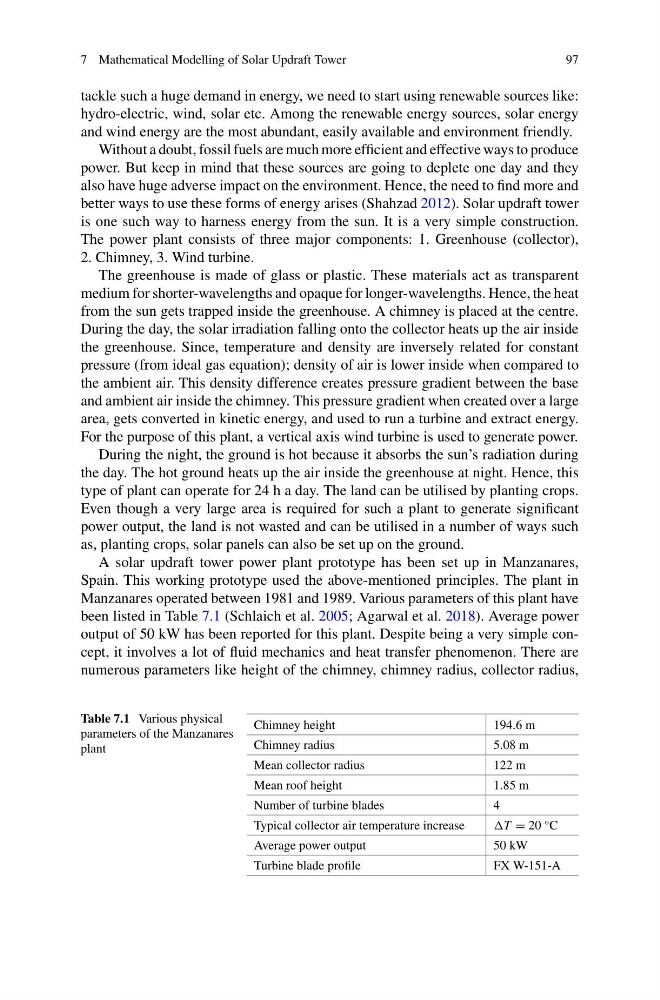
A solar updraft tower power plant prototype has been set up in Manzanares,
Spain. This working prototype used the above-mentioned principles. The plant in
Manzanares operated between 1981 and 1989. Various parameters of this plant have
been listed in Table 7.1 (Schlaich et al. 2005; Agarwal et al. 2018). Average power
output of 50 kW has been reported for this plant. Despite being a very simple concept, it involves a lot of fluid mechanics and heat transfer phenomenon. There are
numerous parameters like height of the chimney, chimney radius, collector radius,
Table 7.1 Various physical
parameters of the Manzanares
plant
Chimney height
194.6 m
Chimney radius
5.08 m
Mean collector radius
122 m
Mean roof height
1.85 m
Number of turbine blades
4
Typical collector air temperature increase
T = 20 °C
Average power output
50 kW
Turbine blade profile
FX W-151-A
97
tackle such a huge demand in energy, we need to start using renewable sources like:
hydro-electric, wind, solar etc. Among the renewable energy sources, solar energy
and wind energy are the most abundant, easily available and environment friendly.
Without a doubt, fossil fuels are much more efficient and effective ways to produce
power. But keep in mind that these sources are going to deplete one day and they
also have huge adverse impact on the environment. Hence, the need to find more and
better ways to use these forms of energy arises (Shahzad 2012). Solar updraft tower
is one such way to harness energy from the sun. It is a very simple construction.
The power plant consists of three major components: 1. Greenhouse (collector),
2. Chimney, 3. Wind turbine.
The greenhouse is made of glass or plastic. These materials act as transparent
medium for shorter-wavelengths and opaque for longer-wavelengths. Hence, the heat
from the sun gets trapped inside the greenhouse. A chimney is placed at the centre.
During the day, the solar irradiation falling onto the collector heats up the air inside
the greenhouse. Since, temperature and density are inversely related for constant
pressure (from ideal gas equation); density of air is lower inside when compared to
the ambient air. This density difference creates pressure gradient between the base
and ambient air inside the chimney. This pressure gradient when created over a large
area, gets converted in kinetic energy, and used to run a turbine and extract energy.
For the purpose of this plant, a vertical axis wind turbine is used to generate power.
During the night, the ground is hot because it absorbs the sun’s radiation during
the day. The hot ground heats up the air inside the greenhouse at night. Hence, this
type of plant can operate for 24 h a day. The land can be utilised by planting crops.
Even though a very large area is required for such a plant to generate significant
power output, the land is not wasted and can be utilised in a number of ways such
as, planting crops, solar panels can also be set up on the ground.
A solar updraft tower power plant prototype has been set up in Manzanares,
Spain. This working prototype used the above-mentioned principles. The plant in
Manzanares operated between 1981 and 1989. Various parameters of this plant have
been listed in Table 7.1 (Schlaich et al. 2005; Agarwal et al. 2018). Average power
output of 50 kW has been reported for this plant. Despite being a very simple concept, it involves a lot of fluid mechanics and heat transfer phenomenon. There are
numerous parameters like height of the chimney, chimney radius, collector radius,
Table 7.1 Various physical
parameters of the Manzanares
plant
Chimney height
194.6 m
Chimney radius
5.08 m
Mean collector radius
122 m
Mean roof height
1.85 m
Number of turbine blades
4
Typical collector air temperature increase
T = 20 °C
Average power output
50 kW
Turbine blade profile
FX W-151-A