

3.5 States’ Priorities and Preferences
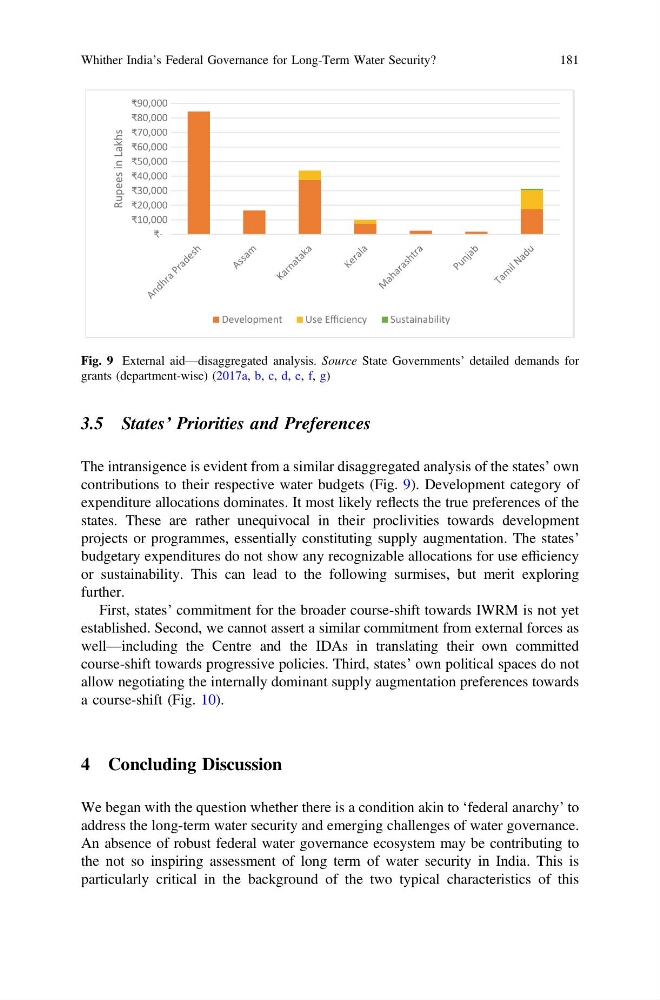
The intransigence is evident from a similar disaggregated analysis of the states’ own
contributions to their respective water budgets (Fig. 9). Development category of
expenditure allocations dominates. It most likely reflects the true preferences of the
states. These are rather unequivocal in their proclivities towards development
projects or programmes, essentially constituting supply augmentation. The states’
budgetary expenditures do not show any recognizable allocations for use efficiency
or sustainability. This can lead to the following surmises, but merit exploring
further.
First, states’ commitment for the broader course-shift towards IWRM is not yet
established. Second, we cannot assert a similar commitment from external forces as
well—including the Centre and the IDAs in translating their own committed
course-shift towards progressive policies. Third, states’ own political spaces do not
allow negotiating the internally dominant supply augmentation preferences towards
a course-shift (Fig. 10).
4 Concluding Discussion
We began with the question whether there is a condition akin to ‘federal anarchy’ to
address the long-term water security and emerging challenges of water governance.
An absence of robust federal water governance ecosystem may be contributing to
the not so inspiring assessment of long term of water security in India. This is
particularly critical in the background of the two typical characteristics of this
₹₹10,000
₹20,000
₹30,000
₹40,000
₹50,000
₹60,000
₹70,000
₹80,000
₹90,000
Rupees in Lakhs
Development
Use Efficiency
Sustainability
Fig. 9 External aid—disaggregated analysis. Source State Governments’ detailed demands for
grants (department-wise) (2017a, b, c, d, e, f, g)
Whither India’s Federal Governance for Long-Term Water Security?
181
The intransigence is evident from a similar disaggregated analysis of the states’ own
contributions to their respective water budgets (Fig. 9). Development category of
expenditure allocations dominates. It most likely reflects the true preferences of the
states. These are rather unequivocal in their proclivities towards development
projects or programmes, essentially constituting supply augmentation. The states’
budgetary expenditures do not show any recognizable allocations for use efficiency
or sustainability. This can lead to the following surmises, but merit exploring
further.
First, states’ commitment for the broader course-shift towards IWRM is not yet
established. Second, we cannot assert a similar commitment from external forces as
well—including the Centre and the IDAs in translating their own committed
course-shift towards progressive policies. Third, states’ own political spaces do not
allow negotiating the internally dominant supply augmentation preferences towards
a course-shift (Fig. 10).
4 Concluding Discussion
We began with the question whether there is a condition akin to ‘federal anarchy’ to
address the long-term water security and emerging challenges of water governance.
An absence of robust federal water governance ecosystem may be contributing to
the not so inspiring assessment of long term of water security in India. This is
particularly critical in the background of the two typical characteristics of this
₹₹10,000
₹20,000
₹30,000
₹40,000
₹50,000
₹60,000
₹70,000
₹80,000
₹90,000
Rupees in Lakhs
Development
Use Efficiency
Sustainability
Fig. 9 External aid—disaggregated analysis. Source State Governments’ detailed demands for
grants (department-wise) (2017a, b, c, d, e, f, g)
Whither India’s Federal Governance for Long-Term Water Security?
181