

Other similar CSSs such as the Ganga Action Plan (GAP—extended to National
River Conservation Plan to include other rivers) are meant to promote water and
river conservation. A closer look at support to states through the CSSs reveals some
interesting insights.
These programmes do not appear much different from earlier ones in terms of the
projects funded or their nature. The transfers continue to largely support supply
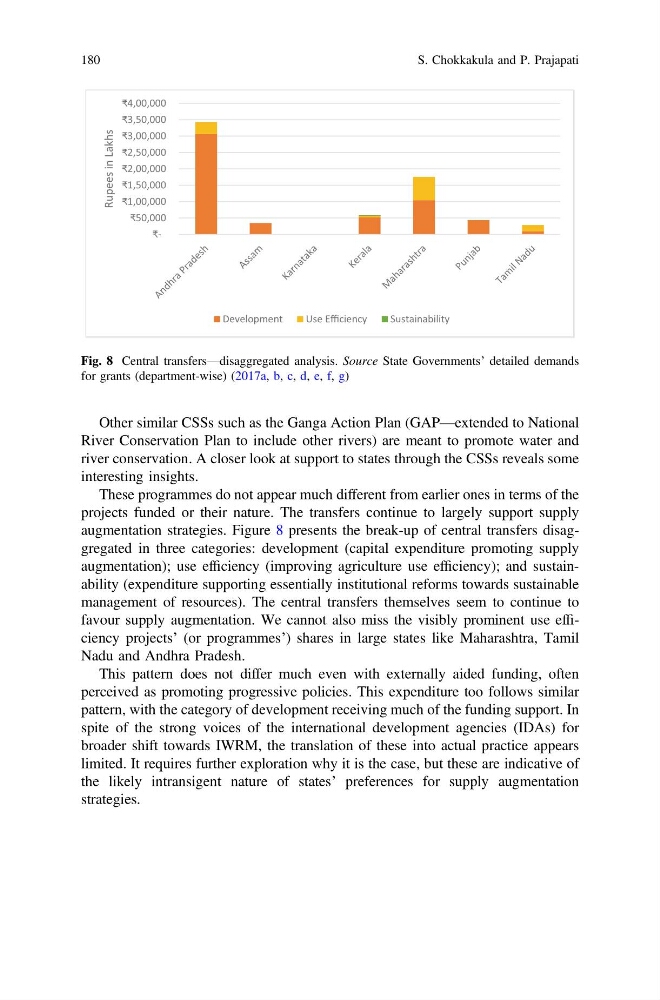
augmentation strategies. Figure 8 presents the break-up of central transfers disaggregated in three categories: development (capital expenditure promoting supply
augmentation); use efficiency (improving agriculture use efficiency); and sustainability (expenditure supporting essentially institutional reforms towards sustainable
management of resources). The central transfers themselves seem to continue to
favour supply augmentation. We cannot also miss the visibly prominent use efficiency projects’ (or programmes’) shares in large states like Maharashtra, Tamil
Nadu and Andhra Pradesh.
This pattern does not differ much even with externally aided funding, often
perceived as promoting progressive policies. This expenditure too follows similar
pattern, with the category of development receiving much of the funding support. In
spite of the strong voices of the international development agencies (IDAs) for
broader shift towards IWRM, the translation of these into actual practice appears
limited. It requires further exploration why it is the case, but these are indicative of
the likely intransigent nature of states’ preferences for supply augmentation
strategies.
₹₹50,000
₹1,00,000
₹1,50,000
₹2,00,000
₹2,50,000
₹3,00,000
₹3,50,000
₹4,00,000
Rupees in Lakhs
Development
Use Efficiency
Sustainability
Fig. 8 Central transfers—disaggregated analysis. Source State Governments’ detailed demands
for grants (department-wise) (2017a, b, c, d, e, f, g)
180
S. Chokkakula and P. Prajapati
River Conservation Plan to include other rivers) are meant to promote water and
river conservation. A closer look at support to states through the CSSs reveals some
interesting insights.
These programmes do not appear much different from earlier ones in terms of the
projects funded or their nature. The transfers continue to largely support supply
augmentation strategies. Figure 8 presents the break-up of central transfers disaggregated in three categories: development (capital expenditure promoting supply
augmentation); use efficiency (improving agriculture use efficiency); and sustainability (expenditure supporting essentially institutional reforms towards sustainable
management of resources). The central transfers themselves seem to continue to
favour supply augmentation. We cannot also miss the visibly prominent use efficiency projects’ (or programmes’) shares in large states like Maharashtra, Tamil
Nadu and Andhra Pradesh.
This pattern does not differ much even with externally aided funding, often
perceived as promoting progressive policies. This expenditure too follows similar
pattern, with the category of development receiving much of the funding support. In
spite of the strong voices of the international development agencies (IDAs) for
broader shift towards IWRM, the translation of these into actual practice appears
limited. It requires further exploration why it is the case, but these are indicative of
the likely intransigent nature of states’ preferences for supply augmentation
strategies.
₹₹50,000
₹1,00,000
₹1,50,000
₹2,00,000
₹2,50,000
₹3,00,000
₹3,50,000
₹4,00,000
Rupees in Lakhs
Development
Use Efficiency
Sustainability
Fig. 8 Central transfers—disaggregated analysis. Source State Governments’ detailed demands
for grants (department-wise) (2017a, b, c, d, e, f, g)
180
S. Chokkakula and P. Prajapati