

3.3 Are the Centre’s Contributions to States’ Water Budgets
Significant Enough to Influence Them?
The flow of financial resources to states happens through the Finance Commission’s
redistribution of tax collections. These IGFTs are of two types: general-purpose
IGFTs and specific-purpose IGFTs. The former follows a particular formula, and
there is not much room for reworking these transfers. The latter flows through the
Central Sector Schemes (CSs) and Centrally Sponsored Schemes (CSSs). These
schemes can be designed to nudge or influence states in a particular direction, as in
the interest of changing states’ strategies or choices to address the larger challenges
liked to long-term water security and sustainability.
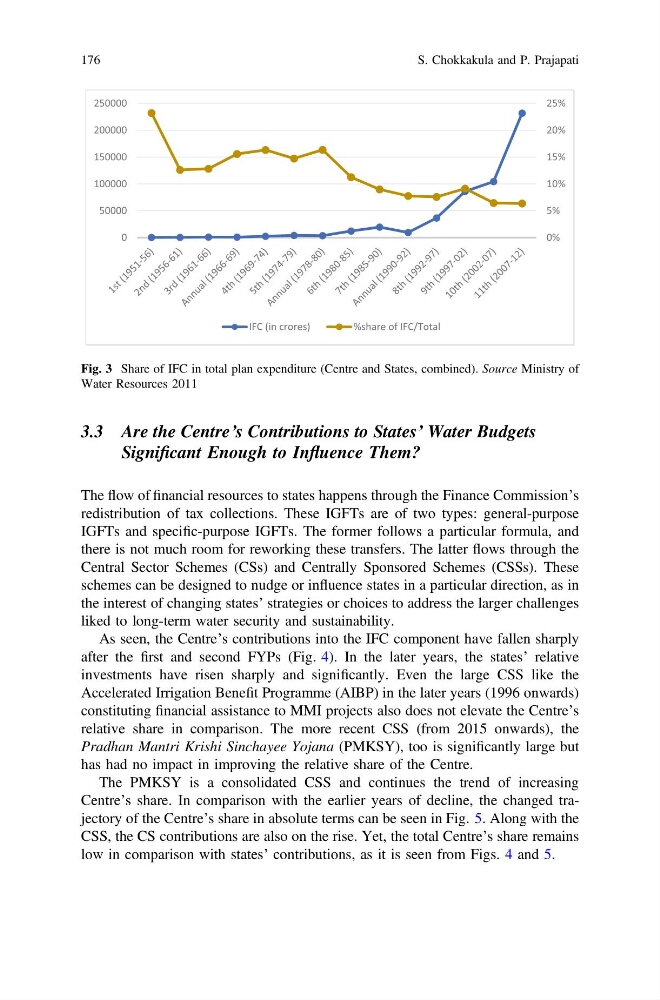
As seen, the Centre’s contributions into the IFC component have fallen sharply
after the first and second FYPs (Fig. 4). In the later years, the states’ relative
investments have risen sharply and significantly. Even the large CSS like the
Accelerated Irrigation Benefit Programme (AIBP) in the later years (1996 onwards)
constituting financial assistance to MMI projects also does not elevate the Centre’s
relative share in comparison. The more recent CSS (from 2015 onwards), the
Pradhan Mantri Krishi Sinchayee Yojana (PMKSY), too is significantly large but
has had no impact in improving the relative share of the Centre.
The PMKSY is a consolidated CSS and continues the trend of increasing
Centre’s share. In comparison with the earlier years of decline, the changed trajectory of the Centre’s share in absolute terms can be seen in Fig. 5. Along with the
CSS, the CS contributions are also on the rise. Yet, the total Centre’s share remains
low in comparison with states’ contributions, as it is seen from Figs. 4 and 5.
0%
5%
10%
15%
20%
25%
0
50000
100000
150000
200000
250000
IFC (in crores)
%share of IFC/Total
Fig. 3 Share of IFC in total plan expenditure (Centre and States, combined). Source Ministry of
Water Resources 2011
176
S. Chokkakula and P. Prajapati
Significant Enough to Influence Them?
The flow of financial resources to states happens through the Finance Commission’s
redistribution of tax collections. These IGFTs are of two types: general-purpose
IGFTs and specific-purpose IGFTs. The former follows a particular formula, and
there is not much room for reworking these transfers. The latter flows through the
Central Sector Schemes (CSs) and Centrally Sponsored Schemes (CSSs). These
schemes can be designed to nudge or influence states in a particular direction, as in
the interest of changing states’ strategies or choices to address the larger challenges
liked to long-term water security and sustainability.
As seen, the Centre’s contributions into the IFC component have fallen sharply
after the first and second FYPs (Fig. 4). In the later years, the states’ relative
investments have risen sharply and significantly. Even the large CSS like the
Accelerated Irrigation Benefit Programme (AIBP) in the later years (1996 onwards)
constituting financial assistance to MMI projects also does not elevate the Centre’s
relative share in comparison. The more recent CSS (from 2015 onwards), the
Pradhan Mantri Krishi Sinchayee Yojana (PMKSY), too is significantly large but
has had no impact in improving the relative share of the Centre.
The PMKSY is a consolidated CSS and continues the trend of increasing
Centre’s share. In comparison with the earlier years of decline, the changed trajectory of the Centre’s share in absolute terms can be seen in Fig. 5. Along with the
CSS, the CS contributions are also on the rise. Yet, the total Centre’s share remains
low in comparison with states’ contributions, as it is seen from Figs. 4 and 5.
0%
5%
10%
15%
20%
25%
0
50000
100000
150000
200000
250000
IFC (in crores)
%share of IFC/Total
Fig. 3 Share of IFC in total plan expenditure (Centre and States, combined). Source Ministry of
Water Resources 2011
176
S. Chokkakula and P. Prajapati