

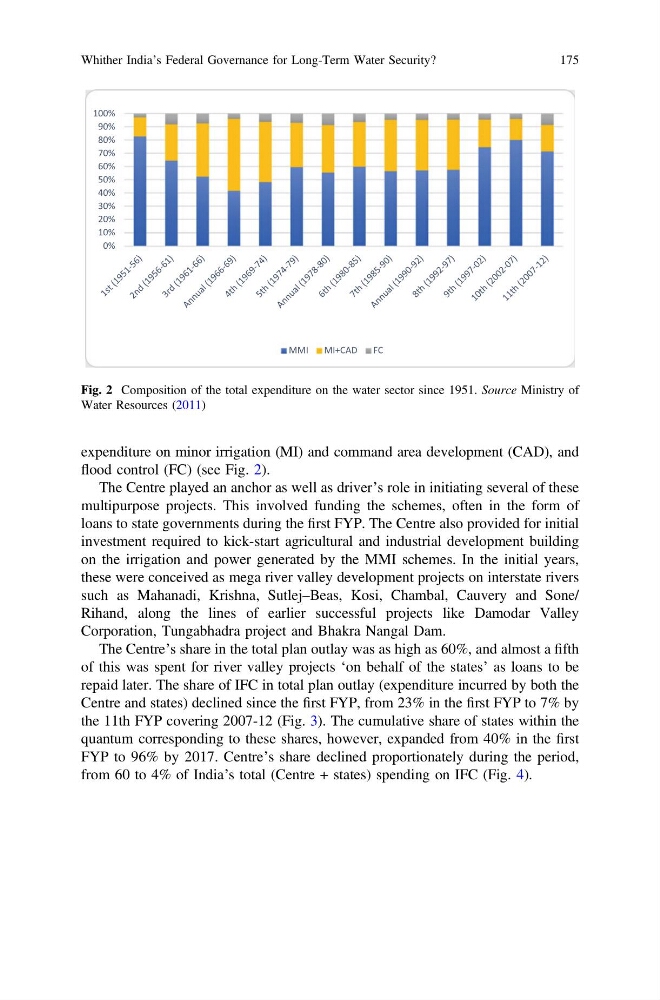
expenditure on minor irrigation (MI) and command area development (CAD), and
flood control (FC) (see Fig. 2).
The Centre played an anchor as well as driver’s role in initiating several of these
multipurpose projects. This involved funding the schemes, often in the form of
loans to state governments during the first FYP. The Centre also provided for initial
investment required to kick-start agricultural and industrial development building
on the irrigation and power generated by the MMI schemes. In the initial years,
these were conceived as mega river valley development projects on interstate rivers
such as Mahanadi, Krishna, Sutlej–Beas, Kosi, Chambal, Cauvery and Sone/
Rihand, along the lines of earlier successful projects like Damodar Valley
Corporation, Tungabhadra project and Bhakra Nangal Dam.
The Centre’s share in the total plan outlay was as high as 60%, and almost a fifth
of this was spent for river valley projects ‘on behalf of the states’ as loans to be
repaid later. The share of IFC in total plan outlay (expenditure incurred by both the
Centre and states) declined since the first FYP, from 23% in the first FYP to 7% by
the 11th FYP covering 2007-12 (Fig. 3). The cumulative share of states within the
quantum corresponding to these shares, however, expanded from 40% in the first
FYP to 96% by 2017. Centre’s share declined proportionately during the period,
from 60 to 4% of India’s total (Centre + states) spending on IFC (Fig. 4).
0%
10%
20%
30%
40%
50%
60%
70%
80%
90%
100%
MMI
MI+CAD
FC
Fig. 2 Composition of the total expenditure on the water sector since 1951. Source Ministry of
Water Resources (2011)
Whither India’s Federal Governance for Long-Term Water Security?
175
flood control (FC) (see Fig. 2).
The Centre played an anchor as well as driver’s role in initiating several of these
multipurpose projects. This involved funding the schemes, often in the form of
loans to state governments during the first FYP. The Centre also provided for initial
investment required to kick-start agricultural and industrial development building
on the irrigation and power generated by the MMI schemes. In the initial years,
these were conceived as mega river valley development projects on interstate rivers
such as Mahanadi, Krishna, Sutlej–Beas, Kosi, Chambal, Cauvery and Sone/
Rihand, along the lines of earlier successful projects like Damodar Valley
Corporation, Tungabhadra project and Bhakra Nangal Dam.
The Centre’s share in the total plan outlay was as high as 60%, and almost a fifth
of this was spent for river valley projects ‘on behalf of the states’ as loans to be
repaid later. The share of IFC in total plan outlay (expenditure incurred by both the
Centre and states) declined since the first FYP, from 23% in the first FYP to 7% by
the 11th FYP covering 2007-12 (Fig. 3). The cumulative share of states within the
quantum corresponding to these shares, however, expanded from 40% in the first
FYP to 96% by 2017. Centre’s share declined proportionately during the period,
from 60 to 4% of India’s total (Centre + states) spending on IFC (Fig. 4).
0%
10%
20%
30%
40%
50%
60%
70%
80%
90%
100%
MMI
MI+CAD
FC
Fig. 2 Composition of the total expenditure on the water sector since 1951. Source Ministry of
Water Resources (2011)
Whither India’s Federal Governance for Long-Term Water Security?
175