

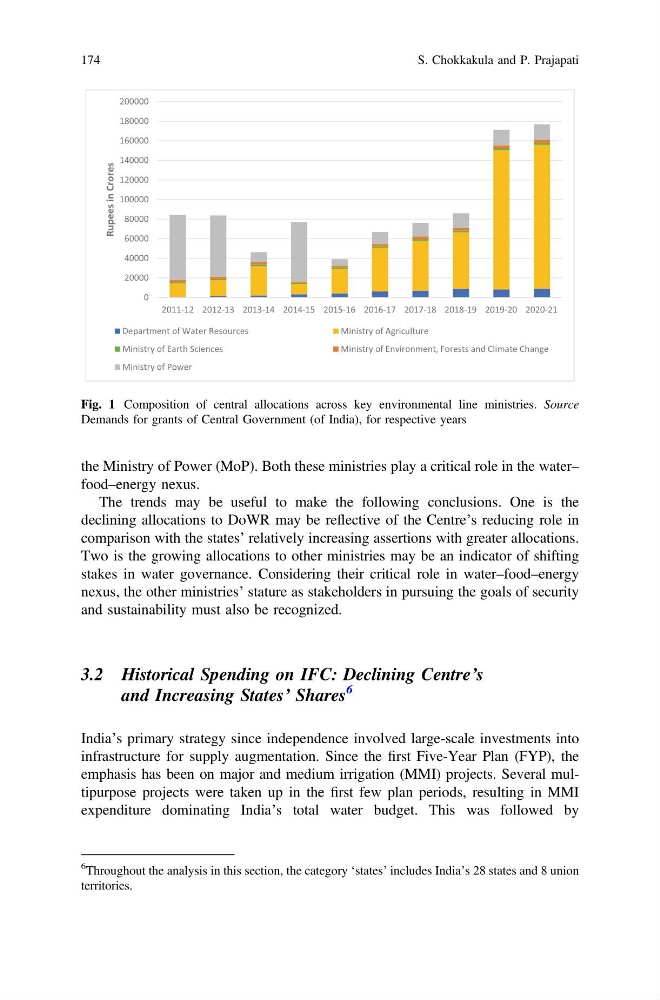
the Ministry of Power (MoP). Both these ministries play a critical role in the water–
food–energy nexus.
The trends may be useful to make the following conclusions. One is the
declining allocations to DoWR may be reflective of the Centre’s reducing role in
comparison with the states’ relatively increasing assertions with greater allocations.
Two is the growing allocations to other ministries may be an indicator of shifting
stakes in water governance. Considering their critical role in water–food–energy
nexus, the other ministries’ stature as stakeholders in pursuing the goals of security
and sustainability must also be recognized.
3.2 Historical Spending on IFC: Declining Centre’s
and Increasing States’ Shares
6
India’s primary strategy since independence involved large-scale investments into
infrastructure for supply augmentation. Since the first Five-Year Plan (FYP), the
emphasis has been on major and medium irrigation (MMI) projects. Several multipurpose projects were taken up in the first few plan periods, resulting in MMI
expenditure dominating India’s total water budget. This was followed by
0
20000
40000
60000
80000
100000
120000
140000
160000
180000
200000
2011-12 2012-13 2013-14 2014-15 2015-16 2016-17 2017-18 2018-19 2019-20 2020-21
Rupees in Crores
Department of Water Resources
Ministry of Agriculture
Ministry of Earth Sciences
Ministry of Environment, Forests and Climate Change
Ministry of Power
Fig. 1 Composition of central allocations across key environmental line ministries. Source
Demands for grants of Central Government (of India), for respective years
6
Throughout the analysis in this section, the category ‘states’ includes India’s 28 states and 8 union
territories.
174
S. Chokkakula and P. Prajapati
food–energy nexus.
The trends may be useful to make the following conclusions. One is the
declining allocations to DoWR may be reflective of the Centre’s reducing role in
comparison with the states’ relatively increasing assertions with greater allocations.
Two is the growing allocations to other ministries may be an indicator of shifting
stakes in water governance. Considering their critical role in water–food–energy
nexus, the other ministries’ stature as stakeholders in pursuing the goals of security
and sustainability must also be recognized.
3.2 Historical Spending on IFC: Declining Centre’s
and Increasing States’ Shares
6
India’s primary strategy since independence involved large-scale investments into
infrastructure for supply augmentation. Since the first Five-Year Plan (FYP), the
emphasis has been on major and medium irrigation (MMI) projects. Several multipurpose projects were taken up in the first few plan periods, resulting in MMI
expenditure dominating India’s total water budget. This was followed by
0
20000
40000
60000
80000
100000
120000
140000
160000
180000
200000
2011-12 2012-13 2013-14 2014-15 2015-16 2016-17 2017-18 2018-19 2019-20 2020-21
Rupees in Crores
Department of Water Resources
Ministry of Agriculture
Ministry of Earth Sciences
Ministry of Environment, Forests and Climate Change
Ministry of Power
Fig. 1 Composition of central allocations across key environmental line ministries. Source
Demands for grants of Central Government (of India), for respective years
6
Throughout the analysis in this section, the category ‘states’ includes India’s 28 states and 8 union
territories.
174
S. Chokkakula and P. Prajapati